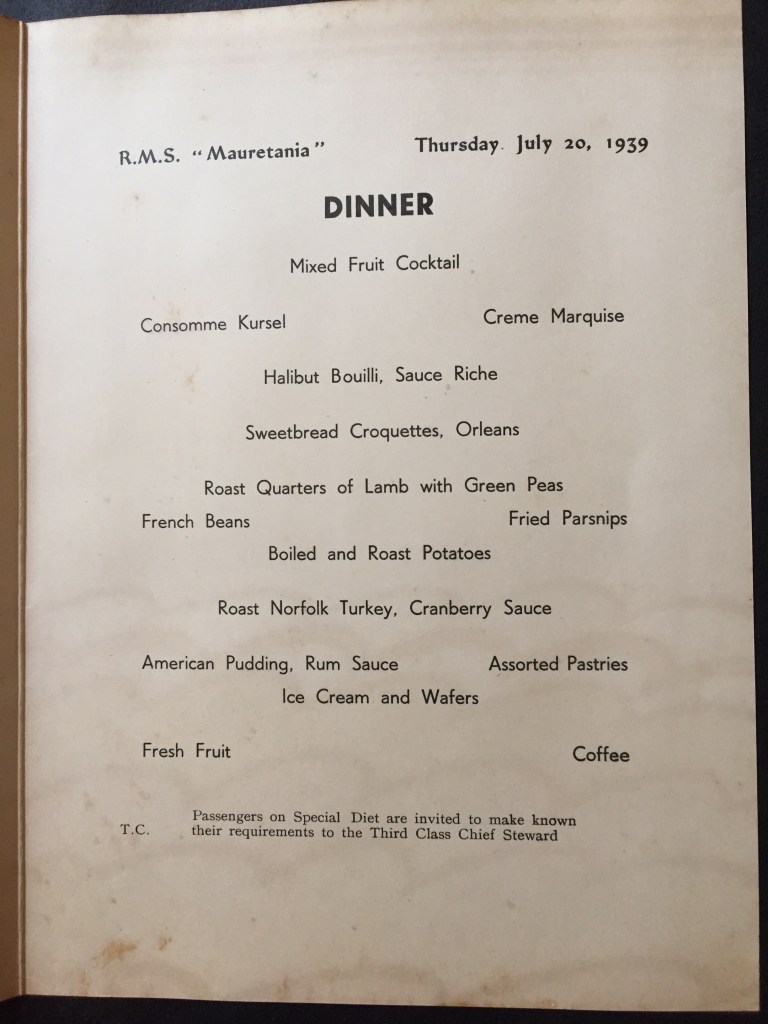
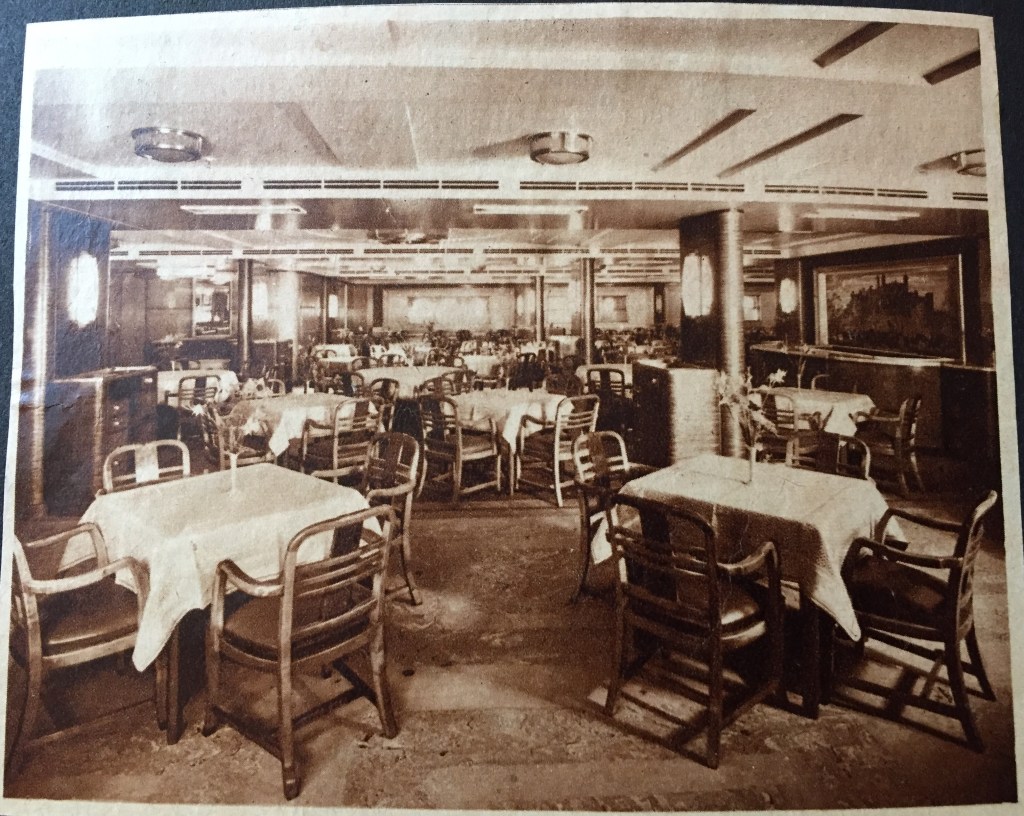
July 20 1939

Dining Saloon

Thursday 20th July.

Up & had our baths. Rather a dull day and the ship heaving around a bit. Quite a few people missing at breakfast, and some retired- Harry among them. Up a deck afterwards and violently blown about. Down to the Cinema to see Bing Crosby in “East Side of Heaven”- we had to stand at the back- two colossal fat women came & stood in front of us & it was terribly hot so we decided to go before the picture even started. Peggy not feeling too good so rushed up a deck, but she was sick. Mummy took her downstairs & John & I wandered about and wondered if we were feeling ill or not! Up on the Sports Deck & talked. After lunch up to Sports Deck again. Peggy was up feeling wobbly but we learned how to play shuffleboard and had a few games. Peggy sick again so I took her down. We sat in our cabin until dinner time then Peggy went to bed. After dinner there was dancing in the lounge- danced with red-haired man called Herbert Samuel- also John, but eventually he deserted me & danced with another young woman! Read, and then a big man I had smiled at before came and asked me to go for a drink. Down we went & found the bar was closed!! He is nice though- big & red-haired & called Nelson Crowder- a Canadian from Toronto.

For passengers not seasick!

July 19 1939

Scrapbook Title Page

Wednesday 19th July.

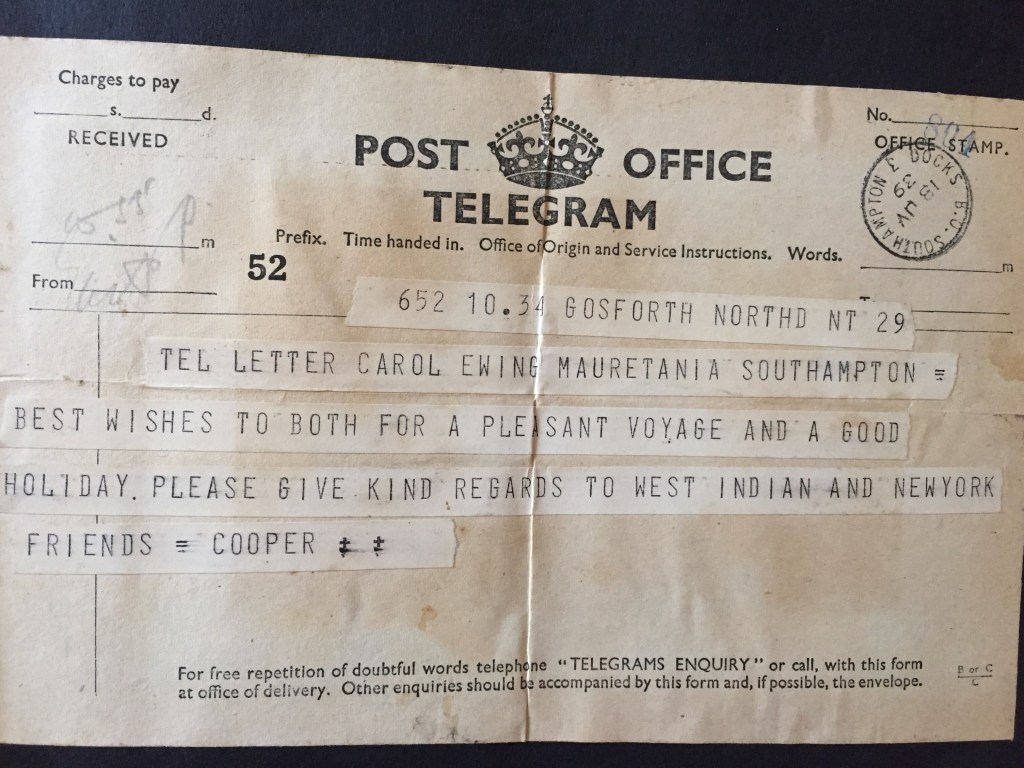
Up early & feeling oh, how sick! Breakfast & Poppa nearly made us late according to his custom. Such a rush getting tickets & onto the train. Found Peggy with Auntie Mil & Jean & Brenda. Hardly recognized Jean. Found seats eventually & said goodbyes & started.

One American lady in the carriage. Quite matey. Eventually too matey and gave us a long lecture on Russia! Arrived at Southampton about 10- quite a short journey. A few formalities & onto the ship- all very bewildering- luggage all over the place everyone lost- & officials dashing around. Found our cabin eventually & in it a marvellous big box of pink roses from Rowly waiting for me- the darling! We then found Peggy’s cabin- 4 berth- ours is a two berth on the outside. None of them very big though, but nicely fitted. Our luggage wasn’t in the cabin but it appeared after a while- much to our relief.

It was still quite early & the ship wasn’t sailing until 12:0- so we booked our places in the dining saloon- 2nd setting and then explored the ship- all the decks- I even tried to go on the bridge but they wouldn’t let me!- we saw a little of the cabin and tourist class but not much. Finally when the boat sailed we went up on the sports deck right at the top & waved goodbye to all the people. We then unpacked a bit & at last lunch- we were so hungrey! Ate a huge lunch & then went to the lounge & wrote cards and letters all afternoon & then had tea there. Just as we finished we arrived at Cherbourg, so we dashed up on deck and watched her coming up to the side & all the people coming on. It was lovely & sunny, but windy. We sat on the stairs & watched the sailors & people & made catty remarks. Peggy is fun. I like her. We got tired of this after a while & went & unpacked & then down to dinner. We are at a table for 6- us 3- 2 girls quiet and mousey & a most exotic American wench- all Joan Crawford- who didn’t deign to speak to us. At lunch a young man- Harry Pemberton- was in her place but he moved to another table with his pals. After dinner we went up on deck- very windy- talked to Harry P. and his friend John Tyler. Down to the lounge & listened to a band- American swing- lousy! Nothing much & at last to bed.

Travel Diary: July 18 1939

Cynthia’s Travel Diary, written in pencil.

Although this Travel Diary is not one of the letters, it is the voice of Cynthia Ewing, at the age of 24, writing a record of her trip to New York to visit family solely for her own eyes. She made a scrapbook of the ephemera she collected, and photos of the friends, family, events and scenery for public viewing, but kept track of it all in detail in her memo book as she went along. I am going to post illustrations from the scrapbook, but use my transcript of her daily entries, which starts as they catch the train in the north of England…

This is Cyn’s handwriting as I know it- quite a change from her schooldays letters.

My American Trip 

by

R.M.S. “Mauretania” and “Queen Mary”

1939

July 19th to August 14th

by Cynthia Ewing

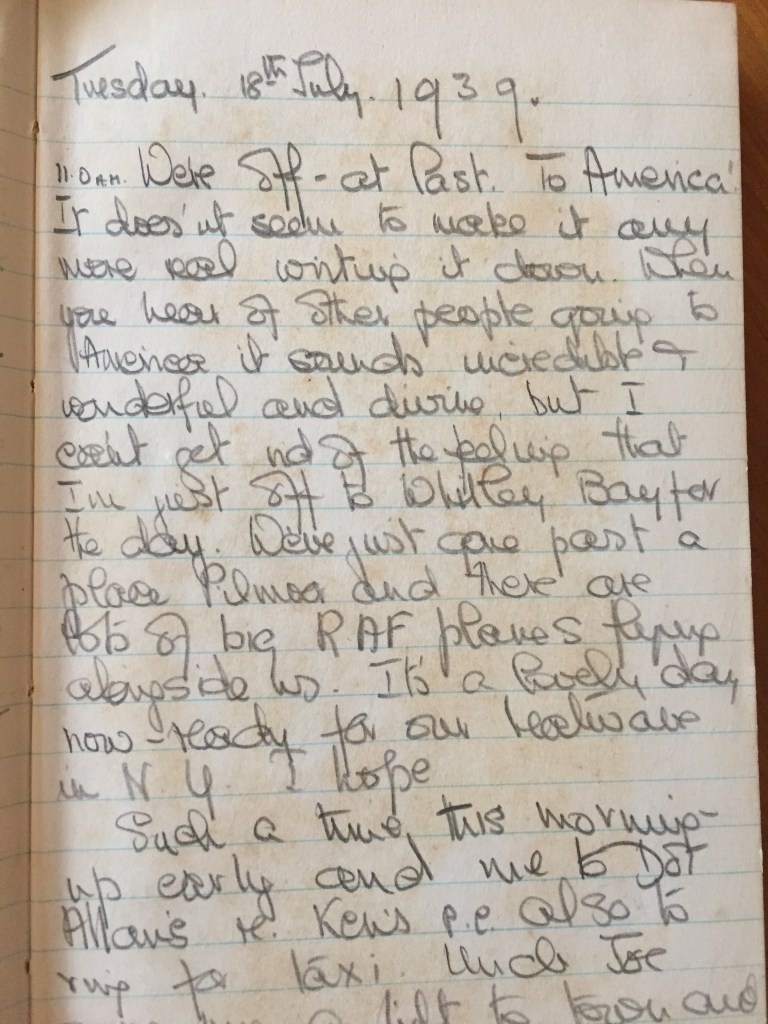
Tuesday 18th July 1939

11:00 AM. We’re off- at last.  To America!  It doesn’t seem to make it any more real writing it down.  When you hear of other people going to America it sounds incredible & wonderful and divine but I can’t get rid of the feeling that I’m just off to Whitley Bay for the day.  We’ve just gone past a place Pilmoer and there are lots of big RAF planes flying alongside us. It’s a lovely day now– ready for our heat wave in N.Y. I hope. 

Such a time this morning- up early and me to Dot Allan’s re Ken’s p.c. also to ring for taxi.  Uncle Joe gave me a lift to town and insisted on giving me an avuncular kiss- in the middle of Northumberland St. too!  Did my chores- couldn’t get wool- very annoyed- and so to station & met Mummy.  Got seats in train eventually after chasing about, and then Rowly arrived and in a few minutes- Nan. While we were all talking and attendant arrived with mags. and letters for us-from Uncle Andy.  Wasn’t it sweet.  All because of Daddy!  Hardly had we got them when up arrived Uncle Andy himself- darling of him.  Bobby never came- the wickedness! Then we all had to say goodbye- flowers from Nan- a lovely rose.  Goodbye to Nan and Uncle Andy and Rowly and Newcastle for a month-  At York now- strange not to have to get out.

The steward on the train is a pet.  A pal of Dad’s- lives at Whitley Bay and looks like Ribbentrop!  He is most fatherly to us and looks after us very tenderly.  He brought me some notepaper- pretty- & I sent a card to Edgar & wrote to Rowly.  At Kings X.  Said farewell to our steward and met Daddy.  By tube to Charing X and to the Craven Hotel.  Nice room.  Mummy & I went out to look at shops- walked up the Strand- saw a lovely shoe shop & had to be positively hauled away by Mummy.  Onto the embankment & so home.  Out to tea & then by tube to Victoria where we once again looked at shops- antique jewelry this time- lovely rings.  Mummy and I promised each other presents if we came home from America with any money!  To the Victoria Palace where we met Margaret- quite a surprise- not good looking but smart with a funny hat & giddy shoes.  The show was Lupino Lane in ‘Me and My Girl’ and contrary to all my expectations it was great fun.  Lupino Lane was marvelous.  Margaret roared with mirth & sang the Lambeth Walk & was very amusing.  Afterwards we went for coffee & Margaret told us all her amazing adventures.  What a life!  And what a girl!  She certainly can talk!  We then left her & went back to the hotel.  Mummy rang Miss Lefroy & then to bed.

June 25 1939

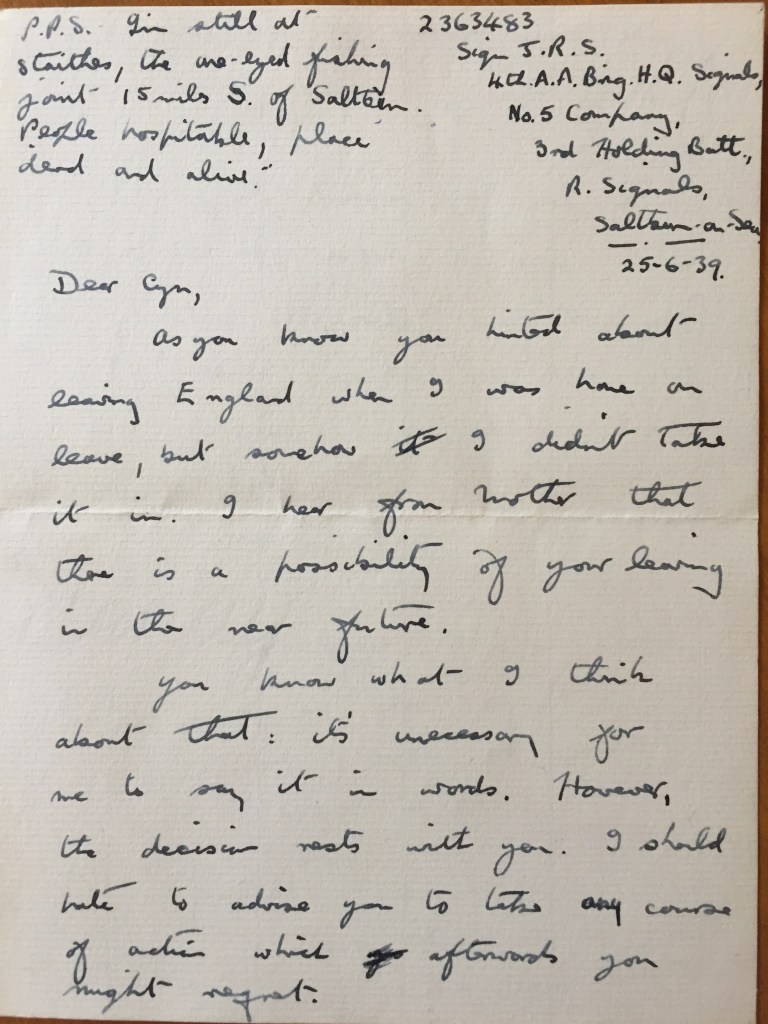
As the Ewings were preparing for the summer trip to New York, Cynthia got a letter from Bobby Sheedy, the younger of the brothers next door she’d grown up with, so different in tone from his letter of 3 years before, that it is hard to believe it is from the same person.  Now in the British forces, Bobby’s letter suggests that there was discussion amongst the family and friends in Newcastle (and probably New York and St Vincent too) about Carol and Cynthia staying in America because of the approaching war.  

2363483

Sign J.R S.

4th A.A. Brig. H.Q. Signals,

No. 5 Company,

3rd Holding Batt.,

R. Signals,

Saltram-on-Sea

25-6-39

Dear Cyn,

As you know you hinted about leaving England when I was home on leave, but somehow I didn’t take it in. I hear from Mother that there is a possibility of your leaving in the near future.

You know what I think about that: it’s unnecessary for me to say it in words. However, the decision rests with you. I should hate to advise you to take any course of action which afterwards you might regret.

The main purpose of this letter is to find out if you’re going, and if so when.

If you have decided to go I must see you before you leave. Once you get out there, it’s unlikely that you will ever return. Somehow I didn’t think of it seriously when you told me in the car on my last night’s leave. I suppose I was too busy thinking of myself.

Please let me know the position as soon as poss,

Yours in haste

Love

Bobby

P. S. In the event of your not going I shall wait until my next leave.

P. P. S. I’m still at Staithes, the one-eyed fishing joint 15 miles S of Saltram. People hospitable, place dead and alive.

Only the second postscript, added on the top of the first page, sounds like Bobby! I don’t know what Cyn replied to Bobby, but I do know that her father had booked a return trip for the three women going, and that nowhere in the entire Travel Diary is there a hint that it is anything but a fun and exciting holiday to her.  Nor is there, however, much introspection or mention of feelings- much more a daily record of events, with evenings of ‘talk’ mentioned but not described.  I’m sure the relatives in New York tried to persuade them to stay where it was safe, and indeed, the younger cousin Peggy did, leaving her berth back on the Queen Mary empty.  Her home was in St Vincent, and I assume she returned to her father in the West Indies with the aunts who had come from there for the New York reunion. But Cynthia and Carol returned to England to do their bit, and Bobby would see Cyn again when he was on leave.

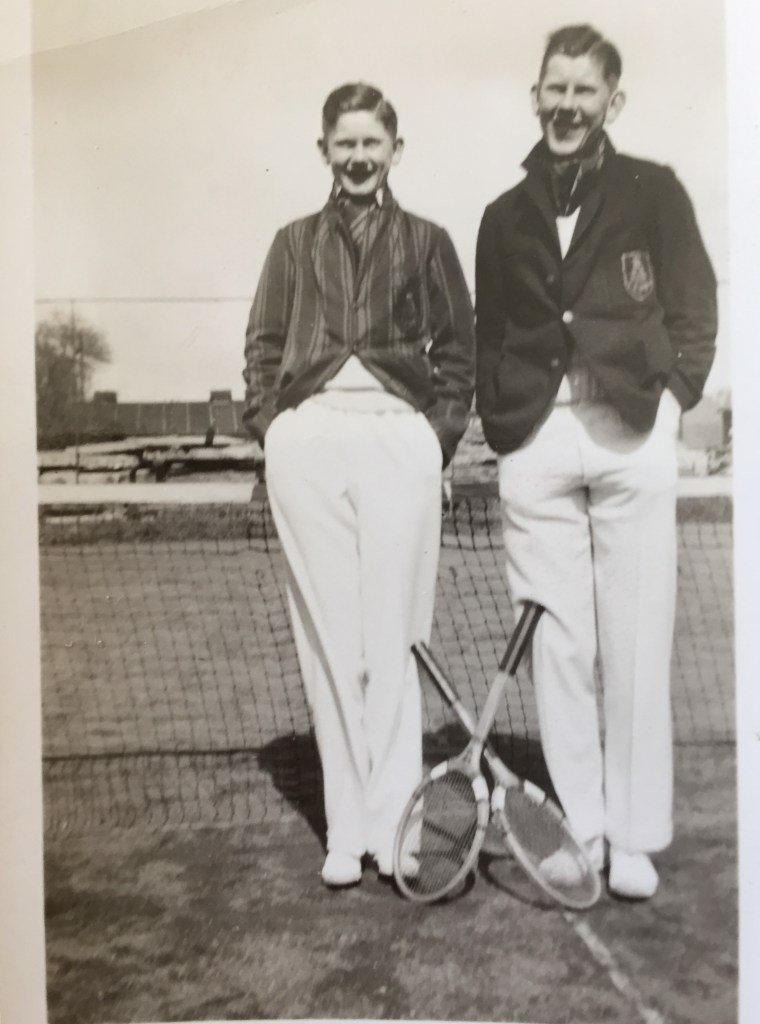
The Sheedy brothers in less serious times.

Preparations

In 1939, Europe was preparing for war in different ways. Germany had been moving for years. England had young men in military training, Bobby Sheedy being one of them. And ordinary citizens, with uncertainty ahead of them, prepared for the last summer of fun before the war.

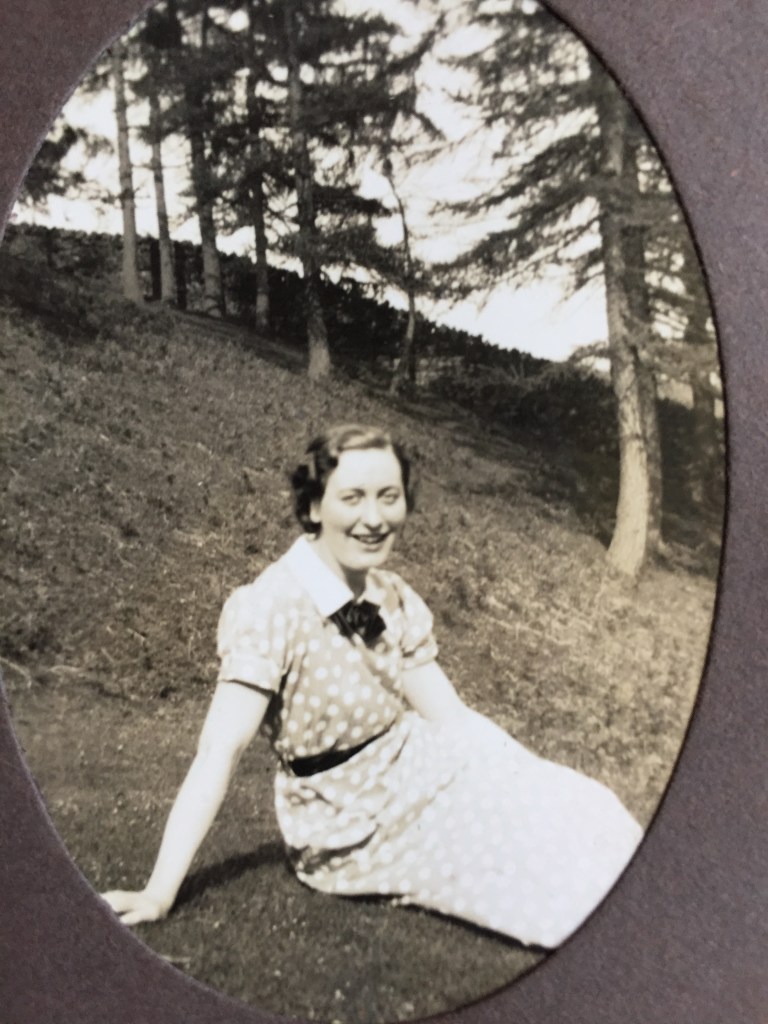
Young Cyn

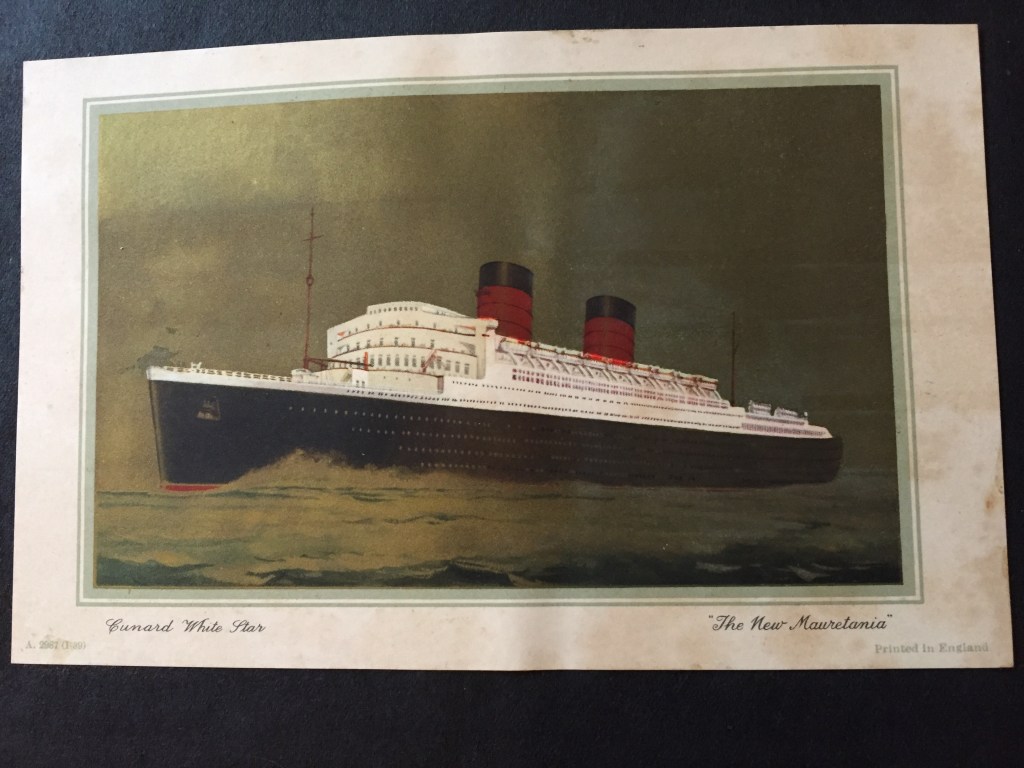
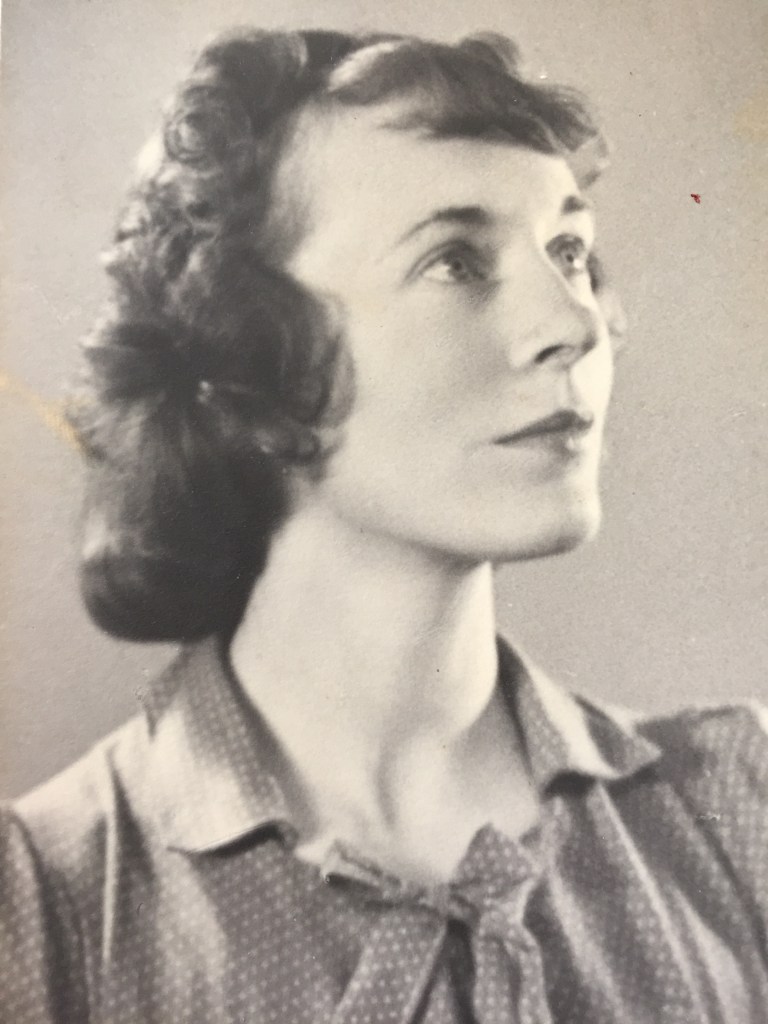
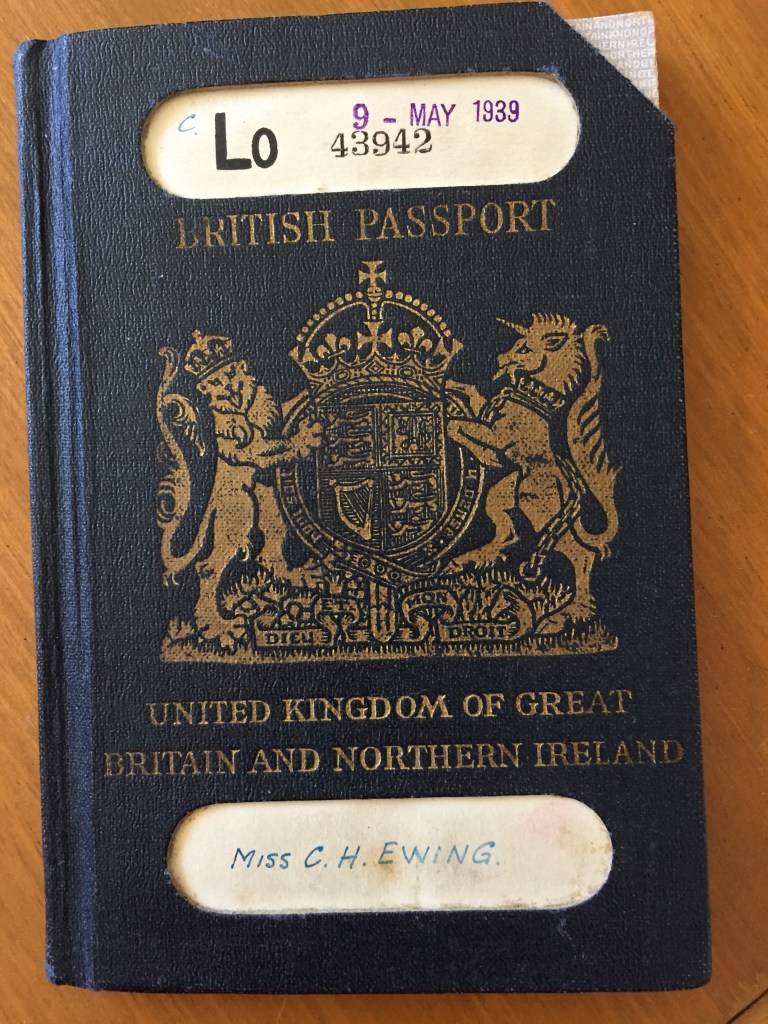
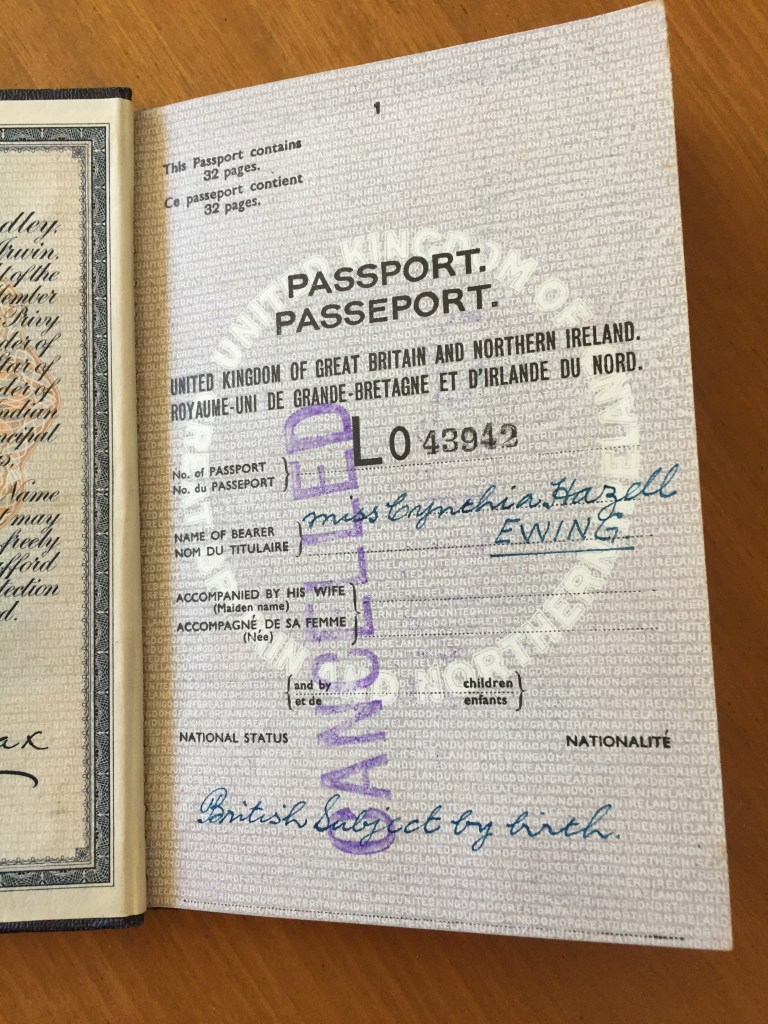
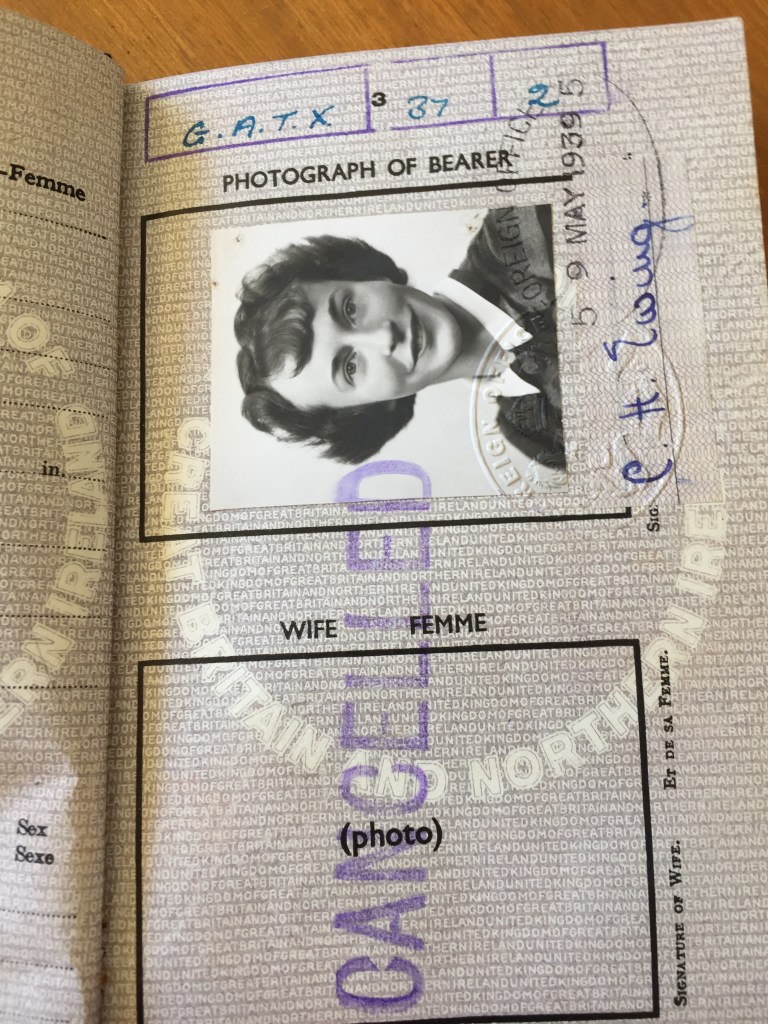
Cynthia, her mother, and a young cousin, Peggy, were going to visit their family in New York and see the World’s Fair in the summer holidays. Other family members were coming from St Vincent, there were new family members to meet because the Hazell descendants were marrying and a new generation had started. So the Ewings made preparations, Cynthia getting a passport, her father booking them tickets on the R.M.S Mauretania to New York and the Queen Mary home again, and after the school year ended, packing began. Cynthia bought a sturdy blank book to be her travel diary.

Dr. J.M.G. Ewing, my grandfather

It wasn’t until I heard Stephen Page, formerly of the band The Bare Naked Ladies, talking on the CBC about his depression and bipolar disorder that I realized my jerk of a grandfather had been mentally ill. We now know more about mental illness, and I hope are more sensitive to it than former generations, but it had never clicked for me that the black holes and weeks of icy silences created by my grandfather in his home meant he was suffering as well as his family. We also, in this age of attempting to address the damage caused by residential schools in Canada, realize that events from 100 years ago affect generations today.  All the more power to my mother (and grandmother) then, for living with a mentally ill father, yet surviving and shielding her children from its effects.

My grandfather, Dr. Gordon Ewing, was born in the Victorian age, the youngest of twelve children in a professional family in Northern Ireland. He became a doctor like his brother John, (and I think his father and another brother) and served in the colonial service as a doctor in the West Indies where he met and married my grandmother Enid Carol Hazell, also the youngest of twelve, a gentle, sheltered, loving woman quite a few years younger than he.  Their daughter Cynthia was born in St. Vincent in 1915, but The Great War separated the two: after Gordon became a physician on board ships in the merchant navy, Carol returned to her childhood home in Kingstown where she and her daughter remained until the end of the war. Then Gordon became a schools doctor in Newcastle-upon-Tyne and Carol and Cynthia joined him in England.

My grandmother was not a forceful woman and found herself unprepared for her life in England, although she had gone to school there, and had a valued friend in her former headmistress, Miss Lefroy.  She had to look after her daughter and her household without the wealth, family, and help she had known from childhood, and although she had servants, she was not effective in managing them, doing household shopping, or living in this new dark, cold, country. Her 4-year-old daughter wasn’t impressed with the change either, and remembered the disillusion of realizing the ‘lovely surprise in the morning’ promised her was this unfamiliar man sharing her mother’s room. So life may not have been rosy for Gordon, with a small child he considered spoiled, and a wife not successfully coping with her new responsibilities.  One can hope that there were happy times as well.  Diagnosis at this point with only secondhand stories to go on is uncertain but I assume from what my mother said that he suffered from depression. He would go into black silences for days, which naturally affected the household. The reason my mother characterized him as a jerk to us is that at the same time as he was putting his family through the guilt, uncertainty and misery of his gloom at home, he could be jovial and outgoing with friends outside the house: “joie de la rue, doleur dans la maison”.  It wasn’t until I heard Page talking of putting a good face on it that I recognized what my grandfather might have been feeling, while his wife and daughter thought he could have helped his behaviour and was punishing the household. 

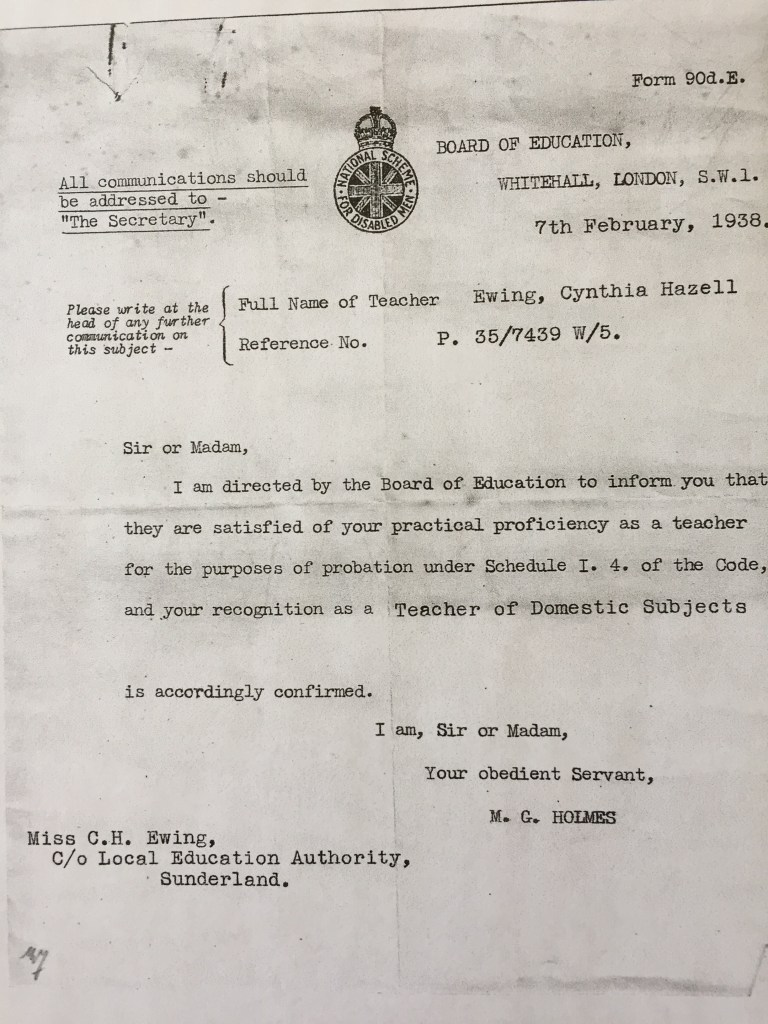
He loved, indulged, and educated his daughter, but controlled her.  She wanted to go to university and read English, but he told her she was to get Domestic Science qualifications because that would ensure she always had a job.  Until she was old enough to be admitted- 18, I presume- she did a secretarial course which also was of value to her in the future.  She did enjoy the cooking, and did an extra year in High Class Cookery at Northern Counties, but he insisted she go into teaching as a career rather than the nutritionist/demonstrator field she would have enjoyed more.  Cynthia was small, only 5 foot, and when she started as a Domestic Science teacher in Sunderland, her students towered over her, and she couldn’t understand their Geordie accent!  She did well, but I don’t think she enjoyed teaching the way I did.

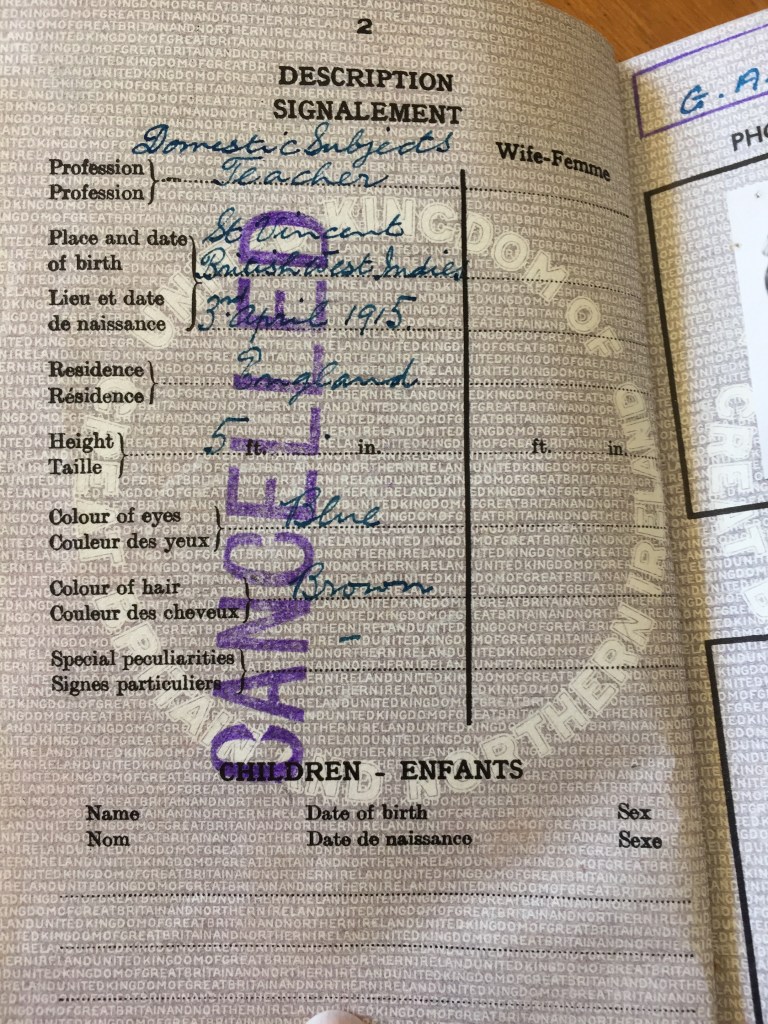
In the summer of 1939, Cynthia went on a visit to the New York aunts and cousins. I had not heard of Cynthia’s American trip as anything but a holiday, but from the disapproving hints in Bobby Sheedy’s letter, obviously other possibilities were considered, perhaps because of the attitude of the American Hazells towards the up-coming war. [Letter dated 25-6-39]  She had a wonderful time- her three New York cousins, Millie, Marguerite, and Mona, were a bit older than she was, and married or approaching it, but that only gave her a pattern to follow.  Her passport shows she entered New York NY July 25, 1939, and there’s a stamp for Niagara August 1st, so she did visit Canada however briefly.  And, like Their Majesties visiting Canada and the USA that summer, she returned home again to face the long dreary sad war.

When the Second World War approached, gas masks distributed, preparations for children being evacuated made, Gordon discussed the possibilities with his family. There was his family in Ireland, and Hazell relatives in the West Indies, Canada, and the USA, and should England be invaded, the idea was that Cynthia would drive her mother (with petrol hoarded for the eventuality) across to the west coast of England, get to Ireland, and go to the New York cousins.  He, Gordon, would not be there, as he wanted to do his bit and, I think, joined the merchant navy as a doctor again, although the idea of a man who hadn’t practiced since 1919 offering medical services to anyone gives you a sense of the desperate straits England was in.  Still, I had the impression, obviously along with Cyn’s friend Bobby who had, with his brother Denis, grown up next door to the Ewings, that “Rolling Stone Ewing, alias ‘Gordon the Con-man’” … setting out once more for distant lands’ wanted to get away from home and would enjoy himself.  [Letter dated 18-4-40]  Teaching was a reserved occupation so Cynthia could not join the forces as she wished to do, but had to continue teaching; evacuate for a time with her school, share fire duty with her colleagues at night, which meant staying awake and patrolling after a day of teaching; and in later years, after coming back to Newcastle with the school, return for a cold meal cooked at noon by her mother (who got to do all the queuing for rations) waiting congealed on the dining-room table for her after her commute.  Sometime before the war ended Gordon came home; Bobby and too many others of his generation did not.  

The war was like six years of pause in life with little changing for my mother- except perhaps her relationship with her father.  In 1944 Cynthia managed to transfer to another teaching job in Cambridge, left her parents’ home, and started life on her own.  And, I think, Gordon’s mental state deteriorated.  Three years later, his wife Carol left him to live with Cyn in Cambridge, and then within a year or so, he seems to have been institutionalized.   He had hardening of the arteries of the brain, and so the mental illness had now combined with a physical one and he was cognitively affected- positive proof of this to his family in the North of Ireland was his conversion to Roman Catholicism!  Cynthia thereafter only ever refers to him in letters to her mother as ‘my father’, quite a change in tone from the 14-year-old writing to Darlingest of Daddies 20 years earlier.  She visited him when she went to Newcastle to see friends, and then after her wedding to say goodbye before she and Cec left for the US and Canada, but he never met Cec, and she never saw him again after emigrating, although she wrote and sent goodies and occasionally got a reply.
Snaps and Certificates

Sheedys

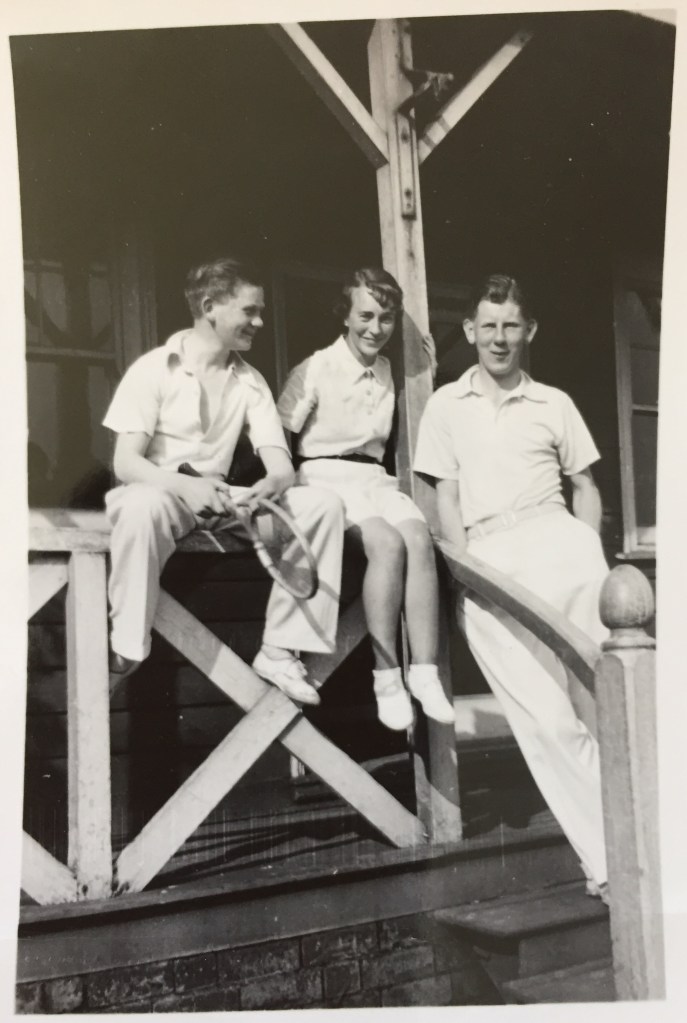
Snaps from summer with friends.

Nancy
Bobby, Cynthia, & Dennis. A bit older?

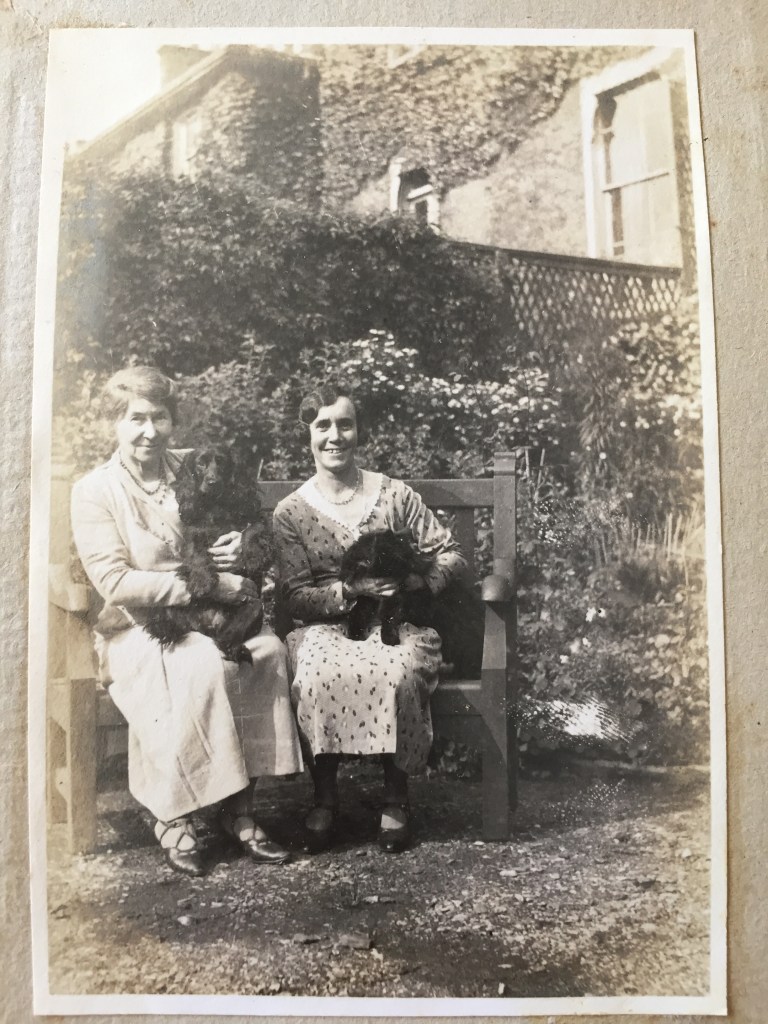
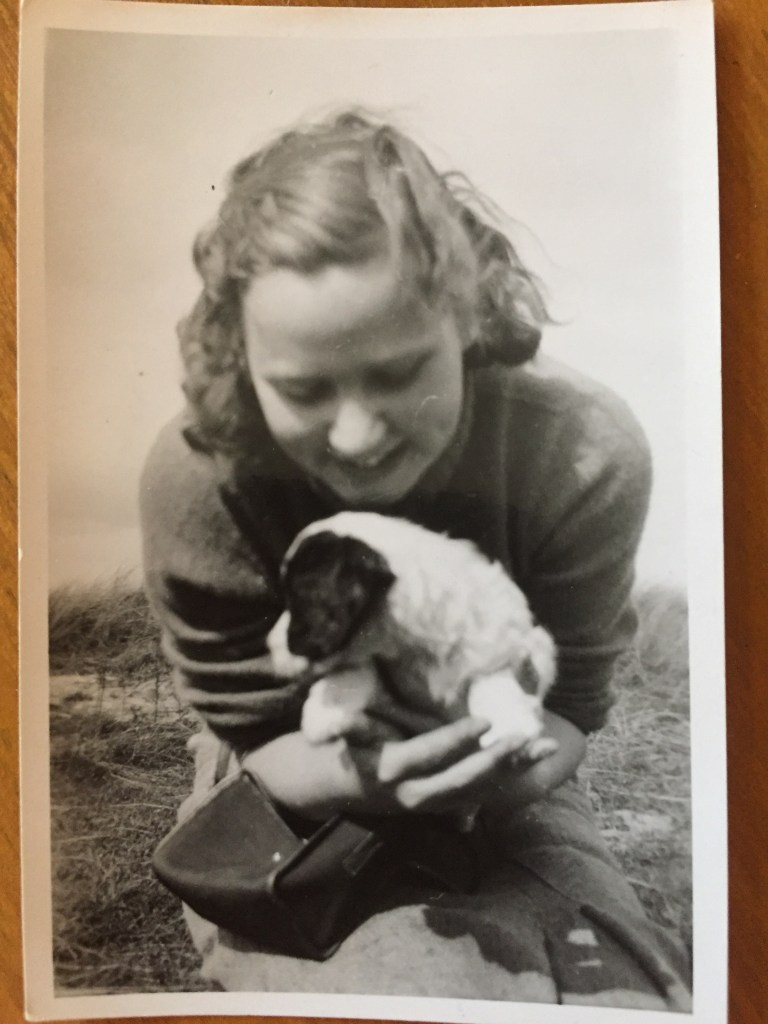
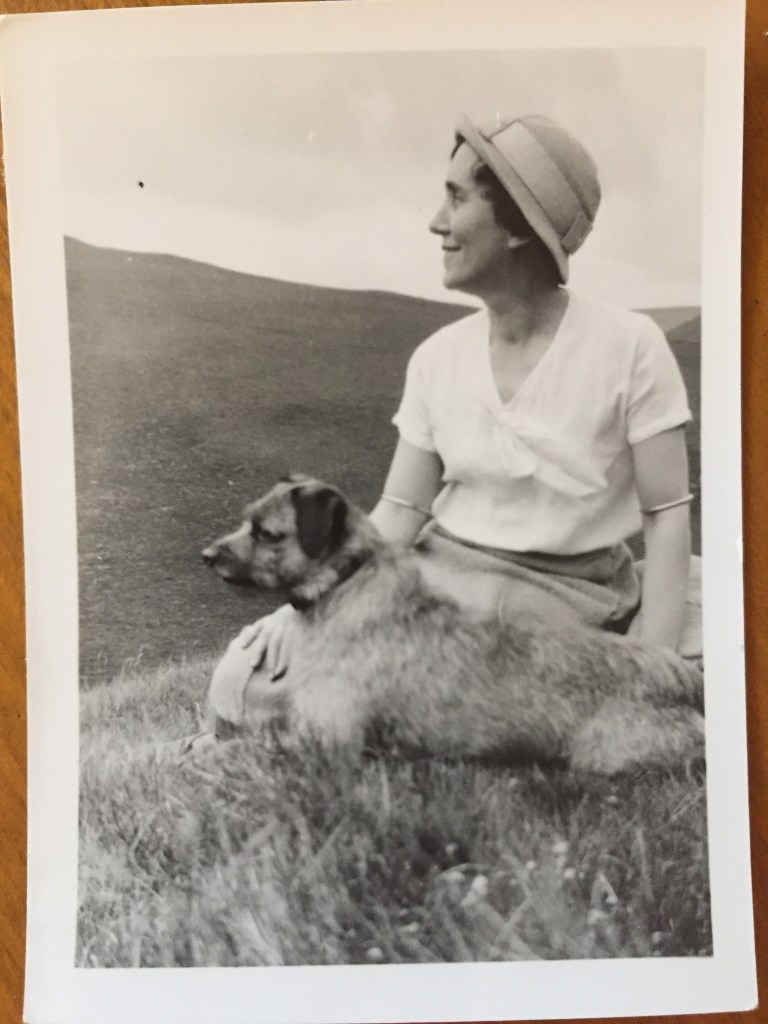
Carol maintained her friendship with her former headmistress and teacher.  The Ewings had a dog and obviously Miss Lefroy and Miss Hull did too!

Miss Lefroy and Carol Ewing

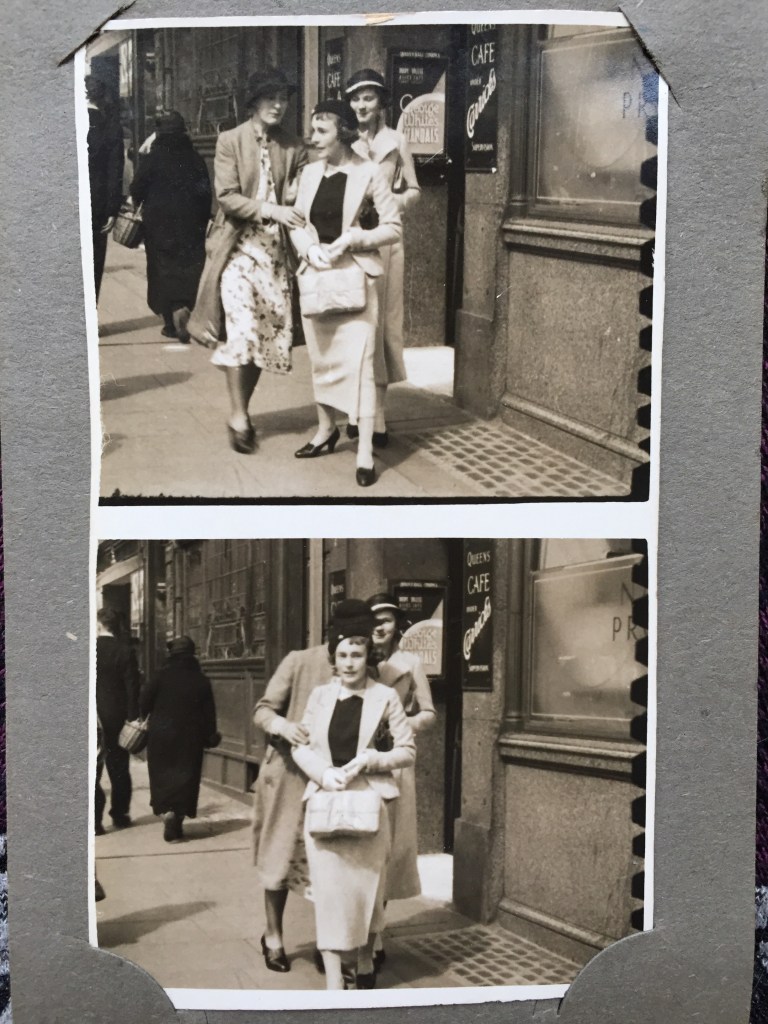
Of course it was not always summer.  In chillier times, the Ewings wore furs. 

Cynthia & Carol
Street scene: Carol & friend.

And hats!

Street Scene: Cynthia and friends.

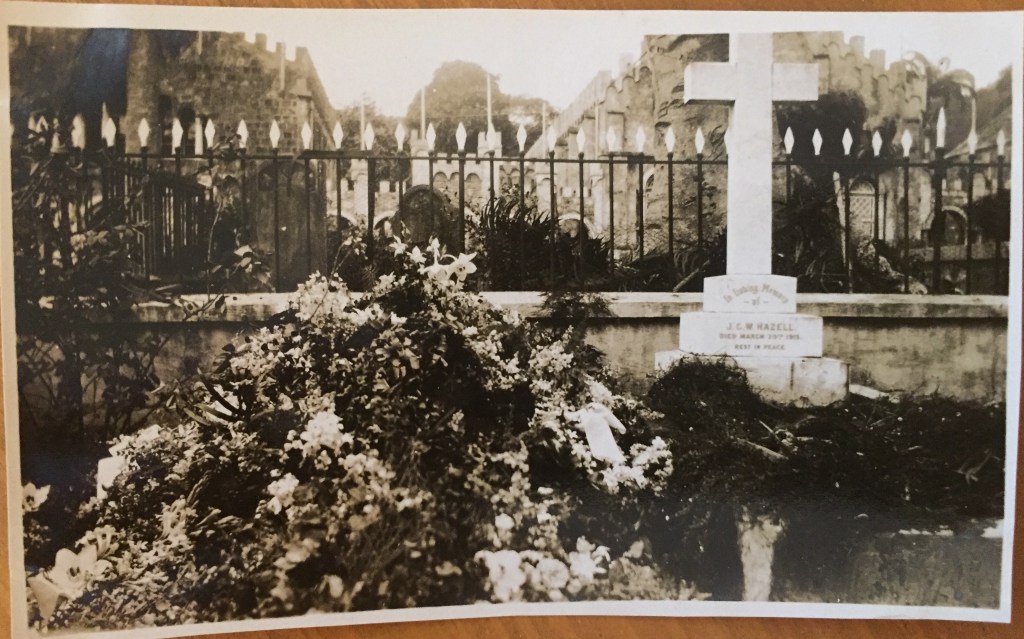
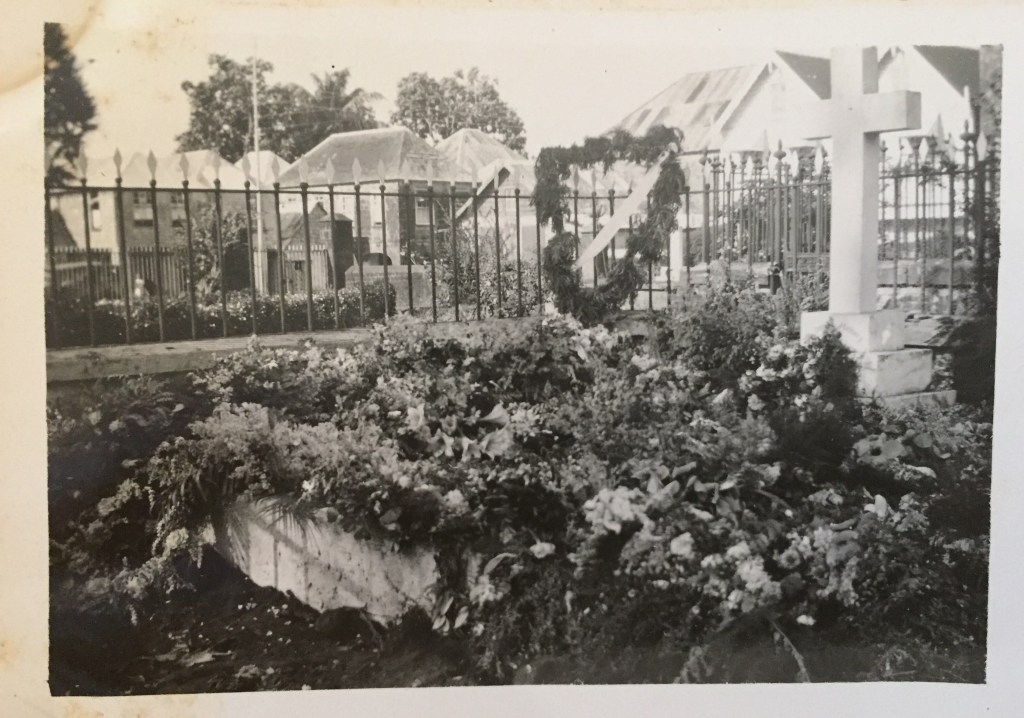
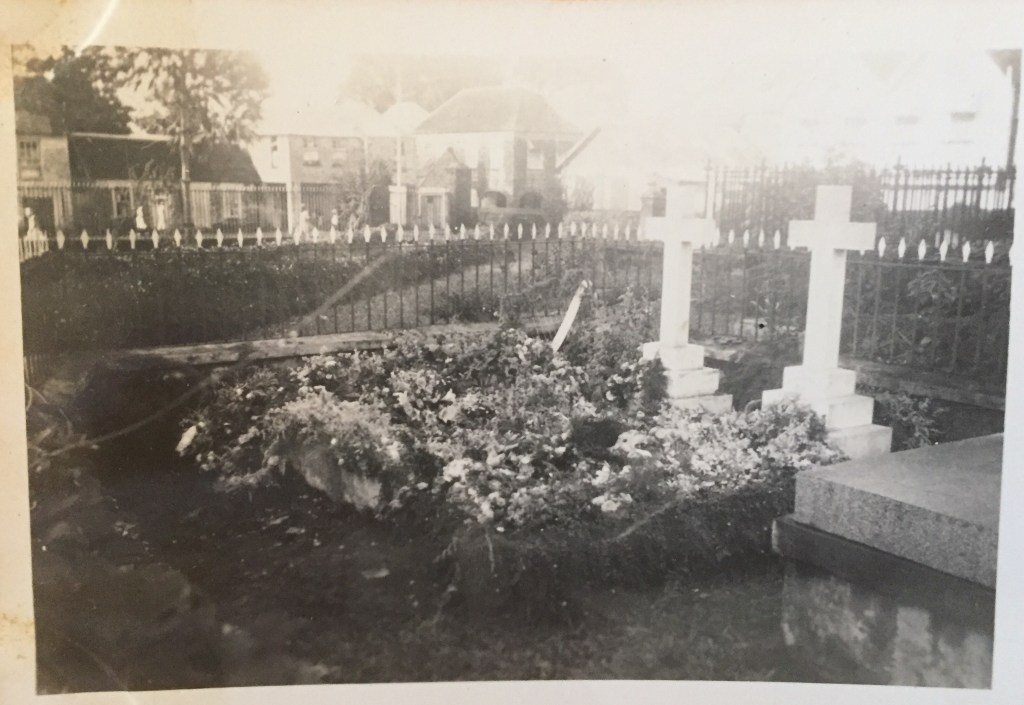
Sometime in the 30s, Carol’s mother, Marion Hazell, whose draft will has already been posted, died in St Vincent, and her sister sent her photos of the gravesite.  Two crosses now, for both her parents.

On the back: Carol. Our dear Mother’s resting place the day she was laid to rest.
On the back: A Harp, it does not show up very well, Rev. Thrower sent it from the Sunday School Teachers and pupils.
Hazell monuments

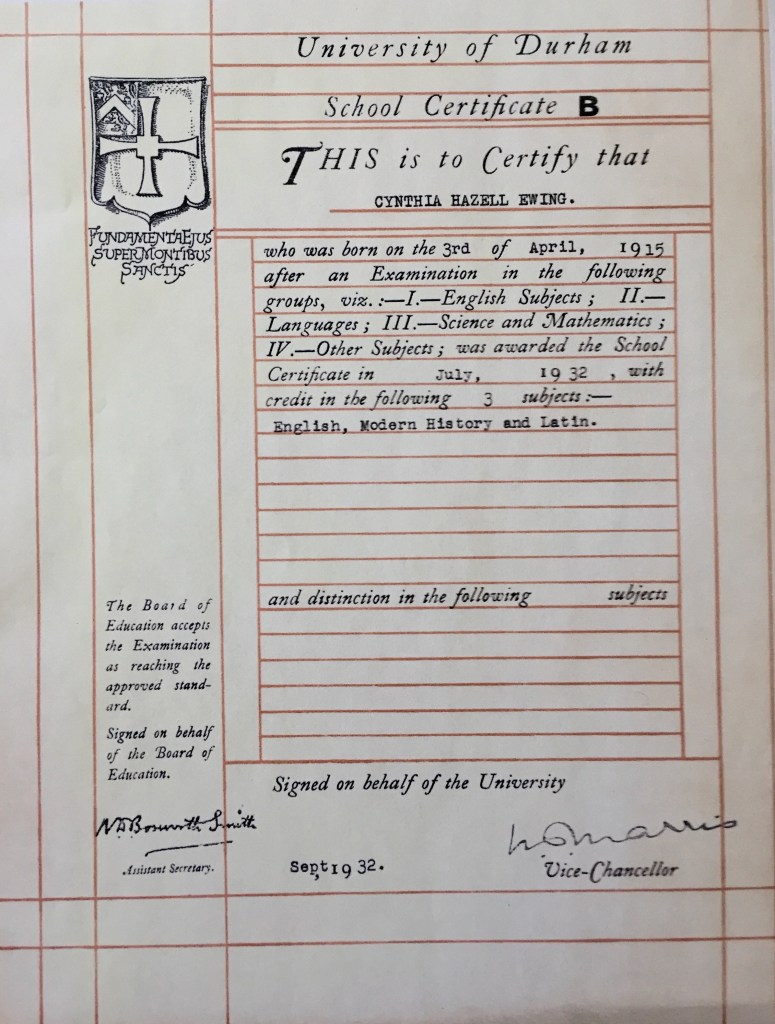
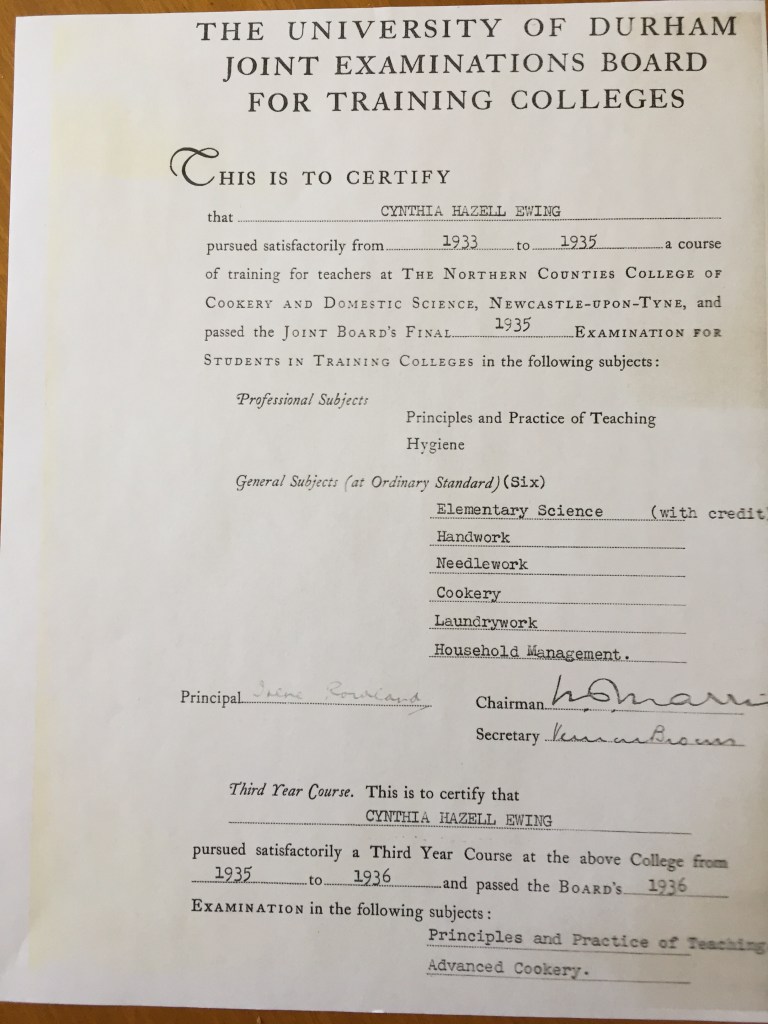
And certificates! School, College, and Career.

1932 School Certificate
1936 College Certificate
1936 Probationary teaching certificate.
1938 Final teaching certificate.

A Mystery Story

Cynthia enjoyed mysteries, and collected the books of her favourite writers of the Golden Age of Detective Fiction, the 1920s and 30s. Perhaps this interest was sparked by another story told in her family, this time from her father’s youth. Here is her fictional version of a medical student’s experience.

The Prick of Death

by Cynthia Costain

My father was a medical student at Edinburgh University in the early 1900s. I imagine that medical students then were much the same as they are now –  an irreverent bunch of young men, determined not to show their feelings, no matter how gruesome and distasteful their work was. However they must have looked very different. Severe professional attire was required and suits, shirts and stiff white starched collars were worn, though not easy to maintain on a student’s budget. Another difference was that there was only one woman in the class. She must have been brave and determined. The stories my father told of the questions the Professors asked her concerning the male anatomy and the composition of various body fluids roused gales of laughter from the fellows, enjoying the Professor’s salacious smirks and the girl’s embarrassment.

One day the class was excited at the news that they were all to attend an autopsy. This was not just any autopsy but that of a man who had died a suspicious death, which had created much interest in the newspapers. He was a tailor called Alfred Maxwell. His father had built up a good business; skilful and popular among his middle class clientele for well-made, moderately priced business suits, as well as morning coats and evening wear. A few years previously the old man had had a stroke and the business was taken over by his son, Alfred. Before long rumours began to circulate- poor workmanship- delays in delivery- shoddy material- which soon turned away the customers with threats of court action in some cases. The various suppliers also found their bills unpaid and angry callers came to demand their money. Alfred was not only careless with his work but a poor businessman with a very high opinion of himself. He was good looking with sleek dark hair and a handsome moustache and always dressed in the height of fashion. Things were different for his young wife who wore the same old black coat and hat without even a different Sunday coat for church. And while Alfred enjoyed dining out at fine restaurants and patronized music halls he never took his wife with him. In fact it was noticed that she often had to wear a veil when she went out, in an attempt to hide a bruise or fading black eye. Her brother had angrily quarrelled with Alfred many times over his treatment of his sister.

One evening Alfred came home early from work complaining of feeling tired and having a pain. However he had a meal then went out, but returned in a short while and went to bed. Next morning he looked pale but ignoring his wife’s enquiries left for work. Although sometimes complaining of pain and feeling tired he continued as usual until one evening as he walked home he stumbled and fell to the ground. An acquaintance was passing, and after looking at Alfred’s white sweating unconscious face he called a cab and told the driver to take him to the hospital. He was dead on arrival.

Now began the mystery. A young man in good health had collapsed and died. He was not drunk, he was not known to have any disease, he had shown no previous signs of a weak heart until the last few days. On examination at the hospital the doctors could not decide what had caused his death. Could it be murder? There was not a mark on his body – he had not been hit, cut or stabbed, but what about poison? The newspapers picked up the story and with the earlier rumours of his business and marital misdemeanours the gossip was soon circulating.

An autopsy was to be performed by the best known forensic surgeon and because of the general interest some of his colleagues asked to attend and the older students were admitted to the examination room. For the students this was both an exciting mystery and a change from the usual routine. Their previous experience of cadavers had not yet been extensive but they felt they knew enough to both appreciate the surgeon’s skill and criticize intelligently. They watched the preliminary incisions being made and the grim task continued. Each organ was carefully removed, labelled and put in a separate container: the liver, the kidneys, the lungs, the stomach and finally the heart. After removing the latter the surgeon halted, placed it in the dish the attendant was holding and looked at it carefully. Motioning to his colleagues to join him they all began to examine the contents of the dish.
The students whispered to each other 

“What’s happening?”

“That was a very queer looking heart, I thought.”

“I didn’t get a good look at it but it seemed a very dark colour.”

“Look, they seem to be making an incision.”

As the whispering died away the surgeon and other doctors clustered around and then there was a sudden sharp exclamation. The surgeon straightened up and holding a small pair of forceps up to the light examined a minute silvery bloodstained object. Turning to the students he said, “Gentlemen, you may say that the tailor was killed by his work. This small needle was inserted into the pericardium, which as you know is like a bag around the heart. Each time the heart beat, blood was pumped through the tiny hole until finally the pericardium filled with blood and stopped the heart from beating.”

The mystery was solved. Like his father before him, Alfred had been used to keeping his needles securely anchored in the lapel of his jacket, but being careless and inclined to move around the shop with his work jacket still on he frequently lost needles and found them scattered around. What tailor worries about a few pricks when he sews and works with needles and pins every day? A sharper prick than usual as he bent over one day and a small thin needle pressed into his chest and gradually worked its way through his body until it pierced his heart.

The newspapers were sorry that it was not a more sensational ending to the mystery, but the students talked about it for weeks. I expect his poor old parents mourned for Alfred, but I doubt if his young wife did.

Summer Holidays

In Jane Duncan’s semi- autobiographical My Friend… series, which follows a Scottish girl born in 1910 though childhood in the Highlands, university in the 20s followed by a working life in England in the 30s, she suggests that the life of her generation in the thirties was a period of waiting, marking time and enjoying themselves without serious thought, with the shadow of war on the distant horizon.  Certainly Cynthia was aware of this- in her visit to the World’s Fair in New York in 1939 she remarks on ‘propaganda of course’ when she visits the Italian and Russian pavilions- but no record of any discussions survives.  

Dottie- Newton 1934
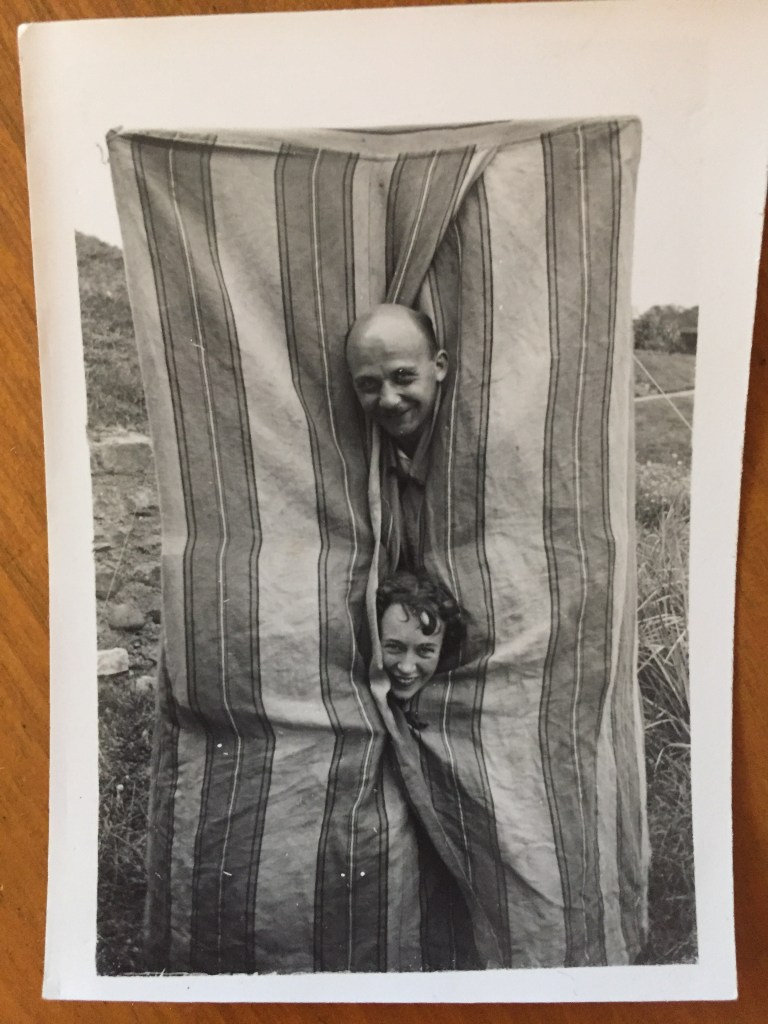
Bathing?

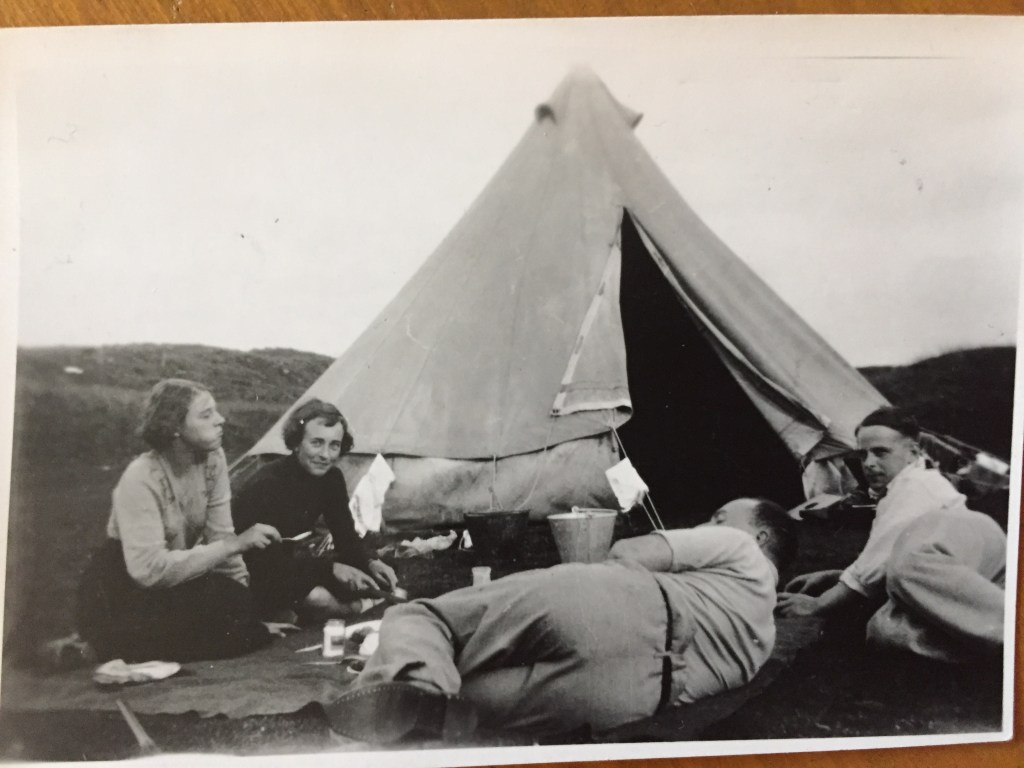
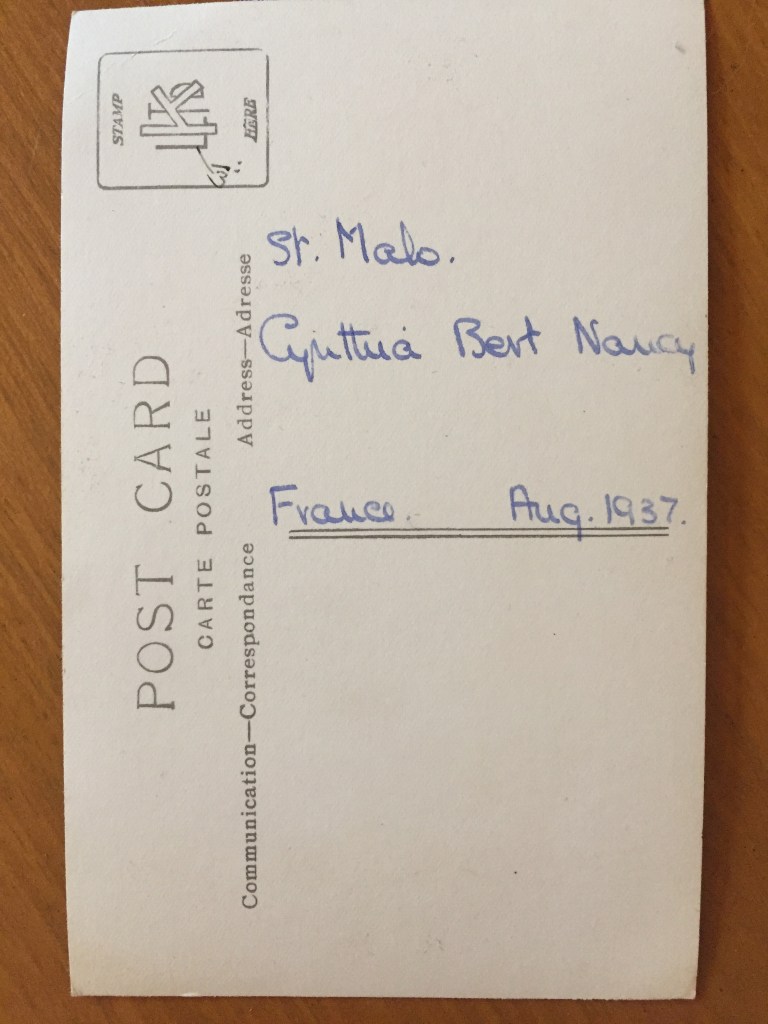
In the holiday snaps we see her family and friends in different parts of England- and in France- having fun after a school year of college and later teaching. 

And as with Carol’s snaps 30 years earlier, the treeless-ness of their picnic and camping sites just looks so wrong to my Canadian eyes!

Carol and Benjie

July 18 1936

She kept the letters and the boot-lace!

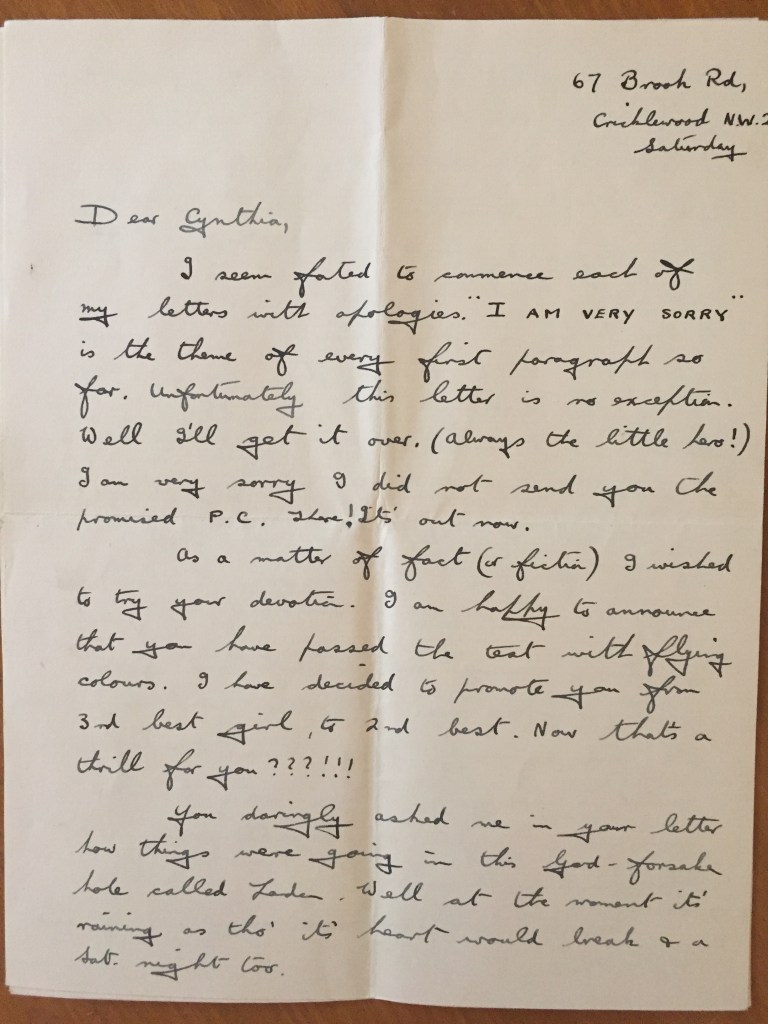
67 Brook Rd., 

Cricklewood N.W.2

Saturday

Dear Cynthia,

I seem fated to commence each of my letters with apologies.  “I AM VERY SORRY” is the theme of every first paragraph so far. Unfortunately this letter is no exception. Well I’ll get it over. (always the little hero!)  I am very sorry I did not send you the promised P.C.  There! It’s out now.

As a matter of fact (or fiction) I wished to try your devotion. I am happy to announce that you have passed the test with flying colours. I have decided to promote you from 3rd best girl, to 2nd best. Now that’s a thrill for you???!!!

You daringly asked me in your letter how things were going in this God-forsaken hole called London. Well at the moment it’s raining as tho’ its’ heart would break & a Sat. night too.

{Pardon my writing on both sides of paper, but I have no option due to lack of said paper.}

I haven’t seen “The Bengal Lancers” one yet D.G., but I’ve seen several other more or less good shows. (a) Charlie Chaplin in “Modern Times” miles better than “City Lights” (unquestionably recommended) (b) Ann Harding in “The Witness Chair” & Margaret Sullivan in “Next time we Live”. (so so).  After seeing the latter I went to a low-down dive called the “Brasserie” where tough looking apaches sloped around. But like ‘Popeye’ after my spinach, I felt I was more than a match for any of them even the waspish House Detective. The band was composed of (presumably) gentlemen wearing red jackets and green pantaloons- a most effective combination. They all had extremely long side-boards and looked “a thoroughly shady lot.” I wished I had taken a couple of knuckle-dusters & a blackjack with me.

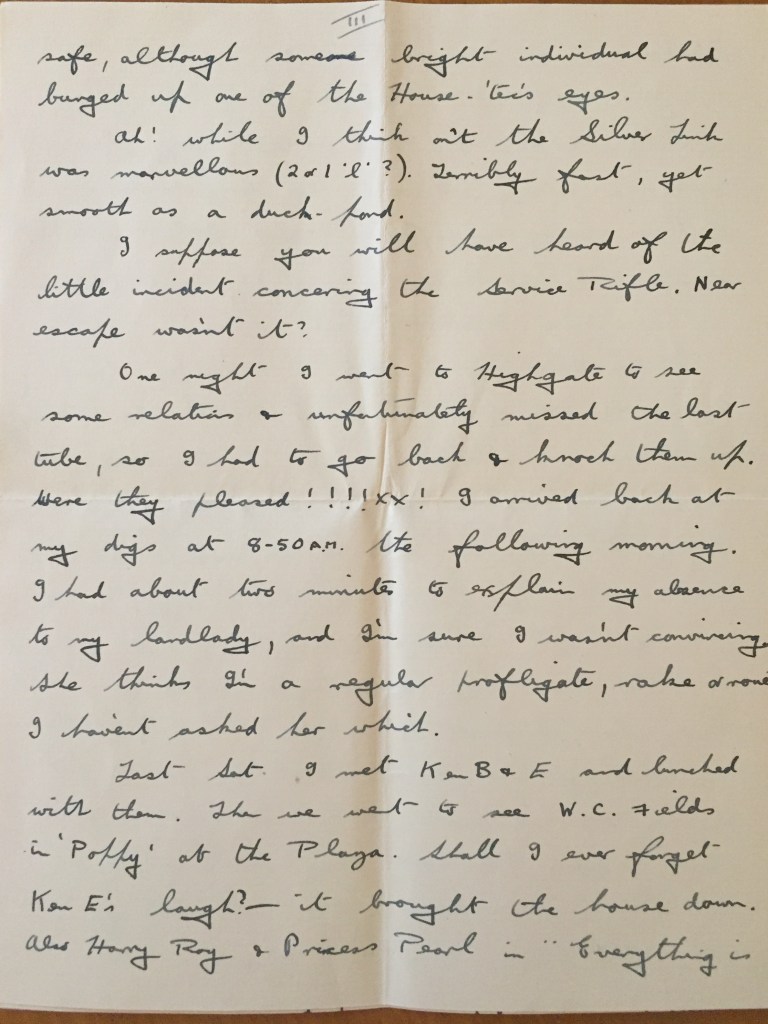
Anyway after we left there we felt we were more or less safe, although some bright individual had bunged up one of the House-‘tec’s eyes.

Ah! While I think on’t the Silver Link was marvellous (2 or 1 ‘l’ ?). Terribly fast, yet smooth as a duck-pond. 

I suppose you will of heard of the little incident concerning the Service Rifle. Near escape wasn’t it?

One night I went to Highgate to see some relatives & unfortunately missed the last tube, so I had to go back & knock them up. Were they pleased!!!! xx!  I arrived back at my digs at 8:50 A.M. the following morning.  I had about two minutes to explain my absence to my landlady, and I’m sure I wasn’t convincing.  She thinks I’m a regular profligate, rake or roué. I haven’t  asked her which.

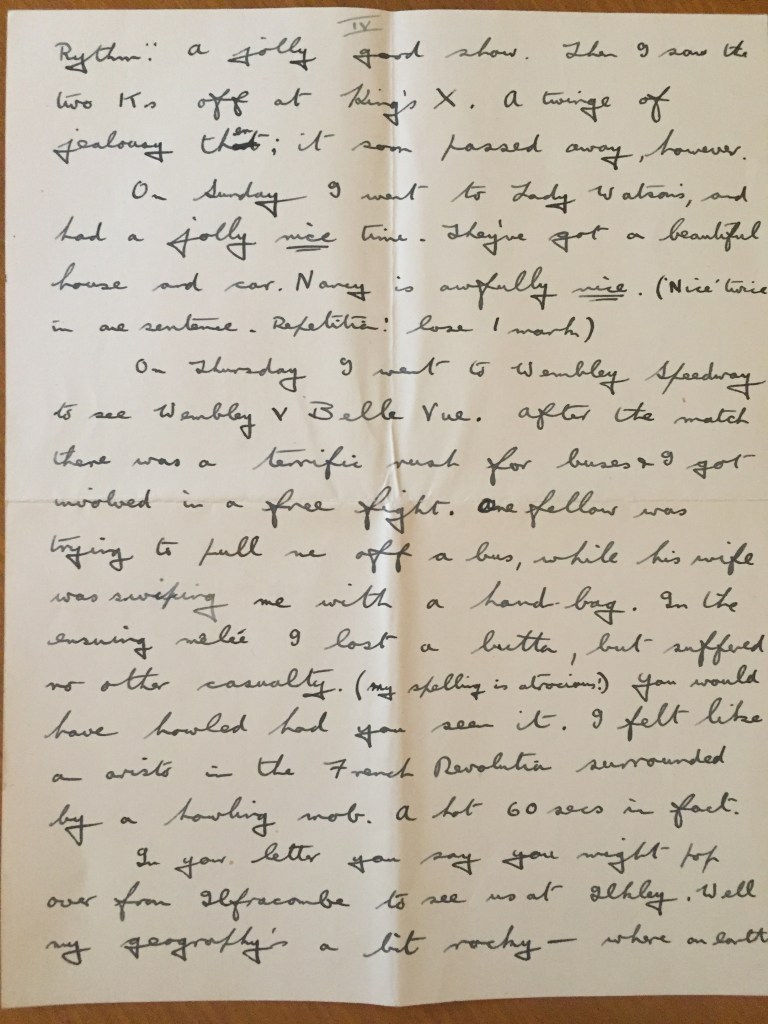
Last Sat. I met Ken B & E and lunched with them. Then we went to see W.C. Fields in ‘Poppy’ at the Plaza. Shall I ever forget Ken E’s laugh?- it brought the house down. Also Harry Roy & Princess Pearl in “Everything is Rhythm” a jolly good show. Then I saw the two Ks off at King’s X.  A twinge of jealousy then; it soon passed away, however.

On Sunday I went to Lady Watson’s, and had a jolly nice time. They’ve got a beautiful house and car. Nancy is awfully nice. (‘Nice’ twice in one sentence. Repetition! lose 1 mark)

On Thursday I went to Wembley Speedway to see Wembley vs Belle Vue. After the match there was a terrific rush for buses & I got involved in a free fight. One fellow was trying to pull me off the bus, while his wife was swiping me with a hand bag. In the ensuing melée I lost a button, but suffered no other casualty. (my spelling is atrocious!)  You would’ve howled had you seen it. I felt like an aristo in the French Revolution surrounded by a howling mob. A hot 60 secs in fact. 

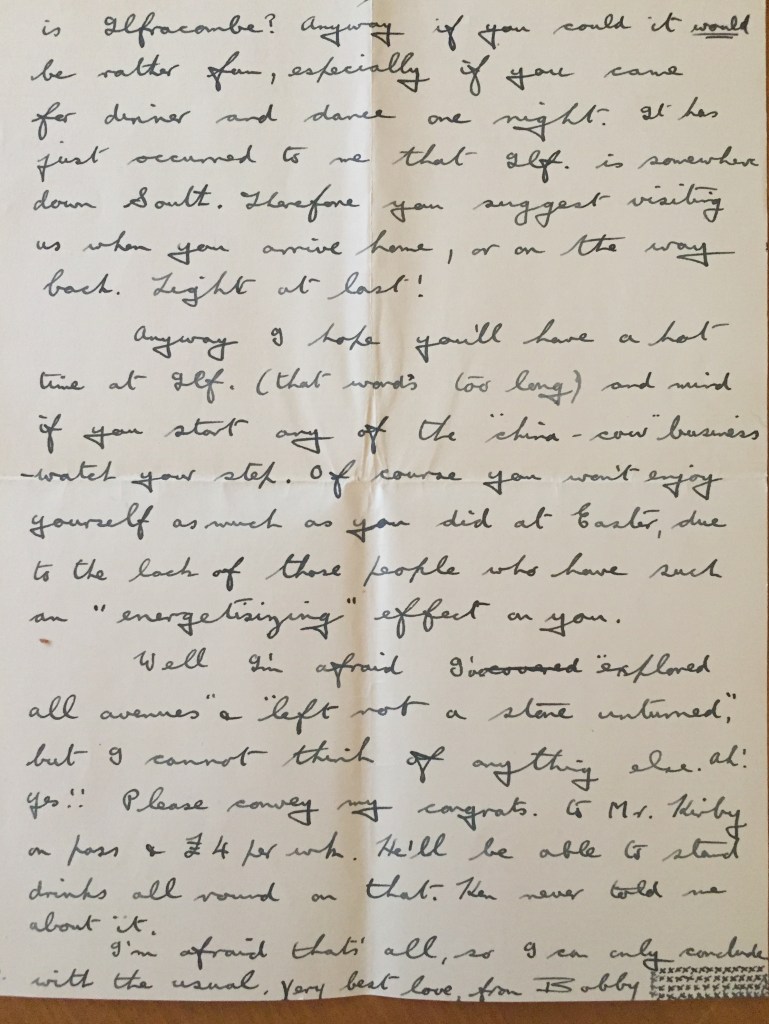
In your letter you say you might pop over from Ilfracombe to see us at Ilkley. Well my geography’s a bit rocky- where on earth is Ilfracombe? Anyway if you could it would be rather fun, especially if you came for dinner and dance one night. It has just occurred to me that Ilf. is somewhere down South.  Therefore you suggest visiting us when you arrive home, or on the way back.  Light at last!

Anyway I hope you’ll have a hot time at Ilf. (that word’s too long) and mind if you start any of the “china-cow” business watch your step.  Of course you won’t enjoy yourself as much as you did at Easter, due to the lack of those people who have such an “energetisizing” effect on you.

Well I’m afraid I’ve “explored all avenues” and “left not a stone unturned”, but I can’t think of anything else.  Ah! Yes!!  Please convey my congrats to Mr. Kirby on poss [position? post?] & £4 per week. He’ll be able to stand drinks all around on that. Ken never told me about it.

I’m afraid that’s all, so I can only conclude with the usual. Very Best love, from Bobby XXXXXXXXXXXXXXXXXXXXXXXXXXXXXXXXXXXXXXXXXXXXXXXXXXXXXX

P.T.O.

P.S.  I meant to read this letter over to punctuate & otherwise correct it, but I don’t feel in the mood to wade thro’ such a whack of concentrated drivel.  I will therefore leave it to your tender mercies “in toto”

Bobby 

Enclosed one boot-lace with which to tie all my letters to be kept in lavender for 50 years at least.

Well, 84 years and counting. I doubt Bobby expected that!