This is the draft of a will of my great-grandmother Marion Hazell. I enjoy the feminist touches, when she leaves money clearly to the women of the family first, and I also appreciate the silver bonbon dishes and vase which have been handed down to me.
I was very excited. My cousin Jack was coming to spend a week with us. Since coming to England at the age of four, only two of my mother’s sisters had come from the West Indies to stay with us, but the whole saga of my mother’s family “back home” was part of the fabric of my childhood. Although I had very little recollection of these relatives, they were entirely familiar.
Jack, I knew, was the older son of my Aunt Trixie and Uncle John. Aunt Trixie in the family photograph album looked to be a little fat jolly woman and Uncle John was a tall pleasant looking man, and I also knew that Aunt Trixie was very bossy and managing while Uncle John calmly went his own way. My mother told of their ongoing disagreement of how rice should be cooked. At dinner Aunt Trixie would look at the rice and start to scold the servant. “Luenda, you’ve cooked the rice too much again! It’s all sticking together. You know I like rice cooked just enough so that the kernels are separate.”
Uncle John, helping himself, “Very nice rice today, Luenda,” he would say.
It was accepted that of her two sons Aunt Trixie favoured the younger one, Bill. In any boyish mischief, Jack was blamed. The story in the family was that one night there was an earthquake not severe, but enough to shake the house and make everything rattle. Aunt Trixie, waking up suddenly in the dark, immediately called out “Jack! Jack! What are you doing now?” Fortunately Jack inherited his father’s good nature.
This was the cousin who was coming to visit. I was maybe twelve or thirteen and Jack was perhaps nineteen or twenty, not merely a Big Boy, but grown up. He had been very active in the Boy Scouts Movement and was coming to England to attend a large Scouts Jamboree as a representative from Grenada. This was Jack’s first time in England, in fact the first time he had left the islands so it must have been a great adventure for him. He came to us after he had been to the Jamboree, a tall goodlooking young man, with an easy casual West Indian manner. Of course I was shy, but Jack didn’t seem to notice and treated me like a younger sister at once. I was not used to the easy affection of West Indians, with an arm over my shoulder as we sat on the sofa, or around my waist as we walked to the store, but it was very thrilling!
My mother and father took him to see the sights, and for drives in the country, but there was a big exhibition in the city that summer, the North East Coast Exhibition, and one morning Jack and I spent the day there. It was a beautiful sunny day, although it was never really hot in our part of the country, and the grounds were colourful with flowers and gardens. The white buildings showing displays of trade, industries etc. turned out to be rather dull, but we dutifully toured each one. Jack was interested in buying a few small gifts to take home and in one of the buildings was a stall with a selection of jewelry made to display brilliantly blue butterfly wings set in silver. They were pretty and not expensive so Jack did some shopping. We strolled out and sat on a bench in the sun to enjoy ice cream cones and Jack took his package out of his pocket and presented me with a small silver ring set with an oval of glorious blue. I was quite speechless with gratitude and joy. I think my daughter still has that little ring.
One day my mother suggested we go down to the sea for a picnic and a swim, so she and Jack and I took the electric train the nine miles to the coast. There were three small seaside towns; Tynemouth, Whitley Bay, and Cullercoats. The latter was mainly a fishing village but at Whitley Bay there was a beautiful stretch of golden sand and lovely blue sea and white waves, so we went there and settled down on the sand. My mother and I, knowing that on the northeast coast of England there was always a chilly wind blowing across the North Sea, had come prepared with sweaters as well as swimsuits but Jack seemed impervious to the less than balmy breeze.
I have a theory that when a person moves to another country or another climate they bring with them an internal thermostat set at the temperature of their homeland. Leaving England for the U.S.A., my husband and I happily lived one winter in an upstairs apartment where our guests refused to remove their coats, but by the next winter we had to beg the landlord to put up the heat. Similarly, Jack did not seem to feel the sun any less warming than in Trinidad or Grenada and the wind not much cooler than a tropical breeze.
My mother decided not to swim so Jack and I retired decorously to the bathing huts to change into swim suits; then we strolled over the sand to the beautiful blue sea with little waves curling gently onto the shore. Knowing the ordeal ahead of me, I hung back, ready to edge into the icy water as slowly as possible, practice my breast stroke for as long as I could bear it, and then rush back to swathe myself in a warm towel.
Bathing Beauties, Cynthia a bit older, with bathing huts in the background.
Jack had no such fears. Used as he was to warm seductive tropical waters all his life, he ran happily into the water and made a long shallow dive through the waves. I watched him in amazement. I don’t think anyone had ever dived into the North Sea with such careless abandon before. It seemed a long time until he surfaced and slowly he stood up and crept towards me. He moved like an aged man and his face was pale and gaunt. Quickly my mother wrapped him in towels and tried to rub some feeling into his shivering body.
I can’t remember if I even went into the water. My mother and I were so occupied in giving Jack hot tea from the thermos: I’m sure it must have been hot sweet tea for the treatment of shock.
My mother’s story ‘Waiting’ is fictional, and ignores an event that would have changed family life as much as the First World War changed the world in the twentieth century. My great-grandfather, John Gregg Windsor Hazell, died in March 1915, and this would have affected the business as well as family life. But Cynthia continued to include him as a character, as the focus moves from St. Vincent to England at the end of the story.
JGWH’s Memorial in the Botanical Gardens, St Vincent, WI
WAITING
by Cynthia Costain
The sun was just rising as Carol slowly turned and left the dock. The ship had completely disappeared towards the dark misty horizon and the clouds were flushed with pink. The cool morning breeze was already becoming warmer with the promise of a hot day. She walked towards the town but instead of taking the turning to ‘Windsor’ she turned aside feeling she needed to be alone for a while. Leaving the little shacks behind, she climbed higher and coming to a low stone parapet edging the sharp drop to the water she stopped. With a guilty glance around she perched on the wall with her feet dangling into space.
“Not the action of a respectable married woman!” she thought. “But although I am married and have a child, I am only 23 years old and I am going back to my old home to live with with my parents. I’m becoming a daughter again with my Mother and Father and sisters because Gordon has gone to England. Thank Goodness Ettie is there with her girls, we’ll be in the same position with both our husbands away, but it will be very strange; like being a girl again. No house or servants to look after, no need to worry about meals or cooks and Mary Sam to look after the baby.” She couldn’t help smiling at the thought – no responsibilities! “Of course I’ll miss Gordon but he’ll soon find a job in England and buy a house so that we can join him.”
There was no doubt that the last year or so had been difficult. Gordon became discontented and restless in Kingstown. He thought Dr. Durrant was old fashioned and incompetent but he was the senior doctor, and his boss. Then again, Gordon didn’t really get on with her parents and resisted being automatically taken over by the Hazell family. Moving to Georgetown had seemed such a good idea – further away but not too far. It had been such fun at first; a nice house in the small town up the Windward Coast and Gordon had been pleased to be on his own in a new district. For a while all went well but it was small with not many estates nearby, so not many friends. Before long Gordon was bored and the friends he had thought so delightful at first became dull. Before the year was finished he was applying for another move.
When the posting to Carriacou came he was pleased, but Carol had dreaded leaving St. Vincent. Yes, she knew Carriacou was not very far away, just one of the Grenadine Islands near Grenada but she would know no one and would have to live in a different house and find new servants, leaving all her family behind. It was a long two days in a sailing vessel with the baby and all their furniture and trunks and when they arrived the house was old and not even very clean because it had been standing empty, and the garden was a jungle. Even Gordon’s pleasure at a new place and new people soon faded and Carol felt miserable. Of course she had tried not to show it but the servants were slow and tended to be rude to such a young mistress. Baby Cynthia missed Mary Sam who had stayed in St. Vincent, and was fretful and difficult.
The decision to go back to England came as a relief. Gordon explained that he would have to go first until he had a job and could get a home for them and Carol realized that this was only sensible.
“You can stay at Windsor with Cynthia when I go,” Gordon said. She had hesitated and he went on, “They’ve already taken in your sister Ethel and her girls while Simmonds is in New York so they can’t refuse to take you.”
Carol felt reluctant but she wrote to her parents when Gordon wrote to England. She need not have worried – her Mother wrote kindly that of course she and Cynthia could live at home while Gordon was away. Many more letters were written and plans were made until finally it was arranged. Dad got a passage for Gordon on a ship with a cargo for London; their furniture was sold, then back they sailed to St. Vincent and home to Windsor. Everyone remarked how the baby had grown and how thin Carol was.
“I seem to have done all this before,” Carol thought. Now all the packing and moving and rushing was over. Carol sat and gazed at the sea and felt all her worries and tension melting away. Scrambling off the wall she began hurrying down the road in the bright morning sunshine, and then up the steep hill to her old home. Mary Sam, back with her again, was strolling down the drive with the little girl in her arms.
“Daddy gone?” said Cynthia.
The house was certainly full; two unmarried sisters, Blanche and Muriel, besides Mother and Dad and Aunt Min then Ettie with her three girls, Milly (11), Marguerite (8) and Mona (5), and now Carol and Cynthia. Fred and Mil lived in town with their baby Jean while Bee and John Otway with their boy Jack were not far away. Carol looked forward to joining the family but Mother had suggested that she and Cynthia and Mary Sam could have the small cottage in the garden as their own, as it would be quieter for the baby and Carol was delighted.
Carol holding Cynthia with a bow in her hair.
They soon settled down to a happy routine. Every morning they went up to the big house for breakfast and Cynthia waved “the big girls” off to school. Afterwards there were jobs to do. Mary Sam would sweep the cottage while Carol made the beds, then go up to the house again to help. Carol would do the flowers or dust the furniture while Mary Sam did the baby’s washing while Cynthia would play happily.
One of her favourite playmates was Great Aunt Min, or Miss Wilhelmina Maria Laborde. She was Mother’s sister who had come to live with her after her marriage. She had not approved of the bridegroom, as he was in Trade and their father had been an Anglican Archdeacon! However, as an unmarried sister, she was grateful for a home, but continued to call her brother-in-law “Mr. Hazell” all her life. She had a very special place in the family and was much beloved by all the children and grandchildren.
Aunt Min would sit quietly sewing or reading while the little girl played at her feet and told her long complicated stories. One place she loved to play was underneath one of the big high mahogany beds where the surrounding starched white valance made a secret playhouse. Hidden there she would play contentedly, if she could find some of the lovely books or paper dolls which were sent to her cousins by their father in the States. She was not supposed to play with them as she was “too little” and would tear them and spoil them. Still she would go looking and bring some of the lovely fragile paper dolls into her hiding place. All would go well until she heard the girls’ voices as they came from school and then panic-stricken she would call, “Aunt Min! Aunt Min! The girls are coming! Help me! Help me!”
Poor little Aunt Min would come running, and crawl under the bed on hands and knees to help gather up the treasures and help return them to their rightful places. Of course the big girls found out many times and Milly would be cross and Marga would scold but there were not many playthings and the paper dolls were too tempting to resist.
The days passed pleasantly for Carol. She enjoyed the company of her sisters and joined in all the family activities. They worked at the Cathedral and every Saturday cut flowers in the garden and took them down to “do” the flowers for the Sunday Services. In the afternoons they would rest or sit on the verandah sewing or making lace and talking while Cynthia slept. Afterwards Mary Sam would take her for a walk and later other friends and family with their children would drop in for tea. Mother was getting old but still very much in charge of everyone and everything. She was a severe-looking old lady and did not take kindly to many of her sons and daughters-in-law, but she was very kind to Carol and Cynthia. Sometimes she would take the little girl onto the verandah at night and show her the stars. She taught her “Twinkle, Twinkle, Little Star”.
Many of Carol’s evenings were spent in the little cottage writing long letters to Gordon. He was a regular correspondent and anxious to hear all her news and how his little daughter was growing. Besides the letters, he sent Cynthia postcards of children and beautiful actresses, so that she looked forward to the mail as much as her mother did.
Gordon had retired from the Colonial Service and had been medically unfit for the Forces because of his childhood illnesses and emphysema. He was applying for jobs and had contacted old friends from his Edinburgh days. One of them had been hopeful that he could find something for Gordon in the area, which was promising.
Willie
Months went by pleasantly to be suddenly shattered with the tragic news that Willie had been killed in France. He had always written so cheerfully and had said that he was the lucky one, that they had come to believe that he would be all right. Carol wept over the picture he had sent her of him in his uniform with a loving message on the back to her and her little girl. Dear kind Willie – it should have been Fred as the youngest son to go to England when the War began, but he was married and had a family and Willie had said, “I’ll go!” Only two Hazell sons left.
Commemorated at Loos Memorial
Glad news came from Gordon that he had got a job in Newcastle-on-Tyne, and Carol was happy and began to plan what she would take with her to England. Already it was nearly a year since he had left and she couldn’t help being anxious. Looking at a map of England, Newcastle seemed a long way from London and the places she had known during her school days and she had hoped to be near her dear Miss Lefroy but she was sure that it would be lovely. Now Gordon’s letters were full of plans. He was saving his money and living in lodgings but he liked the job and he was making friends. He was looking for a house but in 1918 that was not easy and the months went by until at last the War was over! St. Vincent joined in the general rejoicing and gradually young men began to trickle back to the island.
Still Carol waited and hoped but the post-war shipping was in confusion and although Gordon had sent money for a passage to England for her and Cynthia, Dad had not been able to arrange anything. Finally he suggested that he could get a berth on a ship going to New York where she could stay with her brother Arthur, and he would have a better chance of finding her a place on a ship going to England. Gordon agreed, so Carol found that after two years she would soon be with her husband again. Cynthia was now four years old and remembered nothing of her Father, having only looked at his picture and the post cards he sent her. How would they all get on together?
With excitement and misgiving, Carol packed for the last time and said her goodbyes. This time she knew in her heart that she would never see her parents again and probably not many of her family, but she tried to be brave and cheerful for Cynthia’s sake.
The last day arrived and she parted from her Mother with tears but tried to laugh and joke with the sisters and friends who had come to see her off. She stood at the rail of the ship waving while Cynthia kept saying, “Bye bye” and lifted her up to see the last glorious sight of the sunshine glowing on the green and gold island. Would she ever see St. Vincent again? Perhaps when I am an old lady and Cynthia is grown up, she thought, but that was something she could hardly imagine.
The Hazell Business
This letter, while addressed to my grandfather Ewing, ended up in the care of the Hazells in St Vincent. I am very grateful for their generosity in sharing it with me here.
Pages 1 and 4Pages 2 and 3
I believe this transcript is mostly accurate, but any corrections are welcome.
Sat: night
May 11, 1918
Dear Mr. Ewing
I very much regret to inform you that your brother-in-law, Cpl. W Hazell, & incidentally my Pal, has been killed buy a shell last Sat: about midnight as near as I can tell you. We were in a trench on the banks of Bethune Canal crossed-out word, and as the Germans were shelling, we, that is the 12th Northl’d Fusiliers and the people we were relieving, were bunched up together, & an order was passed up, to extend out a little, & Willie passed it on, & moved in accordance, and jammed with several, were in a very shallow part of the line, and a shell burst right amongst them, killing two & severely wounding others, of whom one or two died later.
I don’t know his mother’s address, but he often spoke of you, but I forget the no of your house, but I reckon your name will suffice to find you all right, anyway I thought it best to inform you, so that you can cable his folk, for the War Office message will be some time yet in informing you of his death, and my writing will put their minds somewhat easier, I hope.
Well Sir, he suffered no pain, for he died instantly, for which I am very glad, and if there ever lived a good & brave comrade it was W. Hazell, for he was one of the True Blue, for he was cool & his coolness helped others to stand the awful strain.
He was in command of my section (the Lewis gun) until he was promoted Cpl, then he was on another one, and I took his place being made L/Cpl to do so.
Transcriptions of the newspaper clippings above, June 1914:
Matrimonial
The marriage of Dr. J.M.G. Ewing, a Government District Medical Officer, to the youngest daughter of the Hon’ble J.G.W Hazell of this island, which was solemnized at St George’s Cathedral yesterday, caused a flutter of delightful excitement among their immediate relatives and friends who constitute the leading social circle in the colony. The wedding party was comparatively small, but a large and fashionable gathering in the sacred edifice witnessed the entry of the happy young couple into the joys of married life; and this afforded ample testimony of the goodwill entertained among various sections of the community, towards Mr. J.G.W. Hazell and his family.
The Bride, charmingly attired in a lovely robe of white bijou satin and carrying a bouquet of chicken daisies and tube roses, was escorted by her father, and had, as her bridesmaids, the Misses Mildred Hazell, Joyce Hutchinson, and Millicent Simmons who wore very pretty dresses of mauve silk crepe de chine. The mother, Mrs. Hazell, wore an elegant black silk dress and bonnet, and the other ladies who were guests were equally representative of fashion’s artistic features.
The bridegroom, also a centre of attraction and the happy recipient of sincere congratulations, was accompanied by Mr. F Birkinshaw who filled the favoured office of bestman.
After the service, which was fully choral, the party drove off to Windsor House where the reception was held, and subsequently went away to Grand Sable for the Honeymoon, carrying with them many greetings and good wishes, which we heartily echo, for their future happiness.
Wedding Bells
St George’s Cathedral was today the scene of a fashionable wedding, the contracting parties being Dr. J.M.G. Ewing, the popular medical officer of No. 1 District and Miss Enid Carol youngest daughter of the Hon’ble J.G.W. Hazell and Mrs. Hazel of Windsor. The Sacred Edifice was tastefully decorated for the occasion, and long before the wedding party arrived, the church was filled with the friends and well wishers of the bride and bridegroom. Punctually at the hour fixed for the ceremony the Bride who looked charming in a dress of white satin Charmeuse trimmed with Lace and Orange Blossoms, arrived leaning on the arm of her Father. She was attended by Miss Millie Hazell (cousin of the bride) Miss Joyce Hutchinson, and Miss Millie Simmons (nieces of the bride) tastefully dressed in mauve crepe de chine trimmed with Lace and Orange Blossoms each carrying a bouquet of white lilies. The Service was fully Choral, Appropriate Hymns being rendered, The Nuptial knot being tied by the Venerable Archdeacon Turpin. Mr. F. Birkinshaw performed the duties of Groomsman. The party consisting of members of the Bride’s family, Mr. P. Verrol, the Archdeacon Turpin, and Rev. Dr. McPhail, after the function, drove to Windsor and was entertained at a recherché luncheon by Mrs, Hazell, The presents were costly and numerous, Dr. and Mrs. Ewing left later in the afternoon for Grand Sable House, the Country seat of the Hazell. We wish the happy pair long life and prosperity.
Carol and Doris discovered in the next few weeks that the sun DID shine in England and that there were many beautiful places in London. It was not all dark with dirty buildings and poor-looking people as they had thought that first evening, but they continued to be amazed at the crowds and busy streets.
Fred joined them, looking bigger and older than when they had last seen him the year before, and they soon got over an initial shyness and enjoyed being together again. Dad was a good guide and showed them the beautiful parks and elegant buildings and shops, as well as famous sights such as the British Museum and the Albert Memorial. The Crystal Palace was a big disappointment. Doris thought it was a big dirty building, while Carol had expected a shining glass castle “just like in the fairy stories”
“Never mind,” said Dad, “We’ll go to the White City tomorrow, and maybe you’ll like that better.”
Indeed they did. It was a big Amusement Park with Ferris Wheels, scenic railways, round-a-bouts, and thrilling rides of every kind imaginable. To the girls who had never been on anything more than a swing it was wildly exciting and Fred enjoyed it every bit as much, once he got over being superior. They kept begging for, “Just one more” until Dad finally dragged them away.
All good things must end and first Doris waved goodbye to Carol, as she joined Mr. and Mrs. Hadley who were taking her back to St. Vincent. She did not mind as she had so much to tell them all at home, but Carol saw her go with a sinking feeling. It was worse when Fred returned to school, and Dad called a cab and took her to the Streatham College for Girls. She had tried to imagine this school so often, but she was not prepared for the gracious old country house set in its own grounds, with flower gardens and tennis courts. It was on the outskirts of a wealthy suburb with tree lined streets and handsome houses. The driveway up to the school was long and by the time Carol had crept up the steps to the large porticoed doorway and been ushered into the marble tiled hall she was trembling with fright. “It’s like a palace, Dad,” she whispered.
They were taken into a beautiful drawing room and an imposing little lady rose to greet them. Miss Amy Lefroy was not tall, but the dignity of her carriage and the sharp intelligence of her eyes were impressive. She had been one of the first women graduates of Oxford University and had become the youngest headmistress in the Anglican private school system. Her older sister had a similar school in Halifax in Canada where Muriel had been a pupil. Now it was Carol’s turn to be educated.
All the formalities had been conducted by letter so this was a social visit with afternoon tea brought in by a maid and served from a gleaming silver tea service. Carol was too shy to eat any of the delicacies and listened to Miss Lefroy and Dad chatting while she concentrated on not spilling her tea.
Afterwards they were shown around the school: classrooms, bedrooms for two, dining room and so many other rooms that Carol was overwhelmed. She could not imagine how she would ever find her way around. Her shoes clattered on the Adam staircase and she tripped over the entrance to the Great Hall. At last they said goodbye and Miss Lefroy smiled kindly at her new pupil.
Carol wrote in her journal that she was taken to school by force, but I’m sure that she went meekly but with a faint and trembling heart. (She was given to underlinings and exclamation marks.) It was very strange at first. It was a day school, and the majority of the girls lived in the area and came each weekday from nine in the morning until four in the afternoon. The school also took in a small number of boarders, most of them coming from overseas. The numbers varied. Sometimes Carol was alone, at other times Una from Canada, Vesta from India, Marjorie and others were with her. She was in a class of thirty-two girls, but at first she happened to be the only boarder and it was not easy to make friends. Some of the teachers lived at school: Miss Lefroy, Miss Hull, Miss Dart, and others so before long Carol felt it was very much the same as it had been at home with her big sisters. “Carol dear, run upstairs and bring me my scissors” or “Take these books to the classroom for me, please” and she happily ran errands and made herself useful. Some lessons she loved and some she disliked but she did her best and the teachers were kind. Those in residence often took her out when they went shopping or on little expeditions and made a fuss of her when she had her tonsils and adenoids out. Gradually it became quite fun.
As the holidays approached Carol was worried about what would happen to her when the school was closed, but to her joy her Father was still in London and she and Fred joined him for a final week of sightseeing and theatres before he sailed for New York. As most of the boarders had no relatives in England, Miss Lefroy made arrangements during holidays for them to stay with families in different parts of the country. Many of these were clergy living in big houses in villages who were happy to augment their small stipend and welcome boys and girls into their own large families. All tried to make the holidays enjoyable for these young people far from home.
This time Miss Lefroy sent Carol to a vicar and his family in Norfolk where there was a cheerful group of young people and before long Carol was helping with the Church Bazaar, bicycling to the sea and bathing, and learning to sail on the Norfolk Broads. While Fred was still at school many arrangements included both brother and sister and Fred sometimes spent time with Carol at school if their holidays did not quite coincide. The teachers spoilt them both and took them to theatres in the winter and for bicycle rides in the summer to the country for delicious farm teas.
Perhaps the first Christmas in England was not the best holiday she had, but Fred was with her. They went to a family in Hampshire with three grown up daughters and Carol wrote in her journal, “We had a very quiet time.” They had their parcels from home and other presents which they opened on Christmas morning before the family was awake and giggled as they tried to be quiet. After breakfast they all went to Church, and in the afternoon she and Fred went for a long walk although it was a damp grey day with no sign of the snow which they had been hoping for. The Christmas dinner in the evening was a big success though, with a turkey, flaming plum pudding and crackers. It was not all dull as they were invited to two dances in the neighbourhood. Fred was horrified, but was finally persuaded to go and enjoyed himself immensely. One of the daughters took them to a roller skating rink which was `all the rage’ Carol wrote, and they both became very enthusiastic. One day, unfortunately, the poor lady fell and broke her leg so they were not allowed to go any more. “Just as I was beginning to get the hang of it,” mourned Carol. Fred said a very bad word.
Miss Lefroy’s plan of education for her boarders included not only classroom work but an appreciation of all that London and England could offer. In Carol’s journal she lists the sights she saw: art galleries, parks and gardens, museums, castles and cathedrals. After each outing Carol would sit down at her school desk and write a description of what she had seen, usually very factual and with little personal input as it would be corrected by a teacher. Sometimes emotion did creep in, as when she and Una went to the tower of London and were dazzled by the Crown Jewels and then saw the tiny bare stone room where Lady Jane was imprisoned and the place where she was beheaded. Some of her remarks produced red underlinings by the teacher and many exclamation marks, such as her visit to Nelson’s ship `Victory’ in Portsmouth harbour. There she says she saw where he died and his cabin where there were “many of his remnants”.
Success in school work was also important. In July 1912, Carol was proud to receive a leather bound copy of the Poems of Tennyson as an Elocution Prize. She kept it all her life.
From Streatham, trains and omnibuses could take them all over London and to other towns and cities, bicycles could be taken on trains and used for exploring. There was an Easter holiday weekend in Brighton with Miss Lefroy and Miss Hull, and later on a few weeks in France with Miss Dart and some friends.
The huge variety of London’s entertainment world was not ignored. Carol saw the best English actors in Shakespeare plays; popular drama such as `The Scarlet Pimpernel’ and `The Blue Bird’; the famous Russian Ballet’s first season in London; Maskelyne and Devant; and light musical comedies. She had singing lessons and with the other girls enjoyed singing all the popular songs, as well as preparing a more serious repertoire for evening parties where she would be asked to `bring her music’.
During Carol’s time in England there were two events of national importance: the death and funeral of King Edward VII, and the coronation of King George V. Miss Lefroy arranged that her pupils were able to see the great processions during these events. Edward died in May 1910 and the whole country went into mourning: blinds and curtains darkened every window in each house; black bordered posters and newspapers announced the event; shop windows were draped in black crepe while the counters inside were besieged with people shopping for black clothes and armbands. Carol was impressed because even the crowds hurrying to work and the busy shoppers were quiet and solemn.
On the day of the funeral Miss Lefroy took Carol early in the morning to the Treasury Building in Whitehall where she had reserved seats. They had a magnificent view of the whole street through which the procession would pass. Looking down they saw a dense mass of people walled in by a double row of soldiers stretching off into the distance. They had a long wait but the crowd was quiet even when there was a sharp shower of rain and Carol was amused at some of the soldiers trying to keep their busbies dry. At last they could hear the tread of the horses’ hooves and the wheels of the gun carriage with the coffin. The crowd was still and perfectly silent. The black crepe draped from the lamp posts hung down in the damp air as the procession passed. The coffin was covered with the Royal Standard and the crown, the orb, and the sceptre glittered on top. King George with his two eldest sons on either side walked behind; a group of the great military and naval leaders followed and then came detachments of British regiments as well as the cavalry of Hussars and Dragoons of foreign countries. The colourful slow procession of troops followed and at the end was the King’s horse with empty saddle and reversed stirrups, while behind trotted a small white haired terrier.
Still more pomp of bishops, judges, heads of ancient orders and then a parade of royalty representing seventy nations. Carol was too awestruck to try to count but the newspapers would tell her that there were nine kings, five heirs apparent, forty imperial or royal highnesses, seven queens, and ambassadors from uncrowned countries. The sun broke through the clouds and shone on such a magnificence of uniforms in scarlet and gold, silver, green and blue, gleaming orders on imposing breasts, tossing white plumes on shining helmets so that the people gasped as the parade rode by. Carol thought it was wonderful and wrote in her journal she wished she could “see it all over again”. She did not realize that never again would there be such a gathering; that the German Emperor, freed from his Uncle Bertie’s control, was already planning a war which would bring a pall of darkness over Europe. Barbara Tuchman, in her book, calls it `a dying blaze of splendor never to be seen again’.
The coronation of King George V more than a year later was a happier event and again Miss Lefroy had booked a room from which the girls could watch the procession which took place after the ceremony. The previous night there were bonfires burning all over England and the girls climbed on the roof of the school to see the flames on London hills. An early breakfast followed by a train ride took them to the centre of the procession area where they pushed through crowds to reach their destination. They found a pleasant room with two big windows and a balcony from which they had a wonderful view. Besides comfortable chairs and a sofa there was a piano which delighted the girls. As this was a festive occasion they passed the time during the long wait by singing and eating an early lunch.
At last they could hear cheering in the distance. The soldiers lining the streets came to attention and the cheers grew louder as the procession drew near. Regiments of colonial troops marched past followed by cavalry and the girls cheered enthusiastically, waving scarlet ribbons at representatives of every country in the Empire. At last the open State Coach drawn by six cream horses appeared with the King and Queen. The girls were a little disappointed not to see them in royal robes with crowns on their heads, but they agreed that the King looked quite magnificent in his uniform with the Order of the Garter across his breast. They exclaimed at the Queen’s beautiful white satin robe trimmed with pale blue and hat with blue ostrich feathers to match. Suddenly Carol screamed, “Look! Look! The St. Vincent sunshade!” and there it was at her side, the present from the people of St. Vincent!
After the whole procession had passed by, they finished the remains of the lunch while the crowds dispersed, and then made their way slowly through the people to the Army and Navy Stores where they had a good tea!
Altogether, what a wonderful education for a young person from a tiny isolated island. Miss Lefroy opened a whole new world to her pupils.
Carol sat on her bed and looked at her big cabin trunk. It was all packed and ready to be loaded onto the ship tomorrow morning when she, Dad, and Doris would set sail for England. Her clothes were lying on the top of the trunk; white cotton camisole, drawers and petticoat, navy blue skirt and sailor blouse, black stockings and strong, laced, black boots. Of course she didn’t run around with bare feet now she was fifteen, but those boots looked very hot and heavy.
Suddenly her heart felt as hot and heavy as those boots. Nearly three years ago Fred had gone to school in England and she had known that it would be her turn next. She had been breathlessly excited at the thought of England: seeing the wonderful sights of London, the palace where the King and Queen lived, the beautiful countryside; and eating an apple, all the things Fred wrote about in his letters home. Now she could smell the frangipani and orange blossom from the garden and feel the cool overnight breeze. Some of the family were still on the verandah and she could hear Mother’s voice. She wouldn’t see Mother for years, nor her brothers and sisters at home. She would be eighteen years old when she saw them all again. The enormity of it flooded over her and for the first time she realized what she was facing. When she had first heard that Doris was only coming for the ocean voyage and to see London, because she was delicate, she had been quite pleased because Doris could be so bossy, but now! How she wished they could spend those three long lonely years together. Slowly Carol got ready for bed and her last night at home.
In the morning all was rush and bustle. Sending trunks and other luggage down to the dock; trying to choke down breakfast; saying goodbye to the servants; and last of all hugging Mother with tears streaming down her cheeks. She clambered into the carriage with Dad and Doris, and Dad said, “You two can go on board straight away and get settled in your cabin. I want to talk to the Captain and make sure all the cargo is well stowed”. He kindly gave them each a little pat as Doris snuffled and Carol dried her eyes.
“How will we know which is our cabin?” Doris asked.
“Oh, someone will show you,” Dad said, and as the carriage stopped he jumped down and headed for the small boat waiting for them. He helped the girls in and then marched away. The boatman began slowly rowing them out to the steamer anchored off shore in deep water. It was an English steamship line which Father dealt with in his business to take sugar, cotton, arrowroot, and other island products to England, and to brings back all the goods which Hazell & Sons sold in their big store on the harbour.
Seen from Windsor on the hill above the town the ship had looked quite small, but as they came closer it seemed immense as the huge side towered above them.
“How will we ever get up there?” she whispered to Doris, thinking of the boys’ pirate stories and climbing up rope ladders or ropes. She was relieved to see a reasonable wooden ladder tethered to the ship’s side and a kind middle-aged officer coming to help them up. He showed them down to their cabin and explained that Dad was in the next one and that there were seven other passengers. The girls looked around the tiny neat cabin with two little bunks, one above the other. There was a cupboard and a small washstand with the basin sunk into the top and a chest of drawers with a mirror on the wall above. The porthole was open and peering out they could see the ocean with Bequia in the distance.
“We won’t have much room for clothes in here,” said Doris. “But your stuff is marked Not Wanted On Voyage anyway.”
“Let me have the top bunk, Doris” begged Carol.
“With pleasure, my dear. I don’t fancy being tossed to the floor if we have a storm.”
“We won’t have a storm,” said Carol firmly. “Fred said that it was as smooth as going out fishing at Villa all the way over.”
Carol was regretting the heavy skirt and solid boots, and wished she had on a light cotton dress like Doris, but she had wanted to be an English schoolgirl at once. She decided that when their bags did arrive, she would change.
“Let’s go upstairs,” she said. ” We can see if Dad is on board yet.”
Up on deck they found Dad talking to one of the officers. There was much activity as the ship prepared to leave. The engines were rumbling, the ladder was stowed away, and slowly the ship began to turn while the sirens and whistles blew. On the dock they could see Willie and Muriel and Trixie waving, and up on the verandah at Windsor stood Mother, a little figure waving a white handkerchief. Before long the people, then the houses and mountains grew smaller and smaller until St. Vincent itself was just a speck on the horizon.
The girls enjoyed the voyage, and as Carol had predicted, there was no storm, although the sea became more boisterous as they entered the English Channel. The sky was clouded and their first sight of England was through a grey morning mist. As they sailed on, the sun came out and they caught glimpses of green fields and trees with villages and houses and finally Dad pointed out a line of whitish grey along the shore and said, “Look- those are the white cliffs of Dover.”
By afternoon they were sailing up the Thames to Tilbury Docks and the sun had disappeared behind sullen clouds. The girls stared at the huge busy river with its crowds of boats, tugs, ships, and barges. Looking at the great dirty river and the dark, grimy warehouses and buildings along each shore, the girls could hardly believe that this was London.
With many attendant tugs and loud hoots and whistles they were at last firmly fastened to the dock and the ship’s engines were still. All the passengers had been ready for hours and looking down, Carol could see there were friends and relatives waiting below.
“Where’s Fred?” she asked Dad.
He grunted. “Fred is still in school- we’ll see him in a few days. Now I’m going to take you girls onto the dock. Our luggage should be there very soon, and you can stay with it until I see to Customs and the rest of the paperwork.”
By this time there was a thin drizzle falling and it was beginning to get dark. The girls sat quietly on the trunks in the shelter and waited- neither of them had much to say. Dad seemed to be a very long time and they were getting hungry and chilled when he came with a cab and hurried them off to the hotel.
At first the streets were narrow and cobbled, crowded with carts, barrows, and poorly dressed people. There were tiny, dirty houses on each side with women standing in the doorways and children huddled out of the rain. Gradually they came to wider, smoother streets and the horses were able to go faster, the street lamps were beginning to shine on the greasy pavement and the shops were brightly lit. The houses they passed were bigger but still tightly crowded together, with no trees or gardens to be seen anywhere. The girls just sat and looked out of the cab windows- houses, horses, people, lights, and noise- it was a terrifying new world. After along time they drove into quieter streets and pulled up at a small hotel. As they entered the pleasant, lit hallway, an imposing man came forward and greeted Dad warmly as a well remembered guest.
“I’m very pleased to welcome the young ladies,” he said. “Your rooms are ready and dinner is just being served in the dining room. Billy, show Mr. Hazell and his daughters to Rooms 16 and 17.”
Upstairs and along a corridor they followed the small bell boy and were shown into a large bedroom. Billy struck a match and lit a gas lamp on a bracket by the wall and the bright light showed them a big bed and heavy dark furniture with red plush curtains across the windows. Dad was in a room opposite and called to them, “Hurry up and wash, and then we will go down to dinner.”
Following Dad downstairs Carol thought, “I’m going out to dinner in a hotel with strange people. I’ll never be able to eat a bite.” But when they were seated at a comfortable table with white linen and shining silver, she discovered that all the people were far too busy eating to look at her, so she was able to enjoy the roast beef and Yorkshire pudding which Dad decided was the proper thing for their first dinner in England.
Later, they sleepily unpacked and washed in the hot water the maid had brought up in a shining copper jug.
Doris got into bed first and said, “Pull back the curtains, Monks, and see if the window is open. It’s sort of stuffy in here.”
Carol pushed the heavy curtains aside and said, “Yes, the window is open, but I think the smell is just London. How do I put out this light? I’ll have to climb on a chair to reach it. I never saw a gas light before.”
“Oh, just blow it out, the same as the lamp at home,” said Doris, who had never seen a gas lamp either.
The girls slept soundly, so soundly that the chambermaid’s knock did not waken them and Dad finally marched in at 8:30 a.m. to see why they weren’t ready for breakfast.
The gas fumes were faint since the windows had been open, but the girls were hastily wakened up and roundly scolded by Dad, the chambermaid and later, the Manager. “Don’t you girls know anything?” said Dad.
The year was 1902; Queen Victoria was dead, and the people in St. Vincent now had a King instead of a Queen. The Hazell children were growing up, and 8-year old Carol went to school with Miss Matthews in town. One afternoon she and Fred crept through the garden to the stable yard. A market woman had given them each a mango and they leant over a wall and enjoyed the luscious fruit, dripping juice onto the garden below. They knew what would happen if they were caught: those mangoes are green – look at the mess you have made of your clothes – you’ll get a stomach ache! It wasn’t easy being the youngest of a large family and they did love mangoes!
“We’d better go and wash,” said Carol, looking at her brother’s sticky grime-streaked face. “How did you get so dirty?”
“Your’s is just as bad,” he replied. “It’s because it’s so dusty. Look, you can’t see the sun at all- the sky looks like dirty milk.”
They looked over the garden and down the hill to the harbour and town, but the dust seemed to get into their eyes and everything was hazy. They adjourned to the pump in the stable yard. Cleaner but damper, Carol went to join her older sisters and her Mother on the verandah. She was learning to sew and as much as she enjoyed being with “the big girls” and hearing the grown up chat and gossip, the long seams of the pillowcase she was making were very boring, and she couldn’t help pricking her finger and getting her thread dirty. Her sisters were doing beautiful embroidery and crochet, but it would be a long time before she could attempt such things. This time, however, they were all getting up and putting away their work as she arrived, shaking dust from their long skirts.
“Come on Carol,” said Ettie “We’re going inside. It’s too dusty to work out here today. Look at the dust on my blouse, and yet it isn’t very windy.”
“It’s not wind – the dust just seems to be drifting down,” said Muriel. “I wonder where it’s coming from.”
They were to wonder more as the dust grew thicker and the sky darkened. Next morning there was no sign of sunrise and it was like a queer twilight. The gritty dust was everywhere, in the house, in the air you breathed, and floating on the morning cup of tea. The servants were very quiet, with none of the usual talk and laughter, and the children felt scared because everything was so strange.
Dad and the men and boys set off for town, but Mother told Carol she could stay at home this morning. She couldn’t even feel pleased at the unexpected holiday, especially as Trixie told her to dust all the dining room furniture- What was the point? It got dusty again as she did it. She stopped to look out at the sky and suddenly saw her brother Willie tearing up the driveway, with Fred, red-faced and puffing, not far behind.
Leaning out of the window she called “What are you doing? Didn’t you go to school?”
“There’s been a big eruption in Martinique!” yelled Willie.
“School’s closed!” shouted Fred, and as they tumbled up the steps, there was the clatter of horses’ hoofs and Dad came riding up from town and into the stable yard. Carol could hear Mother’s voice in the kitchen and the sound of Dad marching in. He was sweating and the dust stuck in the lines of his face, making him look like a stranger.
“Jack, what is the matter?” asked Mother. He sank into a chair and tried to wipe the dust and sweat from his face.
“Mount Pelee has erupted on Martinique- a really big blow! They say the town of St. Pierre has been destroyed and perhaps everyone killed.”
“How terrible,” said Mother. “The poor people in Martinique.”
“The shock must have been devastating for the whole island,” said Dad, and as he spoke they suddenly felt a reverberation like a ripple go through the floor and heard in the distance a series of dull thuds. They stayed frozen for a moment, each with the same thought: “What about the Soufriere?”
“I’m going back to town,” said Dad. “See if I can get any news from up country.”
Mother looked pale, but she said, “Come and eat your soup, Jack. You don’t know how long you will be, and the servants would like to get the meal over with.”
No one ate with much appetite as even Carol knew that the Soufriere was their volcano at the northern end of St. Vincent, and that if one volcano erupted it was quite possible for another to do the same. The Soufriere had been dormant for nearly a hundred years and it was right at the other end of the island. But St. Vincent is only 18 miles long.
The young ones crept away and gathered under the porch and the boys tried to scare the girls with horror stories of what they imagined was happening in Martinique. Of course, nothing like that would ever happen in St. Vincent! The adults were not so hopeful. They admitted to each other that a friend from an estate up there had said that the water in the crater had risen and had begun to steam, and John Louis had met George Fraser in town one day who had told him that the earth tremors had been frequent on the Leeward coast, some quite violent, but still! It couldn’t happen here.
The island is so mountainous, and the roads were narrow and twisting, so communication was poor. While the people in Kingstown talked of the terrible news from Martinique, and the estate owners on the Windward Coast took no notice of the small tremors and could not see the mountains for the heavy clouds of dust, the people on the Leeward side of the island felt the earthquakes becoming more violent and the rumblings from the volcano more frightening and they realised that like Mount Pelee, the Soufriere was erupting. Many of the Caribs and others from the villages at the base of the mountain fled to the sea and the coastal villages of Wallabou and Chateaubelair prepared to leave.
Next day, the 7th of May, continued dark and gloomy with the dust from Mount Pelee still falling over the town. The men had gone to town but the children were at home, bored and cross. Suddenly just as it neared midday there was a terrible explosion and a huge black volcanic cloud rose in the north and spread across the sky. Everyone dashed outside to see, but there were great crashing noises and loud rumbles and explosions, so hastily the children were called in and the men servants began to put up the shutters as clouds of ashes with big stones and lumps of solidified lava poured down over the whole island. The family huddled downstairs while through the cracks in the shutters they could see constant vivid flashes of lightning and great roars of thunder. Carol clutched Ettie’s hand and tried to be brave; she wouldn’t let Willie and Fred see her cry. All the servants were huddled in with them and some of the maids were crying. Mother looked pale but Mother would never be frightened. They could hear rocks and big boulders crashing on the roof and Mother just began to say, “I think we should all go down into the cellar,” when the back door blew open and Dad and the other men burst in. They had been on their way home when they heard the first huge eruption so had struggled on, battered with stones and covered with ash but nothing more serious. Dad herded them all downstairs until the bangs and crashes became less frequent. The air in the cellar got so full of dust and smoke and the pungent smell of sulphur, that Dad finally told everyone to go upstairs, but try to keep everything closed as much as possible. Black darkness covered the town while the roar of the volcano continued. Rocks, ash, and cinders fell to be mixed with rain into a glutinous mud. Not a living thing ventured out into the maelstrom.
Eventually the storm lessened and there were fewer falls of rocks. People crept outside and tried to see how much damage had been done. The family began to clear the dust and ash from the veranda while the men rode down to the harbour on horseback through the muddy littered streets. The young people began to shovel mud from the paths and the sky gradually became a little clearer. Down at the harbour Father and the other men saw through the dusk a small boat sailing from the Leeward and entering the harbour. It was crowded with survivors from Chateaubelair with stories of the terrible destruction which had taken place.
No telephones were working and there was no news from the Windward side of the island so next day when the light was better, Father and some of the men decided to sail up north and see what had happened there. Willie and Fred went down to the harbour to see them set sail, but it was still too dusty and grey for Carol to see them from the verandah. They were away all day and just as there was a faint rim of sunset on the horizon for the first time in a week, they slipped back into the harbour. The family waited quietly at home as one of the boys rode down with a horse for Father, and at last they came wearily up the hill. Carol took one look at Father and knew that something dreadful had happened. His face was tear-stained and dirty and he looked like a very old man. Mother said quietly, “Come Jack, have a bath, and after you’ve had a drink and something to eat you can tell us what happened. We know it is bad news.”
After a silent supper Dad stretched out tiredly in his chair and told them. “We sailed up past Georgetown,” he said, ” and the sky was a bit clearer but we couldn’t see any people or anything going on so when we came to that little jetty at Orange Hill we decided to anchor and walk up to the Fraser’s house. Everything was quiet- not a sound of a goat or a bird or a cow, and no one in the fields that we could see. At the house I saw someone sitting on a chair and then another person on the steps. We ran up, but we need not have hurried. George and Flora – both quite dead. We went into the house – nobody there, but down in the cellar – my God! It was packed with the servants and the people from the estate and their families. All dead from gas. You could smell it still and we were glad to get out in the air again. We thought that George and Flora must have found the cellar very crowded and come upstairs to have a breath of air just as the gas rolled down the mountain. There were rocks and stones and lumps of lava everywhere but from what I could see the gas has killed every man, woman and child for miles around as well as animals. Some of the horses had been penned in the fields with the cattle and it looked as if they had been struck by lightning. I never saw more horrible sights.”
A Mr. MacDonald who had been at Richmond Vale close to the volcano was one of the people who had watched and recorded the whole terrible event from 7:30 p. m. on May 6th to 6:00 p. m. on May 7th when he had to retreat to Chateaubelair. He wrote a vivid account of the whole destruction during that time. In Martinique molten lava was the killer. In St. Vincent the eruption was quite as violent if not more so as the explosion blew the whole top of the old volcano away and made another new crater. The gas ejected from the crater and the force of the falling rocks and lava made a “vast graveyard where 2000 bodies are buried under hills of ash and rock”. The fertile valleys and Carib villages were gone.
The young Hazells were very subdued for a while, but it wasn’t too long before Fred and Willie were arguing about how many people would have been killed in Kingstown if the Soufriere had been as close as Mount Pellee had been to St. Pierre.
“There were 40,000 killed in Martinique,” said Willie. “I bet there would have been 50,000 here!”
“More!” shouted Carol. “Fifty thousand and two counting you two horrid things!”
(Quotation: Governor’s Report to the Secretary of State for the Colonies)
The days, weeks, and months after the hurricane dragged on with hardship, work, worry, and problems, but help continued to arrive and eventually the island itself seemed to spring back into life. Green spread over the sodden earth, skeleton trees produced small new leaves and as the sun shone and the warm breeze blew people began planting again. Grown ups were not so worried and the children relaxed into their usual routines of school and play.
One evening Dad suddenly said, “How about a picnic and some sea bathing at Villa tomorrow?”
Mother thought it over and agreed that it would be pleasant to have a change and a rest. Then the girls all exclaimed and and the boys began talking of boats and swimming, and the children poked each other and giggled. Early the next morning then, the wagon was packed with food, the children, driver, and servants set out slowly to drive the six miles to Villa. Later, the ladies in the carriage and the men on horseback followed more quickly. The meeting place was the little stone jetty opposite Young’s Island which stood about two hundred yards across the water. It was a perfect place for a picnic; a series of small bays of sand and rock, with hillsides behind curving in a great semicircle. On Young’s Island was an Isolation Hospital which Dad wanted to examine for needed repairs after the hurricane, and behind was the big rock on which Fort Duvernette had been built during the Napoleonic wars.
The children could hardly wait to tumble out of the wagon and rush down the sand to the glorious sparkling turquoise sea, but the grown-ups were already arriving and Dad soon took charge. The wagon was unloaded, the horses tethered nearby with the driver in charge, while Mother was made comfortable in a folding chair in the shade. All the men and boys went around the bay where they could swim and splash in the nude without offending the sensibilities of the ladies. Meanwhile the girls undressed modestly behind the wagon and helped the smaller ones into an assortment of old cut-down dresses and drawers, then they headed decorously to the shallow water where they bobbed up and down in the little waves. The boys were taught to swim by being thrown into deeper water from a boat and encouraged to dog paddle to shore but the girls were not expected to swim or even to float. They enjoyed the warm water and little waves, playing with the children and laughing together, revelling in the sun and freedom from corsets- what joy!
Afterwards was the picnic in the shade of the few palm trees and bushes still standing- sandwiches and hard-boiled eggs, little meat pies and even a few oranges, although there was little fruit to be had this year. Tea had been brought in the big old Chinese teapot in its padded silk nest and a few small black boys appeared with green coconuts and were well rewarded. The children loved to watch the boys chop off the tops with their cutlasses and enjoyed the cool faintly sweet taste of the coconut water.
The ladies settled to rest and snooze while the older boys ran along the beach to persuade a fisherman to row them to Young’s Island where Dad and the other men could see what damage had been done while the boat took them on to Fort Duvenet. There they climbed the old crumbling stone steps to the top and mounted the abandoned cannon and the immense walls, pretending that the French ships were creeping into the bay. The little girls on shore hunted in the sand for tiny pink shells they called `Puppy Dogs’ Eyes’ while the small boys explored the wrack left by the hurricane high up on the shore and found sad remains of oars and boats, life belts, battered boxes, and debris.
Too soon the afternoon passed. The family gathered to leave and the children clutched their treasures and snuggled down on the floor of the wagon, already half asleep with the sun and the sea, while the adults took one last look at the lovely peaceful sea with the deep blue reaching out to the horizon.
Once the main problems were taken care of and the Government was functioning satisfactorily Dad and the other landowners began to travel further from Kingstown to see what had happened in outlying districts and make sure that help was available. These journeys were by horse or by boat, and as the roads were cleared, people were anxious to see how their own estates had fared.
The term plantation was not used in St. Vincent, and estates were generally quite small. One of the Hazell estates was `Grandsable’ in the north of the island near the town of Georgetown. All the family loved the beautiful old house on the hillside, with the mountains behind and the wide view of the valley and the sea from the big verandah. This might be called their holiday home as it took a whole day to get there by slow moving wagons and carriages over steep narrow roads, transporting family, food, servants, clothes, and linens, so once they arrived they stayed and enjoyed themselves. Carol loved the long drive when one of the excitements was to stop at the village of Stubbs to rest the horses. All the villagers clustered around to exchange news and the children were allowed to get out of the carriage to run around and stretch their legs. Occasionally one of the old ladies would come with a basket of Burney Sugar Cake or Coconut Candy and Mother would recognize old servants or people from the market and buy `treats’ for the children.
On this occasion there was no leisurely family visit. Father with a group of men on horseback set out early one morning to ride up north through Caliaqua, past Ratho Mill and Prospect, and on to Stubbs. A short stop, then along Argyle Beach with its black sands and the islands of Bequia, Balisoe, and Battawea plainly visible out to sea. After that they passed the estate at Spring and the arrowroot factory-washed lean by the torrential rain, it was for once without the pungent unpleasant smell of the bitty, the residue of the crushed root after the starch had been extracted, left to rot in the riverbed until the next rain washed it down to the sea. Then they rode on up the coast and finally to Georgetown. There had been landslides and in many places great trees had blown down, little houses levelled, and roads washed out but already the work of clearing had begun. At Grandsable and most of the other estates, the local people had sheltered in the cellars of the big houses and there had been no loss of life and few injuries. People were rebuilding their small houses and in the main buildings the need for galvanized iron for roofs and glass for windows were the most urgent requirements.
It would be many months before the family could spend happy carefree holidays at Grandsable, sitting on the big verandah entertaining friends and neighbours while the children played barefoot in old clothes and picked fruit. The trees were bare, the sugarcane was flattened, and the soil washed down the hillside into the sea, but Father was pleased to return home with no worse news: the house was still standing, and Mother was relieved to hear that apart from minor damage all was well- even her beautiful scarlet, blue and gold dinner service had survived!
Much as they enjoyed Grandsable, the place the children loved best for a holiday was Mustique, a little bare tropical island down the chain of the Grenadines, far away from everywhere. For the children, Mustique was an adventure. To begin with, you had to sail a long way in a big boat with every single thing you were going to need when you were there: sacks, boxes, crates, and chests packed with food, bedlinen, knives and forks, towels and pans, dolls and balls and hardly any clothes. The adults and the children perched on sacks and boxes while the boys climbed as high as they could and were pirates. All this was necessary because there was not a `proper’ house on Mustique- it was a building with big rooms and wide windows, with furniture like beds and tables and chairs, but just enough for everyday use, and it was like living in a picnic all the time. Everyone had their own favourite place on the island and did whatever they liked to do best. The boys went out with the fishermen and there was delicious redfish for dinner and sometimes even lobster; the little girls found the prettiest shells and picked flowers for the house. Everyone relaxed and enjoyed the sea and the sky and the lovely bare quiet scenery.
How could they know that many years later during the Depression the youngest of the boys, Fred, would sell Mustique for twenty-five thousand dollars? Later, the Honourable Colin Tennant, a British millionaire bought the island with the idea of creating a fabulous retreat for discriminating and wealthy friends. In a wonderful advertising gesture, he gave Princess Margaret, the Queen’s sister, a piece of land to build a house on Mustique as a wedding present. Before long others followed, and beautiful houses were created by the talented Oliver Messel. It remains a quiet but special place for those who can afford it.
Perhaps the Princess, resting in her lovely house, thinks Mustique a pleasant place for a holiday. To the little Hazell children long ago, it was the most beautiful place in the whole world.
January 2020:
Apparently the British Prime Minster Boris Johnson does, in spite of various crises in his own country and in the world…
Life in the family went on quietly through the years as Carol grew up from a baby to a little girl of four years old. There were occasional excitements when Father went to England taking an older brother to school, or one of the big sisters went to Barbados to visit friends. During most of the year the climate was perfect; nearly always warm and sunny with cool sea breezes and sudden short showers which kept the gardens blooming, the trees flowering and bearing fruit, and the crops growing. Cocoa was being cultivated in St. Vincent as an alternate crop to sugar and was doing well with a promise of prosperity in the island.
J.G.W.Hazell and family
It was the year 1898, and during August the weather began to get very hot. The breeze dropped and the air felt heavy and still. The heat pressed down on the island and people became tired and irritable, fanning themselves and complaining about “hurricane weather”. The heat continued and during the night of the eleventh of September the wind began to blow in sharp hard gusts and the barometer fell rapidly. (25.35 and falling). The shutters were closed and the children put to bed, but they found it hard to sleep and tossed and sweated in the darkness. The storm increased: the wind became strong with sounds of thunder in the distance and loud crashes as branches broke and rocks fell.
Carol woke up to find her nurse shaking her and shouting “Come on Miss Baba, wake up! wake up!” Pulling her out of bed, she bundled her into a little shawl and carried her downstairs, ignoring her sleepy whimper, “Whatsamatter?”
In the big hallway all the family was gathered with maids and servants. It was hard to see as the only light was a small oil lamp, but it was the incredible noise which was the most frightening. The whole house shuddered and creaked, the rain lashed against the walls and roof and there was the occasional breaking of glass or crash as something heavy fell nearby. Above all the wind screamed and howled as it swept across the island with terrific force. The children were crying and the adults looked scared but Carol saw Dad standing by the cellar stairs, fully dressed and calmly calling “Come on now, all of you- down to the cellar. You’ll be all right there, Mother is waiting for you”.
Gradually nurses with children, sisters, servants, brothers and all filtered down the steep steps. The house had a strong stone cellar built against the rocky hillside. Lit by the dim lamp carried by Father it looked very strange and eerie. One or two chairs had been brought down and Mother in her usual daytime dress was sitting at one end with the big sisters. The children ran and clustered on the floor at her feet. Carol shouted in Fred’s ear “What makes the big noise, Freddy?” and he shouted back, “It’s the hurricane, silly”.
The cellar door which gave onto the hillside at the back of the house was open, as it was sheltered from the fiercest blasts, and through it came a stream of terrified people; stumbling and limping, families with old women and babies, beaten by the wind, soaked by the drenching rain and scarred by blowing branches and debris. Carol sat against her Mother’s knee and as the cellar was lit by the sudden violent flashes of lightening saw more and more people crowding through the door and heard the great crashes of the wind. Near her was a family settling down on the floor and a man was carrying a little girl about her own age. She had a big gash on her head and there was blood on her curly hair and trickling down her face.
“Papa! Papa!” she sobbed, and her father soothed her, saying, “Hush now chile – doctor will fix yor haid later on,” but still the little girl cried.
“Poor little girl,” thought Carol and leant over and patted her hand. One of her sisters had a box of bandages and came to help, but so many people were hurt with broken bones as well as cuts that there was little that they could do. Dad helped the more seriously hurt to places against the walls and everyone did what they could without panic. At last Dad called to shut the outside door as a deluge of water began to pour over the lintel and the cellar was full, but as it was shutting there was a sudden wild banging at the door and they eased it open to a family drenched and covered with mud who had escaped from the remnants of their house and crawled up the hillside for shelter.
Carol was too young to realise that the small wooden houses and shacks of the people had been literally blown away in pieces. Some families had feared the worst when the storm began and had gathered together what they could and made their way to bigger stronger houses with hurricane cellars like ‘Windsor’, but others had cowered in their tiny homes which were no protection, until it was too late. In spite of the noise the children slept. They had no idea how long it was before they suddenly woke up in the dim breathless darkness of the crowded cellar with the stifling heat and overpowering smell of frightened people. Everything was silent. Only the occasional moan or snore, but otherwise nothing.
“What’s happening?”‘ asked Fred in a scared voice. “It’s called the eye of the hurricane,” Mother said.”It will be quiet for a while and then get noisy again, but it won’t be for so long”.
Reassured, the children dozed once more, huddled together on the hard floor.
Hours later, they became aware of a general movement, as people stood and listened and murmured to each other and on the top of the stairs stood Willie silhouetted against the grey light from the open hall door.
“Dad,” he called, “I think the wind has dropped.” Some of the men went to try to open the outside door but it would not move. Eventually they were able to force it open a bit and push aside the rocks and rubbish which had been piled against it by the storm. A faint light came in and people began to move and pick up children and bundles and try to peer outside. Mother was helped upstairs, stiff after her long ordeal, and the family followed her up into the hall. Dad went to open the front door and everyone pressed forward onto the verandah.
Carol was very frightened because no one seemed happy that the dreadful noise had stopped and she could see nothing until one of her big brothers picked her up. Nobody spoke; it was as if they all held their breaths. “Where has everything gone’?” she asked.
They looked at a scene of devastation. Down the hillside what had been the garden and the drive to the small houses and streets leading to the harbour was now a sea of mud and debris. There were no houses, no trees, retaining walls had collapsed and muddy water was pouring down the hill, carving deep clefts between rocks and fallen trees carrying stones, roof tiles and the bodies of dead animals towards the town. There were huge waves pounding the buildings still standing on Bay Street carrying broken remains of boats, the wreckage at sloops and battered steamers along the harbour. All the small houses and shelters in the town were gone as were the wooden warehouses. Those buildings still standing were roofless and they could see the Cathedral had missing tiles and broken windows. Along what had been the main street of the town the Library and most of the stores were crumbling ruins.
At last Dad said, “Mother, see that everyone has something to eat. We all have a lot to do.”
There was indeed a lot to do. The hurricane had lasted six hours with an interval of fifty-five minutes. In that time between two hundred and three hundred people had been killed, went missing, or were lost at sea. Nearly all the small boats of the island had been destroyed with their crews, ten sloops had been lost or had capsized, and three large steamers had been driven ashore and broken up.
People were homeless and helpless, hungry and hurt. From the countryside wandered scores of lost people to add to the crowds already in the town: their homes were gone, their goats and chickens lost or killed, their crops beaten into the ground.
The Government had the police set up big tents in the grounds of the hospital, which was roofless, and in open spaces nearby where the wounded could be cared for. The dead were brought to the Police Station. All the men were set to clearing the roads of debris -trees, bricks and stone from fallen houses and walls, dead animals such as, pigs, goals, sheep and chickens which had been swept down in the water and mud. In all the big houses the women prepared food for everyone and all who came were fed.
Before the day ended messages were received by telegraph from Queen Victoria and the Royal Family, and from all over the world came offers of help. Within days, ships arrived with food and supplies from other islands. The Hurricane Relief Fund sent food and medical aid while many volunteer workers came to help dig graves and clear away the remains of the ships and buildings. The children were eager to help and the boys cleared branches, rocks and stones and the girls swept and washed the verandah. Mother and the servants cooked and served big pots of cooked rice and soup with the stores they had in the house, feeding all who came but the straggle of sad hungry people seemed never ending. Finally the relief foods arrived and Fred whispered to Carol, “Thank goodness, I’m getting awfully sick of rice.”
As the immediate difficulties were being looked after, the government tried to assess the overall disaster to the island. The sugar estates were ruined, the new cocoa trees were levelled, most of the trees including fruit trees, palm trees, breadfruit and spice trees were down, or if they had survived were stripped bare and would not produce for many months. There was not a green leaf or blade of grass to be seen and all the vegetables, fruits and livestock which the people needed to survive had vanished.
(as written by my mother in a scrappy notebook and interpreted by me. I include (nasty) little details that were part of oral family history that she noted in the list in square brackets.)
Two Hazell brothers came from Liverpool to Saba with their wives. Went from Saba to Bequia where they settled.
Hercules Hazell b. 1749 in Saba d. 1833
Elizabeth Simmons 1785-1848 (I’m inclined to think these are the dates of her marriage and death)
m.
|
Hercules Hazell
m. 1809
Eliza Gregg, his cousin, daughter of Mary Hazell
|
John Hercules (seven children in total, the rest apparently not relevant)
m. July 25 1840 Married in Bequia.
Jane Anne Arrindel [Her father had slaves and when they did something he didn’t like he stamped on their feet.]
John was drowned in Mustique 1886.
|
John Gregg Windsor Hazell 1848-1915 (again, one of 7 children)
m. 1872
Marion Laborde
|
Alfred Gregg Hazell (Uncle Fred) (one of 12 children, dates to follow)
m. 1914
Mildred Ince
|
4 daughters, Jean, Brenda, Peggy, Patsy- my mother’s cousins. (Not sure why my mother’s list had Fred, the youngest son, in the line of succession, but he was the one who inherited the business, having stayed in St. Vincent.)
The 12 Hazell children of JGWH and Marion Laborde:
Georgina 1873 (Auntie Gee)
Arthur 1875 (Uncle Artie?)
Blanche 1877 (Auntie Bee)
Ethel 1878 (Aunt Ettie)
Cyprian 1880 Died in infancy?
John Louis 1882 Died as a young man?
Muriel 1884 (Auntie Moo)
Trixie 1886
Willie 1888 Died 1918 in WW1, Loos I think
Doris 1890 Is she the one who died in 3 days of a stye?
Fred 1892 (Uncle Fred)
Carol 1894 My Grandmother
Laborde Family
Jean Dupin Dauphiné Laborde came to St Vincent in 1751.
m.
Marie
|
William Danger Philipe
m. 1770
Marie François Guilleampré La Croix
|
Maxime (3 children)
m. 1787
Marie Francois La Croix
|
Horatio William (5 children)
m.
Georgina Melville
|
Marion Laborde (6 children)
m. 1872
John G.W. Hazell
Note: When Marion married Jack, her sister, Wilhelmina Maria, came with her and lived with the Hazells all her life, never calling her brother-in-law anything but Mr. Hazell. She was known as Aunt Min.
Melville Family
John Melville
m. 1715
Margaret Ochterloney?
|
Alexander
m. 1747
Anna Duff (1st wife)
|
Alexander b. 1758 (one of 7 children). Graduated from U. of Edinburgh 1778/80 in Medicine. Joined British Army and during the Revolution served in America then he
m.
Lady Elizabeth Spencer in Virginia and came to St. Vincent and settled.
|
Dr. Alexander Melville (one of 8 children)
m.
Margaret Jane Cox
|
Thomas b. 1797 (0ne of 8 children)
m.
Sarah Rebecca Lyte
|
Georgina 1821-1868 (one of 4 children)
m.
Horatio William Laborde 1821-1891
|
Marion (one of 6 children)
m.
John Gregg Windsor Hazell
|
12 children
Now, here are the family tree diagrams Cynthia and her Hutchinson cousins Basil and Ina, maybe Monica too, put together in Ottawa toward the end of the century. Cyn was clear about her own generation, but the third generation is scrappy, and their children mostly missing. As we get into the 1950s, maybe the letters will help fill in the blanks.
Hutchinson Family Tree 1Hutchinson Family Tree 2Ettie and daughters Fred and daughters
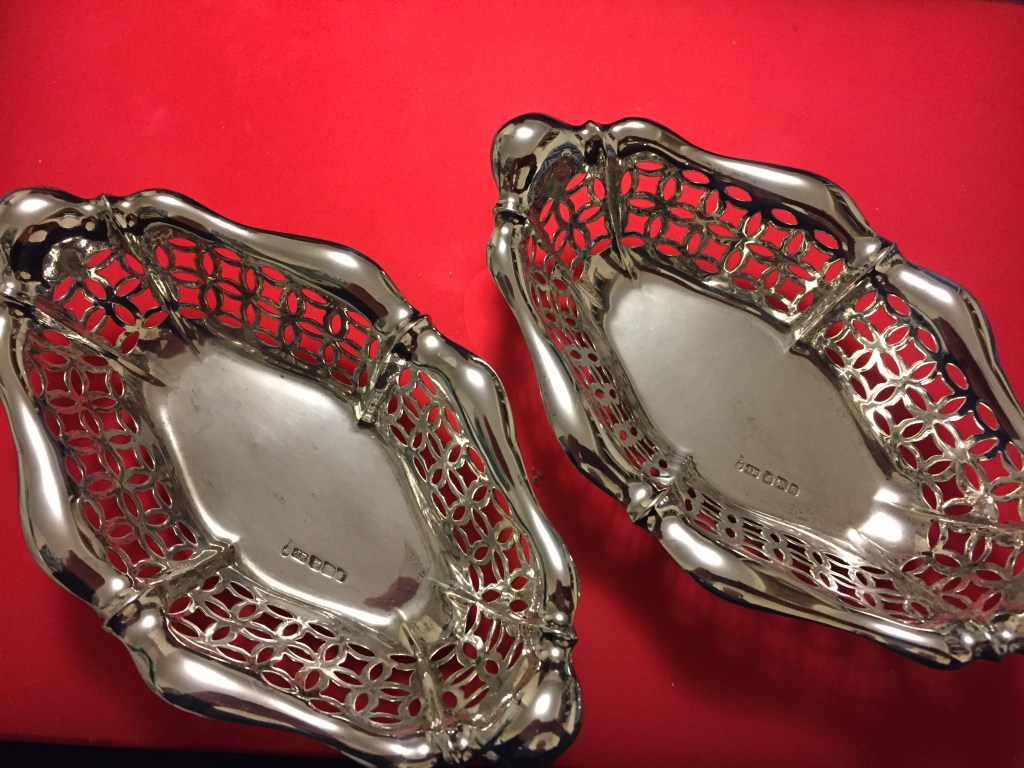
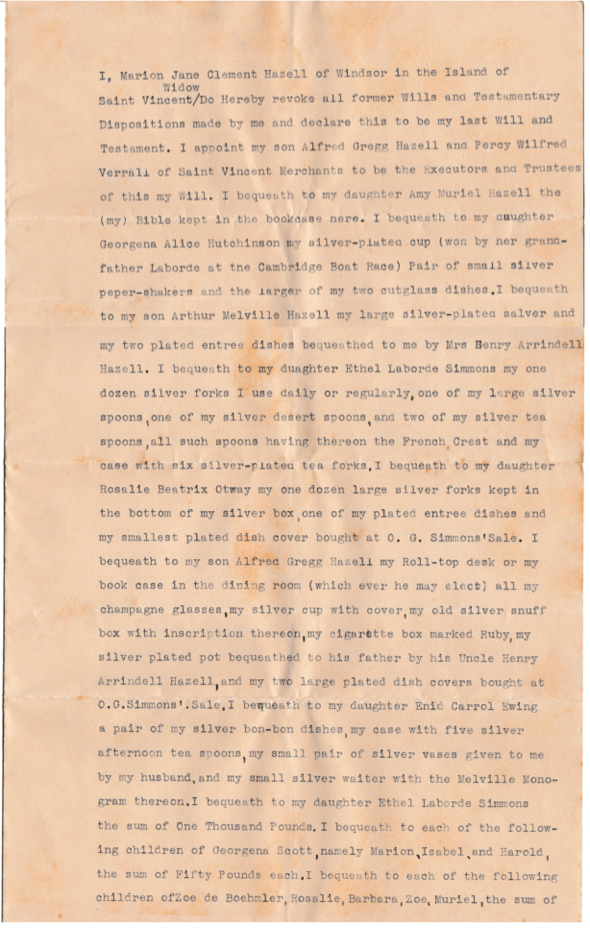
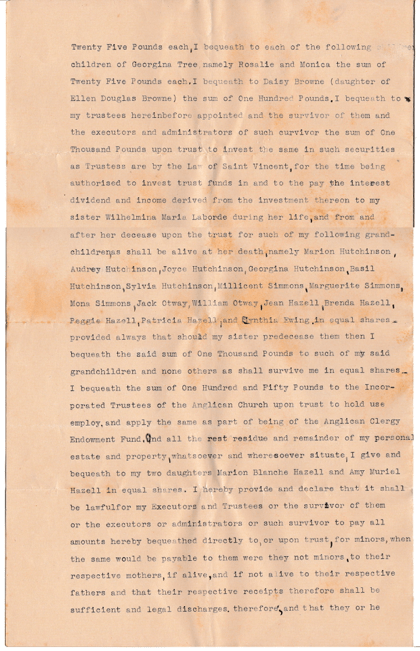


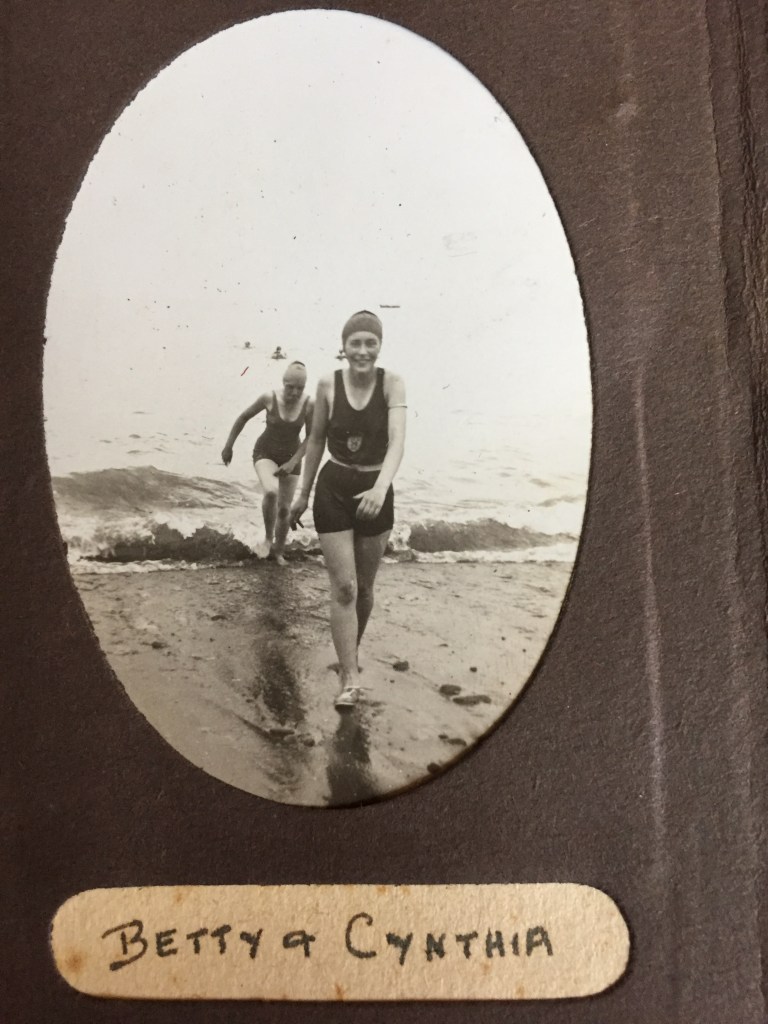
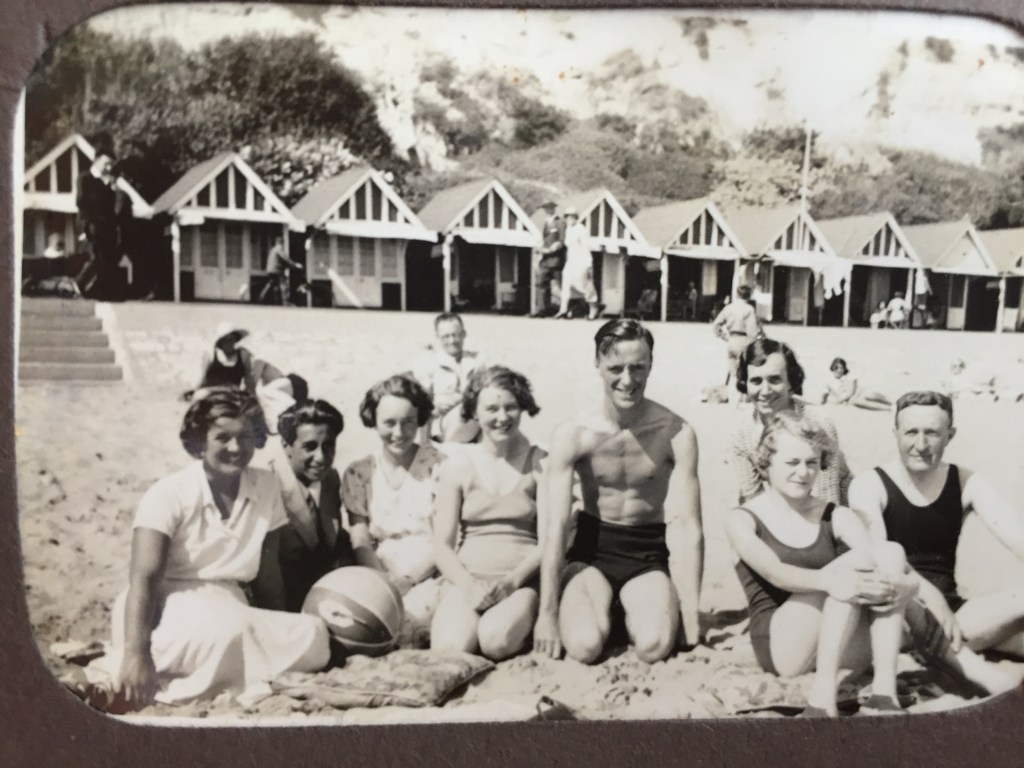


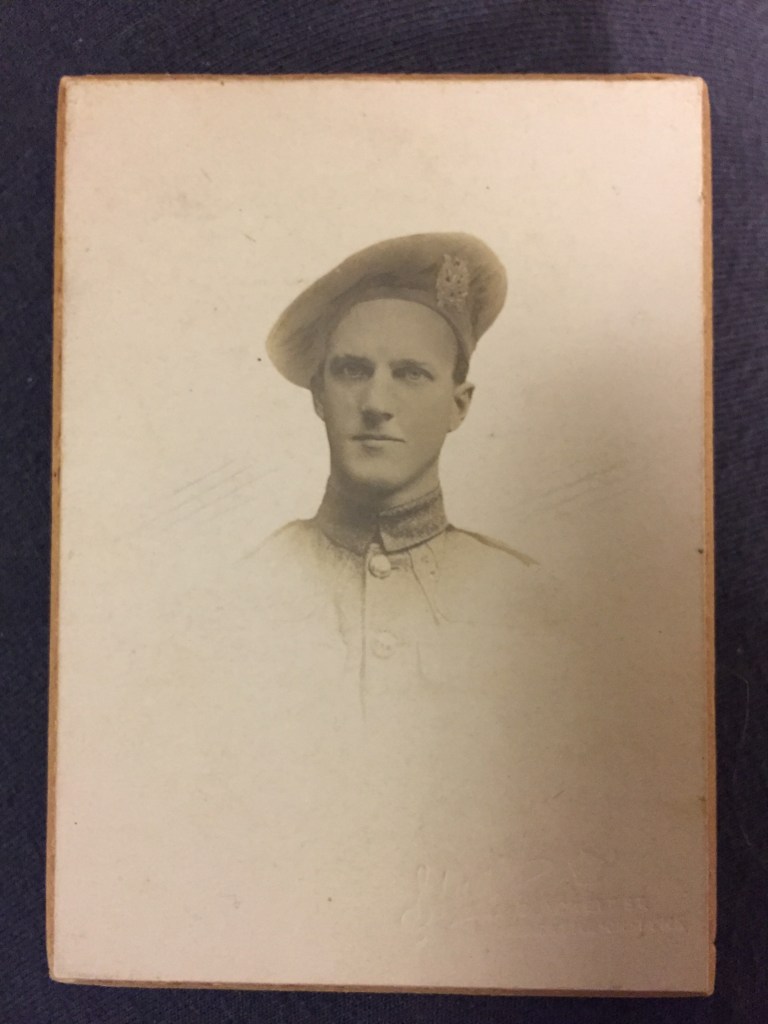
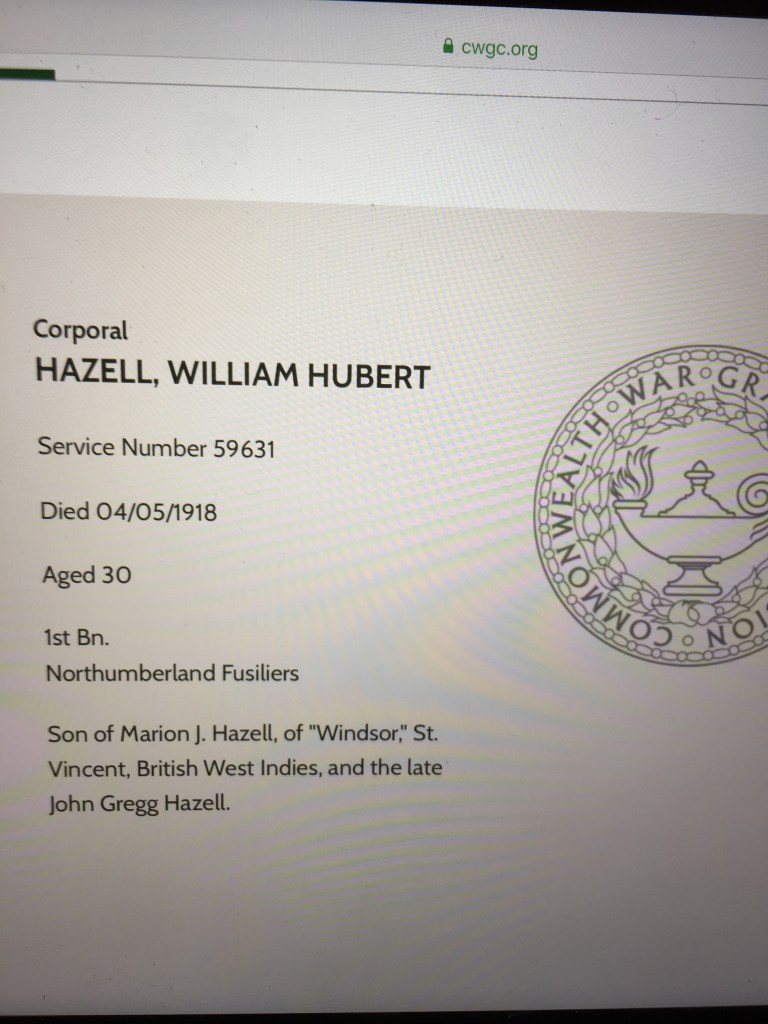
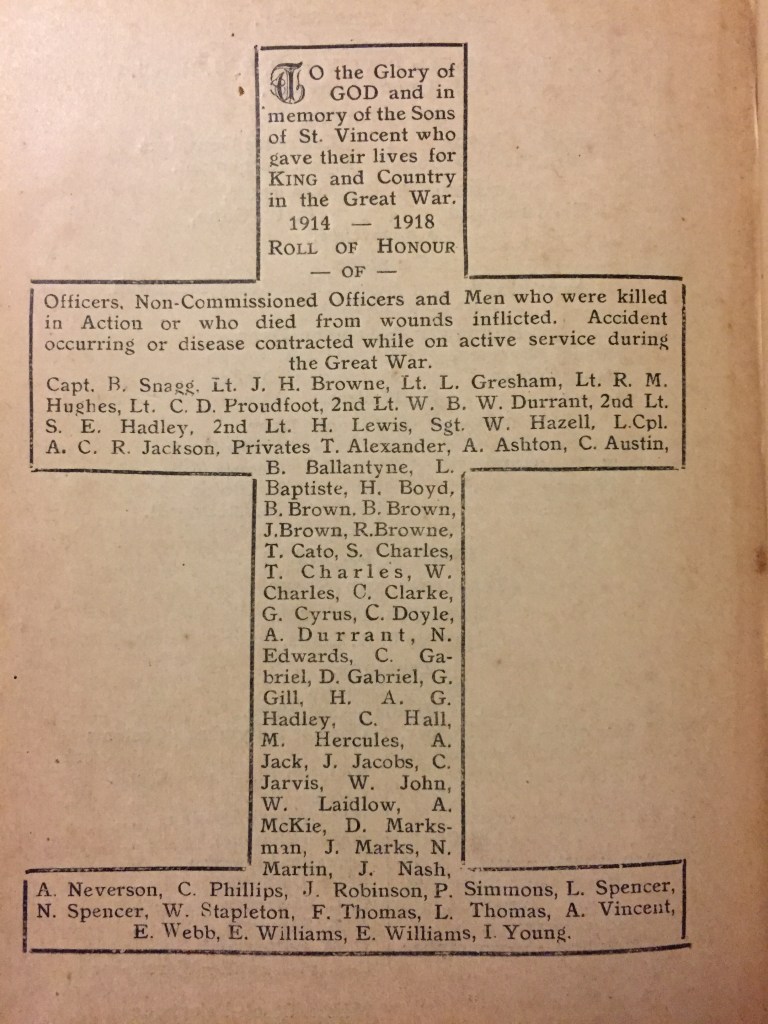


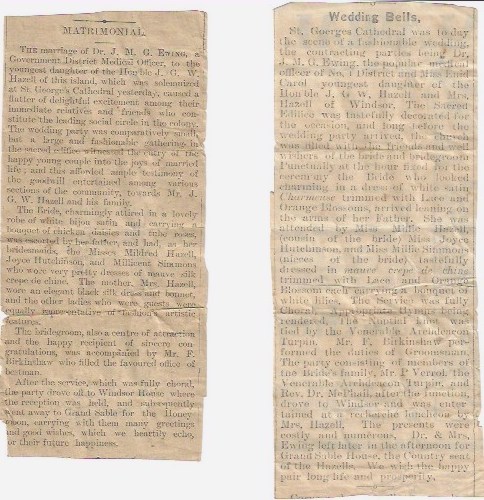
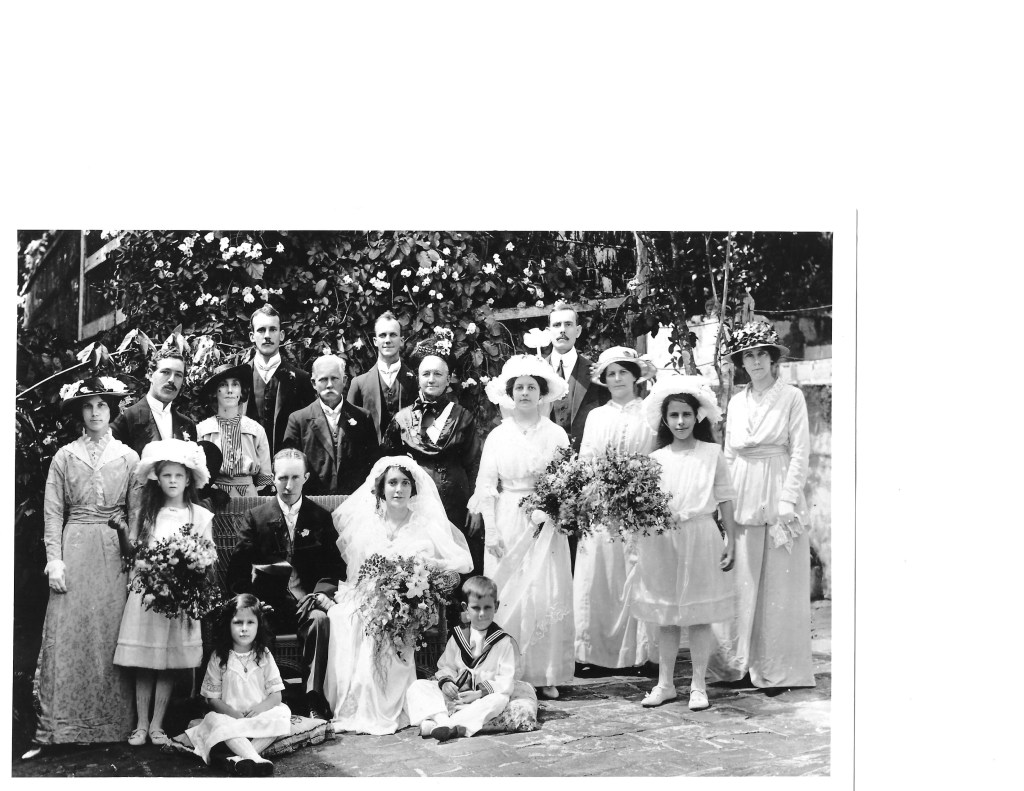

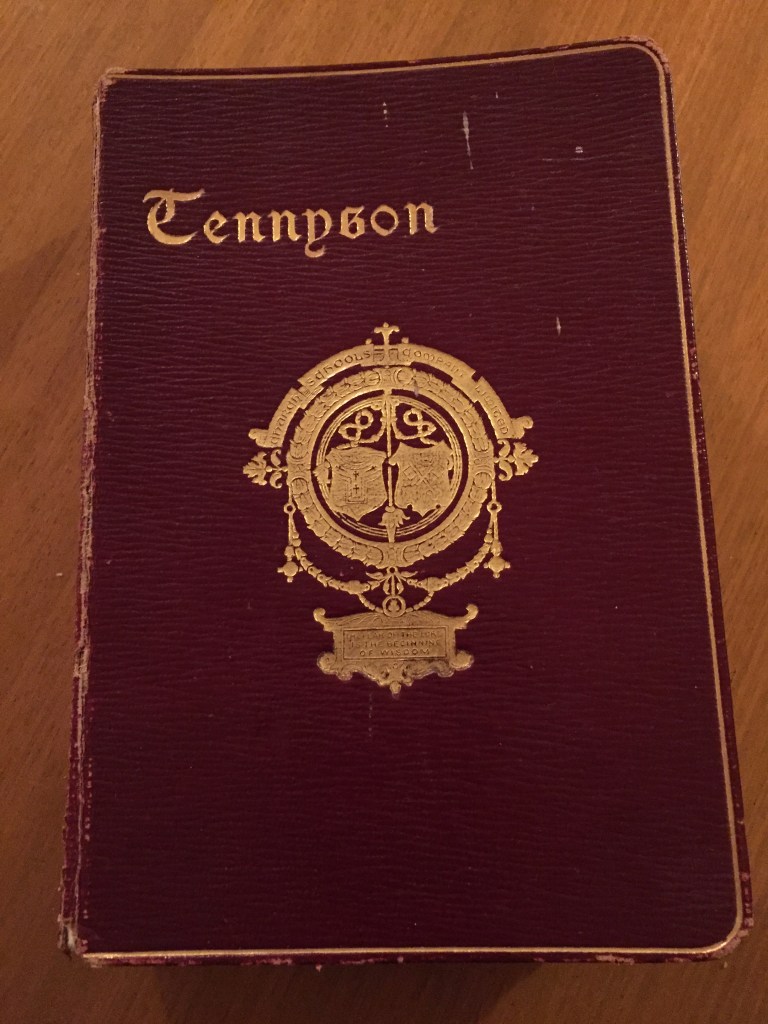

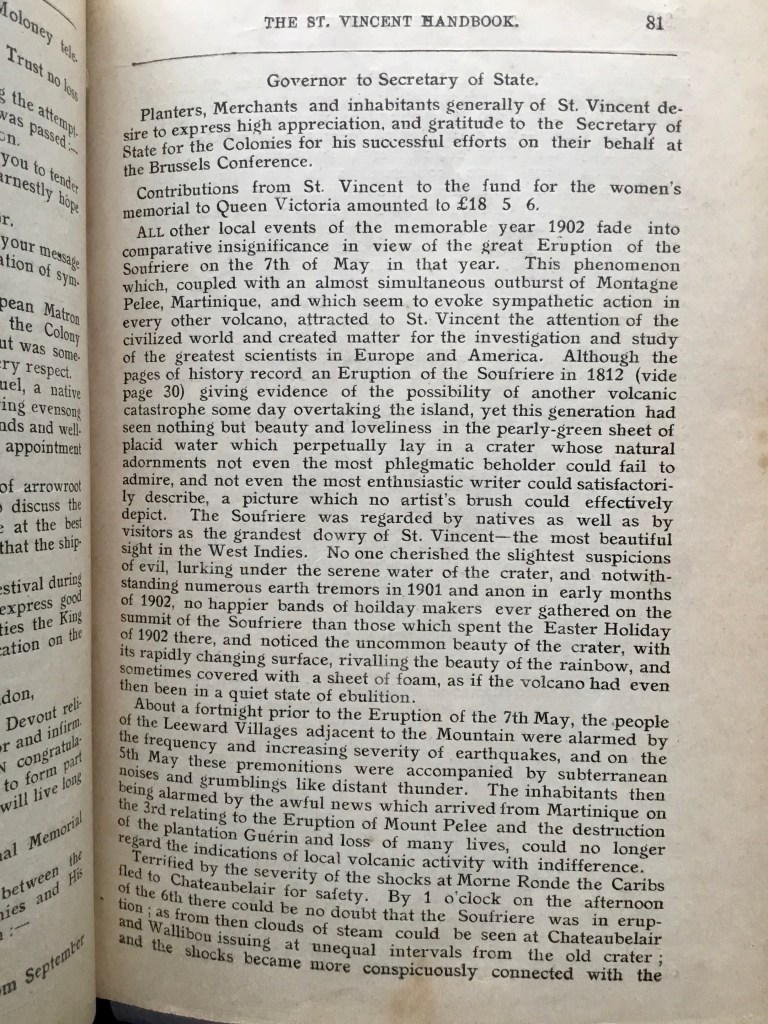
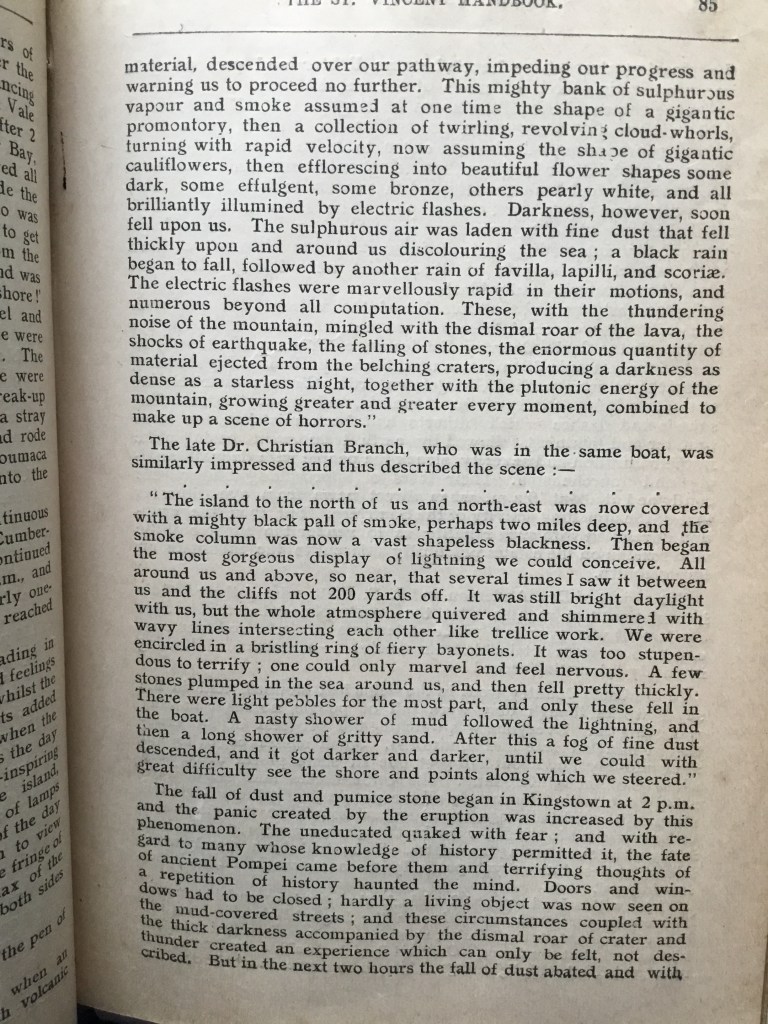
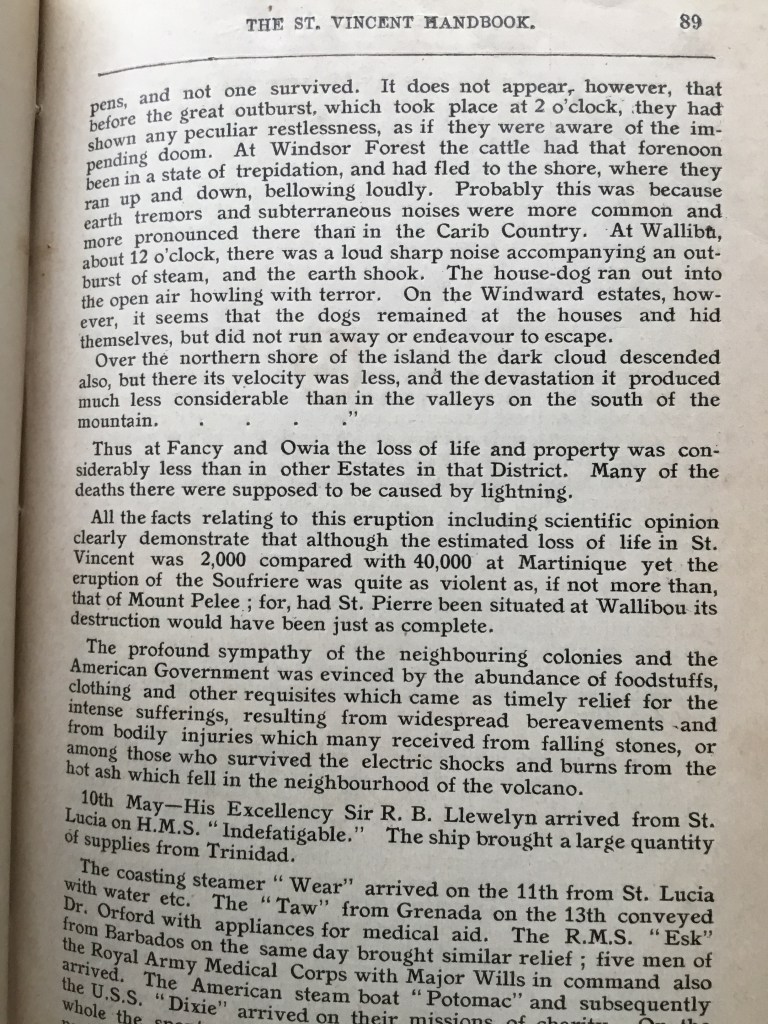
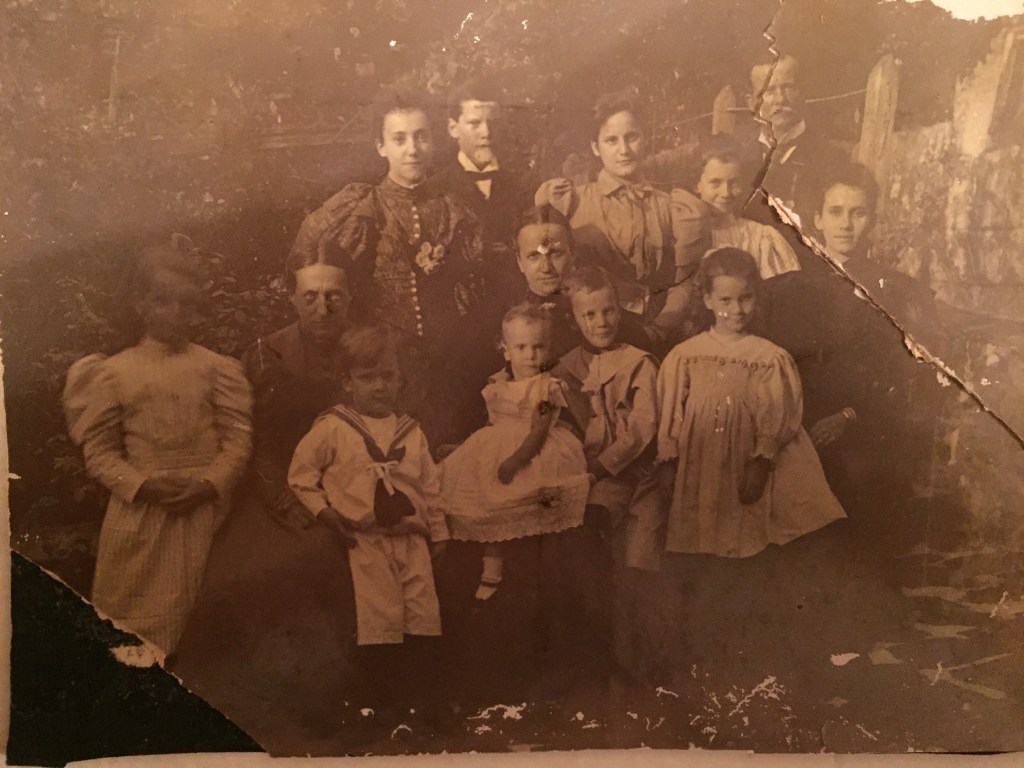

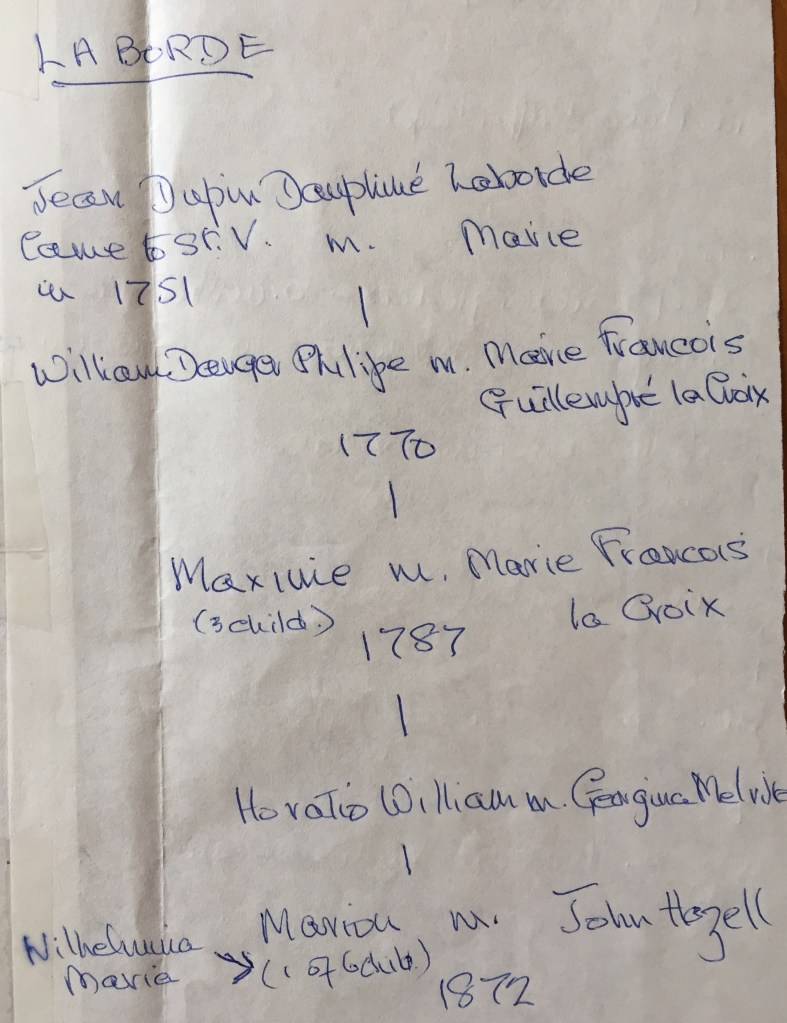
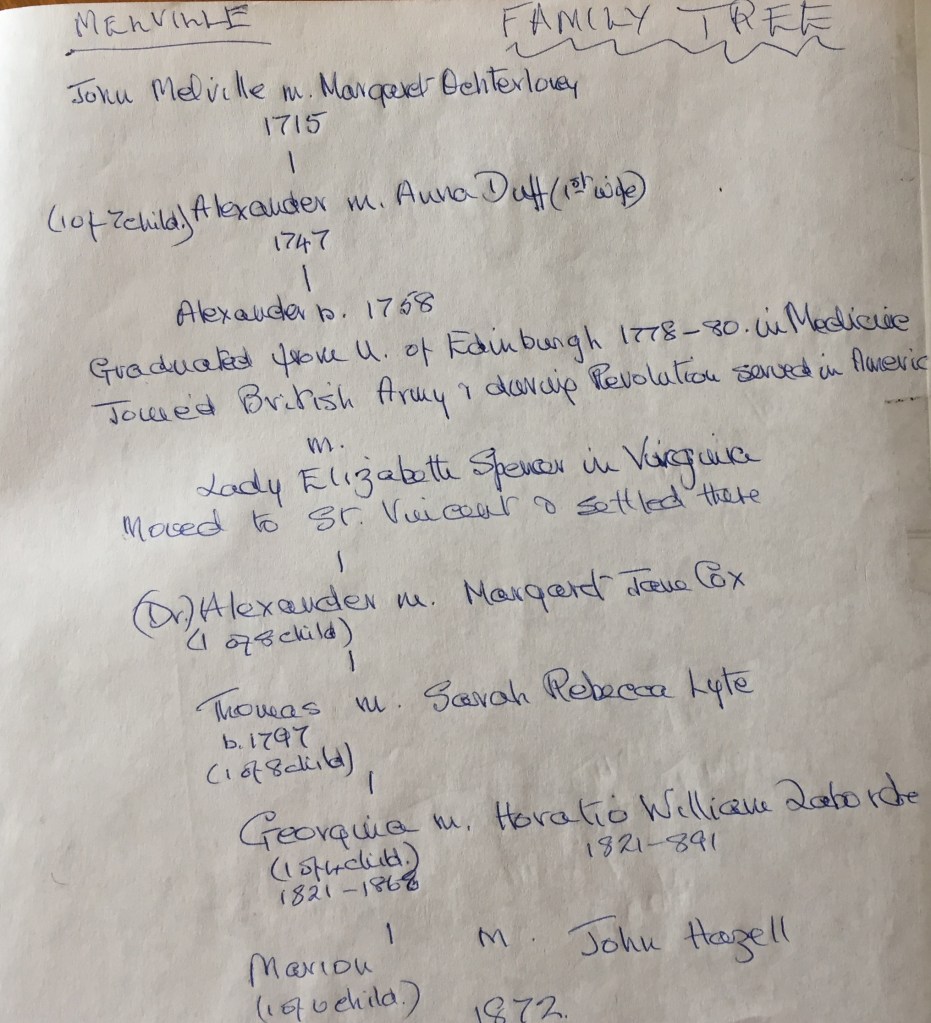
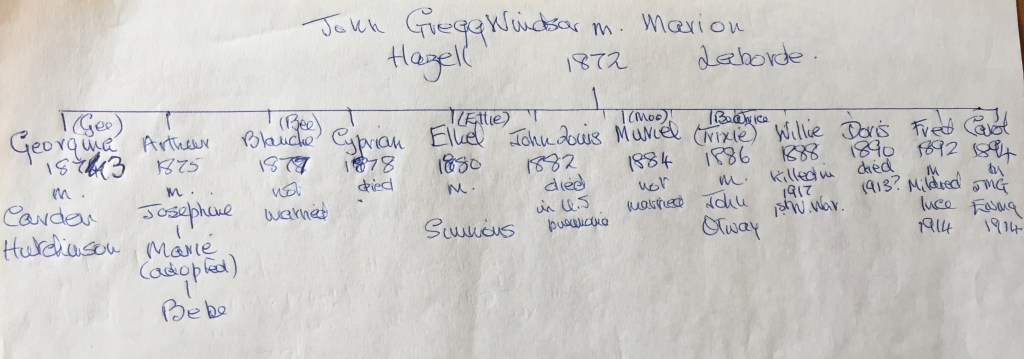


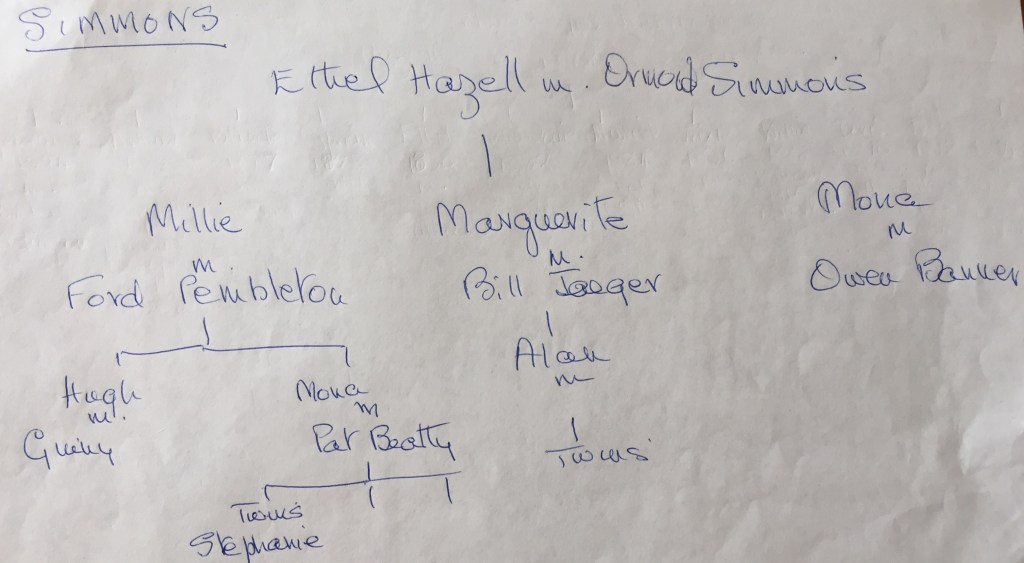

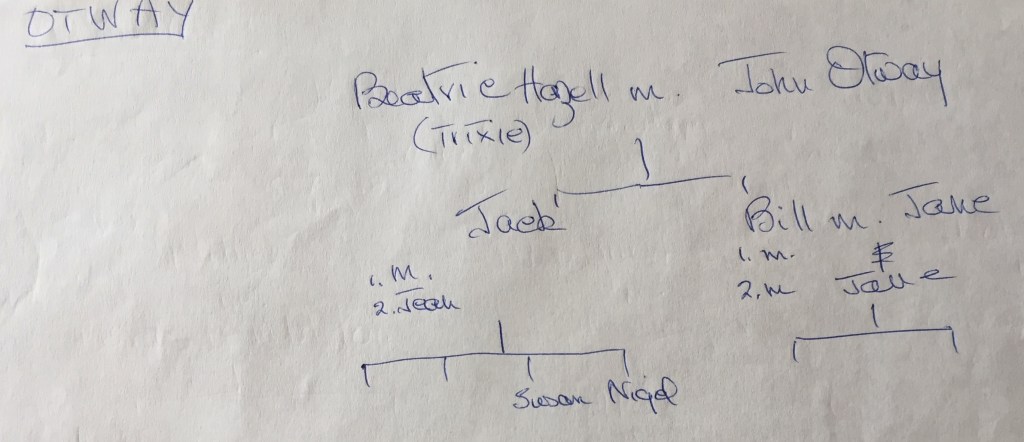
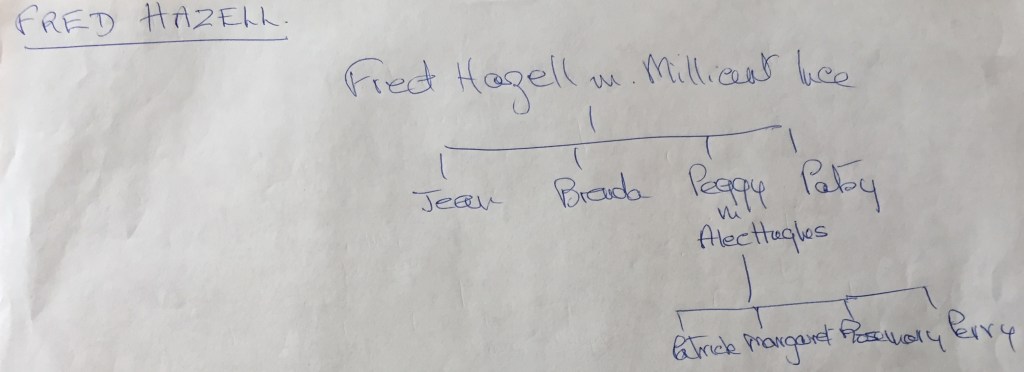
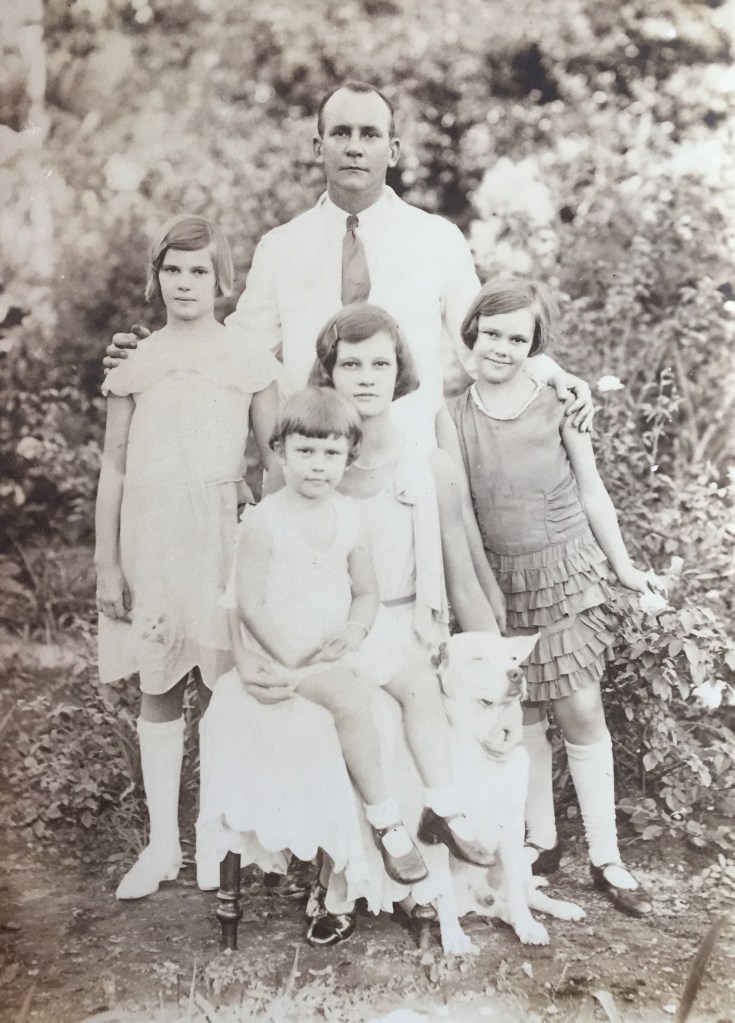
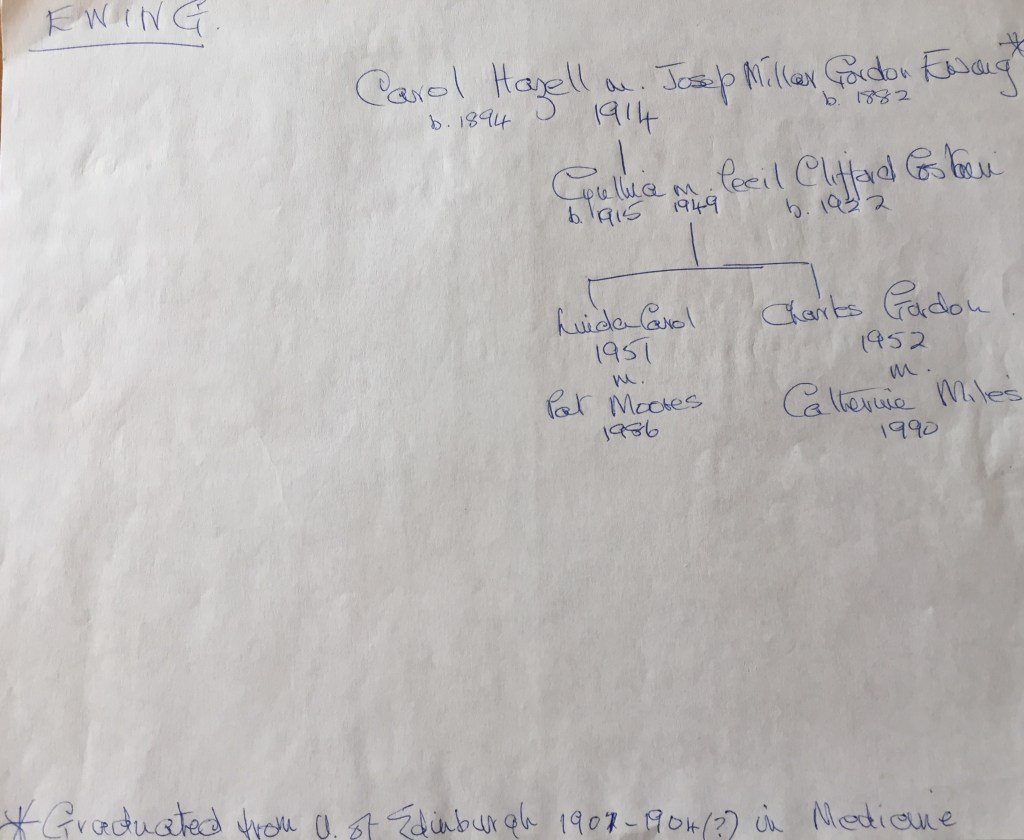
 A Family History in Letters