To England 1909

by Cynthia Costain

Carol sat on her bed and looked at her big cabin trunk. It was all packed and ready to be loaded onto the ship tomorrow morning when she, Dad, and Doris would set sail for England. Her clothes were lying on the top of the trunk; white cotton camisole, drawers and petticoat, navy blue skirt and sailor blouse, black stockings and strong, laced, black boots. Of course she didn’t run around with bare feet now she was fifteen, but those boots looked very hot and heavy.

Suddenly her heart felt as hot and heavy as those boots. Nearly three years ago Fred had gone to school in England and she had known that it would be her turn next. She had been breathlessly excited at the thought of England: seeing the wonderful sights of London, the palace where the King and Queen lived, the beautiful countryside; and eating an apple, all the things Fred wrote about in his letters home. Now she could smell the frangipani and orange blossom from the garden and feel the cool overnight breeze. Some of the family were still on the verandah and she could hear Mother’s voice. She wouldn’t see Mother for years, nor her brothers and sisters at home. She would be eighteen years old when she saw them all again. The enormity of it flooded over her and for the first time she realized what she was facing. When she had first heard that Doris was only coming for the ocean voyage and to see London, because she was delicate, she had been quite pleased because Doris could be so bossy, but now! How she wished they could spend those three long lonely years together. Slowly Carol got ready for bed and her last night at home.

In the morning all was rush and bustle. Sending trunks and other luggage down to the dock; trying to choke down breakfast; saying goodbye to the servants; and last of all hugging Mother with tears streaming down her cheeks. She clambered into the carriage with Dad and Doris, and Dad said, “You two can go on board straight away and get settled in your cabin. I want to talk to the Captain and make sure all the cargo is well stowed”. He kindly gave them each a little pat as Doris snuffled and Carol dried her eyes.

“How will we know which is our cabin?” Doris asked.

“Oh, someone will show you,” Dad said, and as the carriage stopped he jumped down and headed for the small boat waiting for them. He helped the girls in and then marched away. The boatman began slowly rowing them out to the steamer anchored off shore in deep water. It was an English steamship line which Father dealt with in his business to take sugar, cotton, arrowroot, and other island products to England, and to brings back all the goods which Hazell & Sons sold in their big store on the harbour.

Seen from Windsor on the hill above the town the ship had looked quite small, but as they came closer it seemed immense as the huge side towered above them.

“How will we ever get up there?” she whispered to Doris, thinking of the boys’ pirate stories and climbing up rope ladders or ropes. She was relieved to see a reasonable wooden ladder tethered to the ship’s side and a kind middle-aged officer coming to help them up. He showed them down to their cabin and explained that Dad was in the next one and that there were seven other passengers. The girls looked around the tiny neat cabin with two little bunks, one above the other. There was a cupboard and a small washstand with the basin sunk into the top and a chest of drawers with a mirror on the wall above. The porthole was open and peering out they could see the ocean with Bequia in the distance.

“We won’t have much room for clothes in here,” said Doris. “But your stuff is marked Not Wanted On Voyage anyway.”

“Let me have the top bunk, Doris” begged Carol. 

“With pleasure, my dear. I don’t fancy being tossed to the floor if we have a storm.”

“We won’t have a storm,” said Carol firmly. “Fred said that it was as smooth as going out fishing at Villa all the way over.”

Carol was regretting the heavy skirt and solid boots, and wished she had on a light cotton dress like Doris, but she had wanted to be an English schoolgirl at once. She decided that when their bags did arrive, she would change.

“Let’s go upstairs,” she said. ” We can see if Dad is on board yet.”

Up on deck they found Dad talking to one of the officers. There was much activity as the ship prepared to leave. The engines were rumbling, the ladder was stowed away, and slowly the ship began to turn while the sirens and whistles blew. On the dock they could see Willie and Muriel and Trixie waving, and up on the verandah at Windsor stood Mother, a little figure waving a white handkerchief. Before long the people, then the houses and mountains grew smaller and smaller until St. Vincent itself was just a speck on the horizon.

The girls enjoyed the voyage, and as Carol had predicted, there was no storm, although the sea became more boisterous as they entered the English Channel. The sky was clouded and their first sight of England was through a grey morning mist. As they sailed on, the sun came out and they caught glimpses of green fields and trees with villages and houses and finally Dad pointed out a line of whitish grey along the shore and said, “Look- those are the white cliffs of Dover.”

By afternoon they were sailing up the Thames to Tilbury Docks and the sun had disappeared behind sullen clouds. The girls stared at the huge busy river with its crowds of boats, tugs, ships, and barges. Looking at the great dirty river and the dark, grimy warehouses and buildings along each shore, the girls could hardly believe that this was London.

With many attendant tugs and loud hoots and whistles they were at last firmly fastened to the dock and the ship’s engines were still. All the passengers had been ready for hours and looking down, Carol could see there were friends and relatives waiting below.

“Where’s Fred?” she asked Dad.

He grunted. “Fred is still in school- we’ll see him in a few days. Now I’m going to take you girls onto the dock. Our luggage should be there very soon, and you can stay with it until I see to Customs and the rest of the paperwork.”

By this time there was a thin drizzle falling and it was beginning to get dark. The girls sat quietly on the trunks in the shelter and waited- neither of them had much to say. Dad seemed to be a very long time and they were getting hungry and chilled when he came with a cab and hurried them off to the hotel.

At first the streets were narrow and cobbled, crowded with carts, barrows, and poorly dressed people. There were tiny, dirty houses on each side with women standing in the doorways and children huddled out of the rain. Gradually they came to wider, smoother streets and the horses were able to go faster, the street lamps were beginning to shine on the greasy pavement and the shops were brightly lit. The houses they passed were bigger but still tightly crowded together, with no trees or gardens to be seen anywhere. The girls just sat and looked out of the cab windows- houses, horses, people, lights, and noise- it was a terrifying new world. After along time they drove into quieter streets and pulled up at a small hotel. As they entered the pleasant, lit hallway, an imposing man came forward and greeted Dad warmly as a well remembered guest.

“I’m very pleased to welcome the young ladies,” he said. “Your rooms are ready and dinner is just being served in the dining room. Billy, show Mr. Hazell and his daughters to Rooms 16 and 17.”

Upstairs and along a corridor they followed the small bell boy and were shown into a large bedroom. Billy struck a match and lit a gas lamp on a bracket by the wall and the bright light showed them a big bed and heavy dark furniture with red plush curtains across the windows. Dad was in a room opposite and called to them, “Hurry up and wash, and then we will go down to dinner.”

Following Dad downstairs Carol thought, “I’m going out to dinner in a hotel with strange people. I’ll never be able to eat a bite.” But when they were seated at a comfortable table with white linen and shining silver, she discovered that all the people were far too busy eating to look at her, so she was able to enjoy the roast beef and Yorkshire pudding which Dad decided was the proper thing for their first dinner in England.

Later, they sleepily unpacked and washed in the hot water the maid had brought up in a shining copper jug.

Doris got into bed first and said, “Pull back the curtains, Monks, and see if the window is open. It’s sort of stuffy in here.”

Carol pushed the heavy curtains aside and said, “Yes, the window is open, but I think the smell is just London. How do I put out this light? I’ll have to climb on a chair to reach it. I never saw a gas light before.”

“Oh, just blow it out, the same as the lamp at home,” said Doris, who had never seen a gas lamp either.

The girls slept soundly, so soundly that the chambermaid’s knock did not waken them and Dad finally marched in at 8:30 a.m. to see why they weren’t ready for breakfast.

The gas fumes were faint since the windows had been open, but the girls were hastily wakened up and roundly scolded by Dad, the chambermaid and later, the Manager. “Don’t you girls know anything?” said Dad.
Party Time

by Cynthia Costain

Father and Mother were having a very special dinner party.  The Cotton Growers Association had awarded Grandsable the First Prize and Silver Medal for producing the best cotton grown on the Island.  Father was delighted that cotton was doing so well on this estate, as it was a new venture, and not only was it doing well but the staple was exceptionally long and fine.  [The staple was the measurement of cotton fibre: later known as Sea Island Cotton.].  To celebrate, he had invited all his friends in the Government and the Association to come to dinner, and the household was in a state of excited turmoil.

By 8 o’clock, the guests and older members of the family were congregated on the verandah and Willie, Doris, Fred and Carol were hiding on the little balcony at the end of the house, invisible in the darkness but enjoying a fine view of the sparkling lamplit scene below.

“Doesn’t Muriel look beautiful in her blue dress?” whispered Carol.  Muriel was not long home from school in Canada and had fashionable new clothes.

“I don’t think Muriel is really beautiful,’ said Doris, “her nose turns up too much but she has nice blue eyes.”

“Well, perhaps so.  Ettie is really the prettiest and look how Mr. Cameron is flirting with her!”

“That old fellow,” said Fred.  “Ettie wouldn’t flirt with him.”

“He’s the Administrator,” said Doris. “And everyone has to be polite to him.”

“And he has a big fat wife,” added Willie.  “but she’s too busy talking to old Popham Lobb to notice.”

I don’t think old ladies should wear bright flowered dresses like that, “said Doris.  “Mother always wears black and looks lovely.”

The girls continued to whisper about the ladies’ dresses but the boys were interested in watching Leo, Dad’s man, acting as bartender.  He was mixing and shaking the new American cocktails in a big silver shaker and filling the little crystal glasses with lovely frothy pink liquid.

“I wonder what it tastes like?” whispered Willie.

“It looks so pretty,” said Carol.  “And it must taste good- see how often Leo goes around and fills the glasses.”

The lamps glowed on the ladies’ soft silk dresses and the white jackets of the men, while the talk and laughter mingled with the fragrance of the jasmine climbing up the railing.  At last dinner was announced and they all drifted into the big dining room at the end of the hall.

The children could see no more, but Fred and Willie were still curious about the pink cocktail.  The maids were busy serving dinner and the glasses on the tables remained in plain view.

“Come on, Fred,” said Willie quietly.  “If we go downstairs and walk along underneath, we can get onto the verandah with no one seeing us.”

“We’re coming too,” said Carol and Doris.

The four of them crept quietly down the steps, through the garden, and up onto the abandoned verandah.  Still shining in the lamplight was the cocktail shaker and all the pretty glasses- some empty, but many still holding the remains of that delightful froth.

“Look,” said Willie.  “Aunt Min didn’t finish hers,” and picking up the glass he took a careful sip. “M-m-m.  It’s good,” and with no hesitation he drank the rest.

“Let me try,” said Fred, picking up a glass, and before long, the girls joined in and they were all draining the glasses and giggling as the grenadine-sweet liquor disappeared.

Suddenly they heard Father’s voice calling to Leo to bring more wine, and afraid he would come to the verandah they all rushed to the steps and tumbled down.  At least Doris tumbled over Willie and landed in a heap at the bottom.  She was too scared to yell, but she whimpered, “Oh my nose, my nose,” as Carol and the boys dragged her into the house and they scuttled along the passage to bed.

Next morning was Sunday and because of the party, things were not as calm and organized as usual.  The children had breakfast alone and so it was not until the family gathered for Church that anyone noticed Doris’s nose.  That normally unobtrusive feature was twice its usual size and a bright red.

“My goodness, child,” said Blanche, “what have you done to your nose?”

“Oh, Dolly tripped on the stairs last night and banged it on the bannister,” said Willie quickly.

“Why didn’t you tell me sooner, Doris,” said Mother.  “It is too late now, but this afternoon you must lie down.  You really look a sight.”

Doris glared at Willie, and Carol felt rather pleased.  Doris was always the pretty one and had a blue sash and ribbons, and she always had to wear that awful pink which she hated. 

The whole family took up two pews at the front of the Cathedral and the service was very long.  Carol looked at the flowers on the altar which her sisters did every week- white spider lilies with blue jacaranda and pink ixora today- it was hard to fill the vases when it was so dry.  She looked at the memorial tablets on the wall and read over the names and tried to remember if they were great-great or great grandparents, until she felt a sudden poke and a muttered “Wake up!”  She certainly had slept soundly last night and maybe she was still feeling sleepy.  She tried to listen to the sermon but Archdeacon Turpin was very boring.

The girls drove home with Mother in the carriage, and they all rested on the verandah, restored to its usual everyday appearance.  The boys soon arrived, hot and sweaty after climbing the hill, and Doris grabbed Willie in a corner.  

“I’m going to tell.  I’m going to tell Mother,” she muttered.  “It was bad to drink that pink stuff.”

“If you tell,” said Willie, “I’ll say you fell downstairs because you were DRUNK!” as they all went into the dining room for lunch.

Doris spent the afternoon lying down with a cold compress on her nose.  But she didn’t tell.

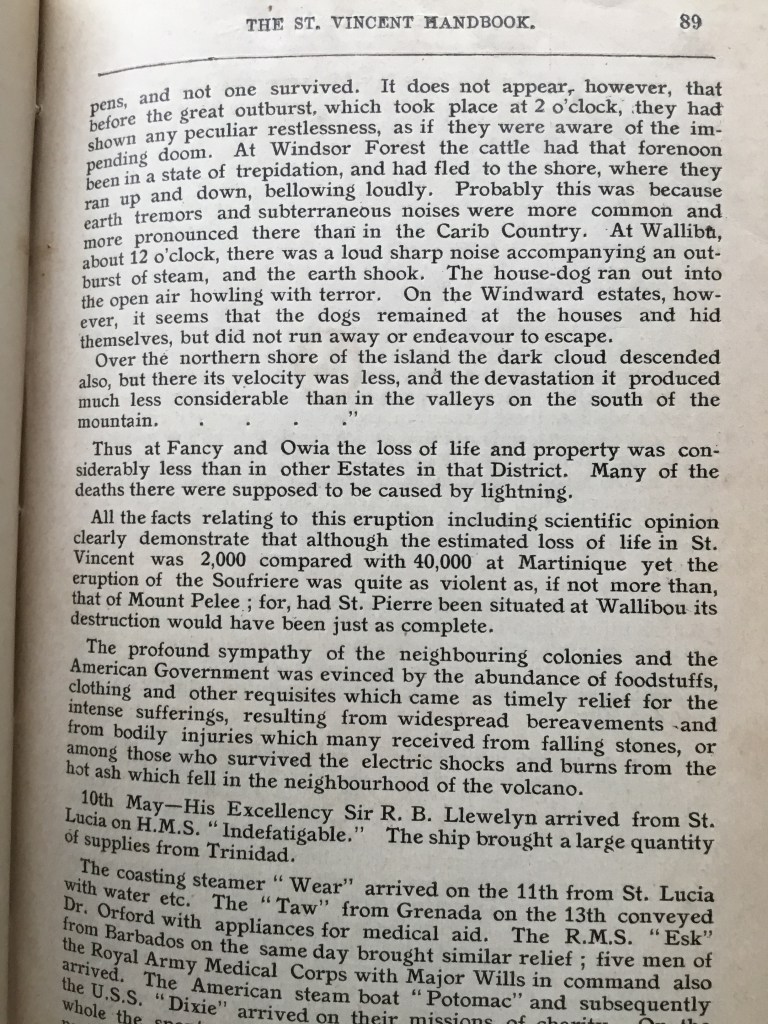
The Eruption 1902

The year was 1902; Queen Victoria was dead, and the people in St. Vincent now had a King instead of a Queen. The Hazell children were growing up, and 8-year old Carol went to school with Miss Matthews in town. One afternoon she and Fred crept through the garden to the stable yard. A market woman had given them each a mango and they leant over a wall and enjoyed the luscious fruit, dripping juice onto the garden below. They knew what would happen if they were caught: those mangoes are green – look at the mess you have made of your clothes – you’ll get a stomach ache! It wasn’t easy being the youngest of a large family and they did love mangoes!

“We’d better go and wash,” said Carol, looking at her brother’s sticky grime-streaked face. “How did you get so dirty?”

“Your’s is just as bad,” he replied. “It’s because it’s so dusty. Look, you can’t see the sun at all- the sky looks like dirty milk.”

They looked over the garden and down the hill to the harbour and town, but the dust seemed to get into their eyes and everything was hazy. They adjourned to the pump in the stable yard.  Cleaner but damper, Carol went to join her older sisters and her Mother on the verandah. She was learning to sew and as much as she enjoyed being with “the big girls” and hearing the grown up chat and gossip, the long seams of the pillowcase she was making were very boring, and she couldn’t help pricking her finger and getting her thread dirty. Her sisters were doing beautiful embroidery and crochet, but it would be a long time before she could attempt such things. This time, however, they were all getting up and putting away their work as she arrived, shaking dust from their long skirts.

“Come on Carol,” said Ettie “We’re going inside. It’s too dusty to work out here today. Look at the dust on my blouse, and yet it isn’t very windy.”

“It’s not wind – the dust just seems to be drifting down,” said Muriel. “I wonder where it’s coming from.” 

They were to wonder more as the dust grew thicker and the sky darkened. Next morning there was no sign of sunrise and it was like a queer twilight. The gritty dust was everywhere, in the house, in the air you breathed, and floating on the morning cup of tea. The servants were very quiet, with none of the usual talk and laughter, and the children felt scared because everything was so strange.

Dad and the men and boys set off for town, but Mother told Carol she could stay at home this morning. She couldn’t even feel pleased at the unexpected holiday, especially as Trixie told her to dust all the dining room furniture- What was the point? It got dusty again as she did it. She stopped to look out at the sky and suddenly saw her brother Willie tearing up the driveway, with Fred, red-faced and puffing, not far behind.

Leaning out of the window she called “What are you doing? Didn’t you go to school?”

“There’s been a big eruption in Martinique!” yelled Willie.

“School’s closed!” shouted Fred, and as they tumbled up the steps, there was the clatter of horses’ hoofs and Dad came riding up from town and into the stable yard. Carol could hear Mother’s voice in the kitchen and the sound of Dad marching in. He was sweating and the dust stuck in the lines of his face, making him look like a stranger.

“Jack, what is the matter?” asked Mother. He sank into a chair and tried to wipe the dust and sweat from his face.

“Mount Pelee has erupted on Martinique- a really big blow! They say the town of St. Pierre has been destroyed and perhaps everyone killed.”

“How terrible,” said Mother. “The poor people in Martinique.”

“The shock must have been devastating for the whole island,” said Dad, and as he spoke they suddenly felt a reverberation like a ripple go through the floor and heard in the distance a series of dull thuds. They stayed frozen for a moment, each with the same thought: “What about the Soufriere?”

“I’m going back to town,” said Dad. “See if I can get any news from up country.”

Mother looked pale, but she said, “Come and eat your soup, Jack. You don’t know how long you will be, and the servants would like to get the meal over with.”

No one ate with much appetite as even Carol knew that the Soufriere was their volcano at the northern end of St. Vincent, and that if one volcano erupted it was quite possible for another to do the same. The Soufriere had been dormant for nearly a hundred years and it was right at the other end of the island. But St. Vincent is only 18 miles long.

The young ones crept away and gathered under the porch and the boys tried to scare the girls with horror stories of what they imagined was happening in Martinique. Of course, nothing like that would ever happen in St. Vincent! The adults were not so hopeful. They admitted to each other that a friend from an estate up there had said that the water in the crater had risen and had begun to steam, and John Louis had met George Fraser in town one day who had told him that the earth tremors had been frequent on the Leeward coast, some quite violent, but still!  It couldn’t happen here.

The island is so mountainous, and the roads were narrow and twisting, so communication was poor. While the people in Kingstown talked of the terrible news from Martinique, and the estate owners on the Windward Coast took no notice of the small tremors and could not see the mountains for the heavy clouds of dust, the people on the Leeward side of the island felt the earthquakes becoming more violent and the rumblings from the volcano more frightening and they realised that like Mount Pelee, the Soufriere was erupting. Many of the Caribs and others from the villages at the base of the mountain fled to the sea and the coastal villages of Wallabou and Chateaubelair prepared to leave.

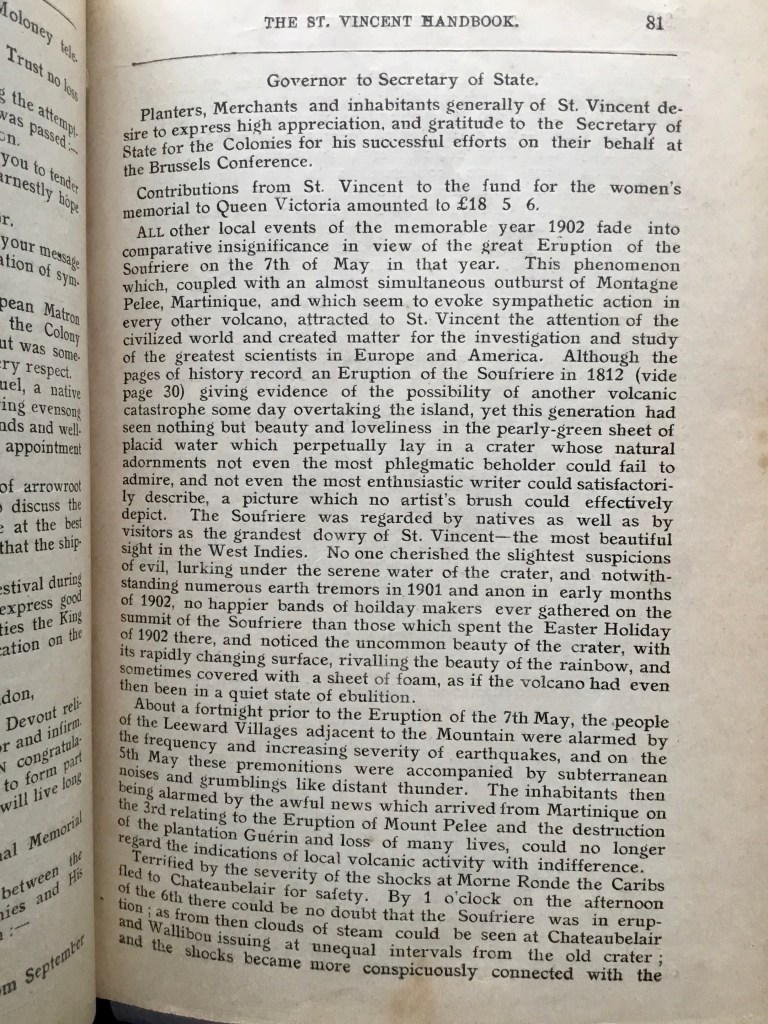
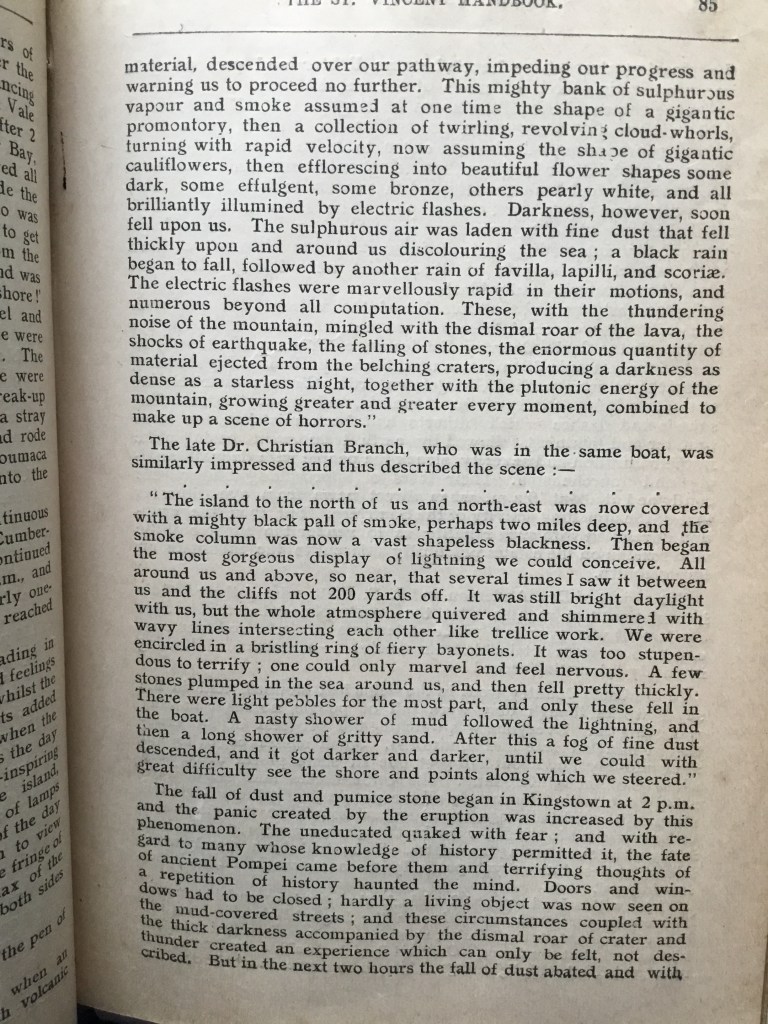
Next day, the 7th of May, continued dark and gloomy with the dust from Mount Pelee still falling over the town. The men had gone to town but the children were at home, bored and cross. Suddenly just as it neared midday there was a terrible explosion and a huge black volcanic cloud rose in the north and spread across the sky. Everyone dashed outside to see, but there were great crashing noises and loud rumbles and explosions, so hastily the children were called in and the men servants began to put up the shutters as clouds of ashes with big stones and lumps of solidified lava poured down over the whole island. The family huddled downstairs while through the cracks in the shutters they could see constant vivid flashes of lightning and great roars of thunder. Carol clutched Ettie’s hand and tried to be brave; she wouldn’t let Willie and Fred see her cry. All the servants were huddled in with them and some of the maids were crying. Mother looked pale but Mother would never be frightened. They could hear rocks and big boulders crashing on the roof and Mother just began to say, “I think we should all go down into the cellar,” when the back door blew open and Dad and the other men burst in. They had been on their way home when they heard the first huge eruption so had struggled on, battered with stones and covered with ash but nothing more serious. Dad herded them all downstairs until the bangs and crashes became less frequent. The air in the cellar got so full of dust and smoke and the pungent smell of sulphur, that Dad finally told everyone to go upstairs, but try to keep everything closed as much as possible. Black darkness covered the town while the roar of the volcano continued.  Rocks, ash, and cinders fell to be mixed with rain into a glutinous mud. Not a living thing ventured out into the maelstrom.

Eventually the storm lessened and there were fewer falls of rocks. People crept outside and tried to see how much damage had been done. The family began to clear the dust and ash from the veranda while the men rode down to the harbour on horseback through the muddy littered streets. The young people began to shovel mud from the paths and the sky gradually became a little clearer. Down at the harbour Father and the other men saw through the dusk a small boat sailing from the Leeward and entering the harbour. It was crowded with survivors from Chateaubelair with stories of the terrible destruction which had taken place.

No telephones were working and there was no news from the Windward side of the island so next day when the light was better, Father and some of the men decided to sail up north and see what had happened there. Willie and Fred went down to the harbour to see them set sail, but it was still too dusty and grey for Carol to see them from the verandah. They were away all day and just as there was a faint rim of sunset on the horizon for the first time in a week, they slipped back into the harbour. The family waited quietly at home as one of the boys rode down with a horse for Father, and at last they came wearily up the hill. Carol took one look at Father and knew that something dreadful had happened. His face was tear-stained and dirty and he looked like a very old man.  Mother said quietly, “Come Jack, have a bath, and after you’ve had a drink and something to eat you can tell us what happened. We know it is bad news.”

After a silent supper Dad stretched out tiredly in his chair and told them. “We sailed up past Georgetown,” he said, ” and the sky was a bit clearer but we couldn’t see any people or anything going on so when we came to that little jetty at Orange Hill we decided to anchor and walk up to the Fraser’s house. Everything was quiet- not a sound of a goat or a bird or a cow, and no one in the fields that we could see. At the house I saw someone sitting on a chair and then another person on the steps. We ran up, but we need not have hurried. George and Flora – both quite dead. We went into the house – nobody there, but down in the cellar – my God! It was packed with the servants and the people from the estate and their families. All dead from gas. You could smell it still and we were glad to get out in the air again. We thought that George and Flora must have found the cellar very crowded and come upstairs to have a breath of air just as the gas rolled down the mountain. There were rocks and stones and lumps of lava everywhere but from what I could see the gas has killed every man, woman and child for miles around as well as animals. Some of the horses had been penned in the fields with the cattle and it looked as if they had been struck by lightning. I never saw more horrible sights.”

A Mr. MacDonald who had been at Richmond Vale close to the volcano was one of the people who had watched and recorded the whole terrible event from 7:30 p. m. on May 6th to 6:00 p. m. on May 7th when he had to retreat to Chateaubelair. He wrote a vivid account of the whole destruction during that time. In Martinique molten lava was the killer. In St. Vincent the eruption was quite as violent if not more so as the explosion blew the whole top of the old volcano away and made another new crater. The gas ejected from the crater and the force of the falling rocks and lava made a “vast graveyard where 2000 bodies are buried under hills of ash and rock”.  The fertile valleys and Carib villages were gone.

The young Hazells were very subdued for a while, but it wasn’t too long before Fred and Willie were arguing about how many people would have been killed in Kingstown if the Soufriere had been as close as Mount Pellee had been to St. Pierre.

“There were 40,000 killed in Martinique,” said Willie. “I bet there would have been 50,000 here!”

“More!” shouted Carol. “Fifty thousand and two counting you two horrid things!”

(Quotation: Governor’s Report to the Secretary of State for the Colonies)

Hazell/Laborde/Melville Genealogy

Hazell Family Genealogy

(as written by my mother in a scrappy notebook and interpreted by me.  I include (nasty) little details that were part of oral family history that she noted in the list in square brackets.)

Two Hazell brothers came from Liverpool to Saba with their wives.  Went from Saba to Bequia where they settled. 

Hercules Hazell b. 1749 in Saba d. 1833

Elizabeth Simmons 1785-1848 (I’m inclined to think these are the dates of her marriage and death)

m.

|

Hercules Hazell

m. 1809

Eliza Gregg, his cousin, daughter of Mary Hazell

|

John Hercules (seven children in total, the rest apparently not relevant)

m. July 25 1840   Married in Bequia.

Jane Anne Arrindel [Her father had slaves and when they did something he didn’t like he stamped on their feet.]

John was drowned in Mustique 1886.

|

John Gregg Windsor Hazell 1848-1915 (again, one of 7 children)

m. 1872

Marion Laborde

|

Alfred Gregg Hazell (Uncle Fred) (one of 12 children, dates to follow)

m. 1914

Mildred Ince

|

4 daughters, Jean, Brenda, Peggy, Patsy- my mother’s cousins.  (Not sure why my mother’s list had Fred, the youngest son, in the line of succession, but he was the one who inherited the business, having stayed in St. Vincent.)

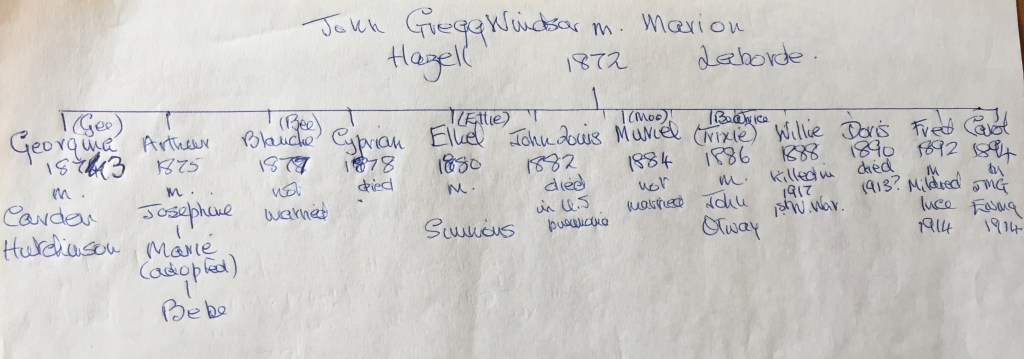
The 12 Hazell children of JGWH and Marion Laborde:

Georgina 1873 (Auntie Gee)

Arthur 1875 (Uncle Artie?)

Blanche 1877 (Auntie Bee)

Ethel 1878 (Aunt Ettie)

Cyprian 1880 Died in infancy?

John Louis 1882 Died as a young man?

Muriel 1884 (Auntie Moo)

Trixie 1886

Willie 1888 Died 1918 in WW1, Loos I think

Doris 1890 Is she the one who died in 3 days of a stye?

Fred 1892 (Uncle Fred)

Carol 1894 My Grandmother

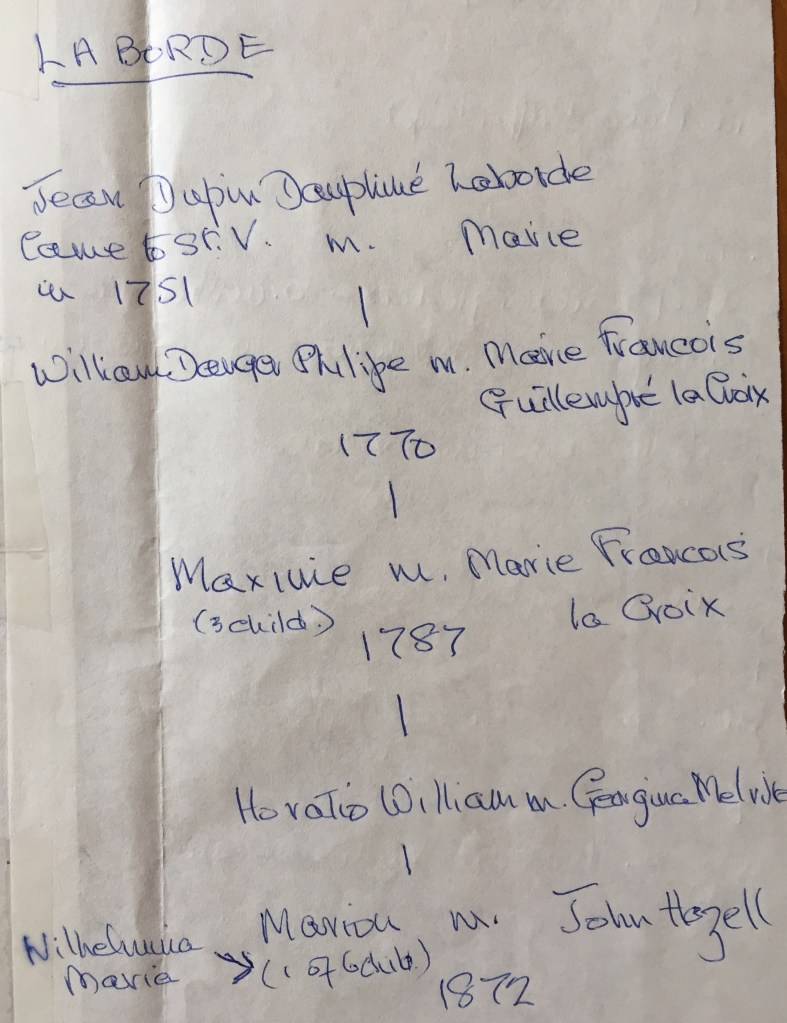
Laborde Family

Jean Dupin Dauphiné Laborde came to St Vincent in 1751.

m. 

Marie

|

William Danger Philipe

m. 1770

Marie François Guilleampré La Croix

|

Maxime (3 children)

m. 1787

Marie Francois La Croix

|

Horatio William (5 children)

m.

Georgina Melville

|

Marion Laborde (6 children)

m. 1872

John G.W. Hazell

Note: When Marion married Jack, her sister, Wilhelmina Maria, came with her and lived with the Hazells all her life, never calling her brother-in-law anything but Mr. Hazell.  She was known as Aunt Min.

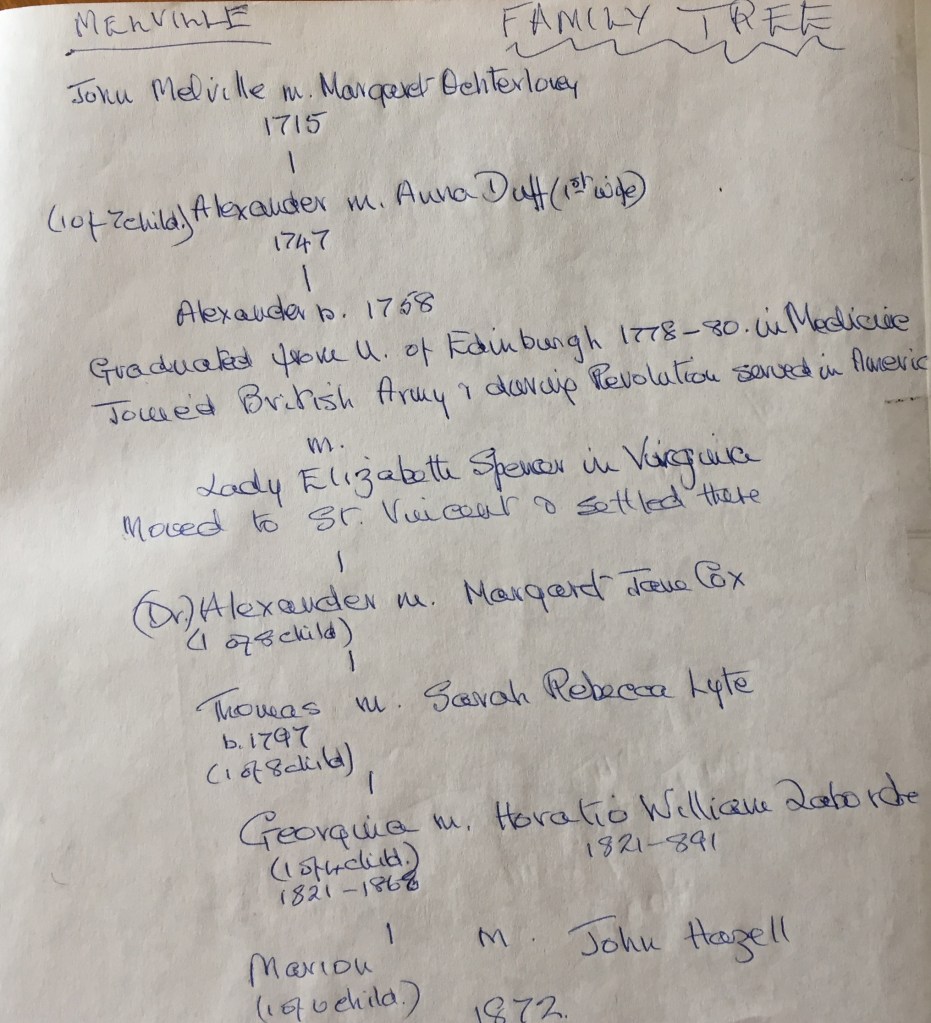
Melville Family 

John Melville

m. 1715

Margaret Ochterloney?

|

Alexander 

m. 1747

Anna Duff (1st wife)

|

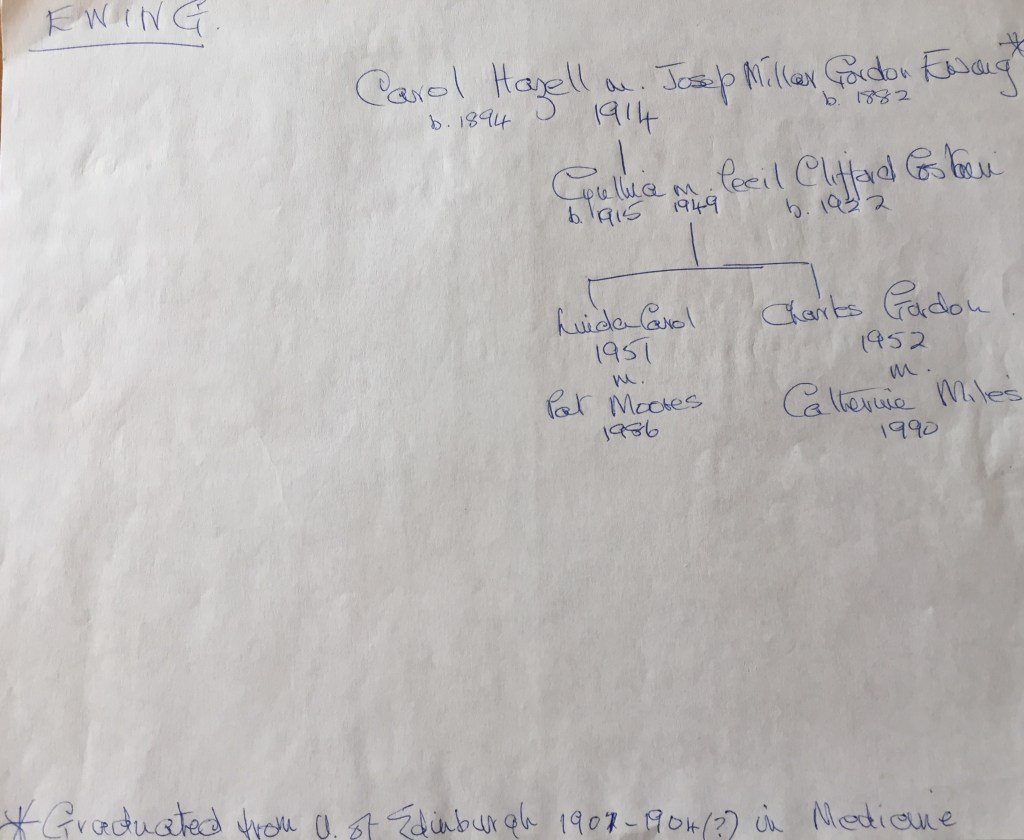
Alexander b. 1758 (one of 7 children). Graduated from U. of Edinburgh 1778/80 in Medicine.  Joined British Army and during the Revolution served in America then he 

m. 

Lady Elizabeth Spencer in Virginia and came to St. Vincent and settled.

|

Dr. Alexander Melville (one of 8 children)

m.

Margaret Jane Cox 

|

Thomas b. 1797 (0ne of 8 children)

m.

Sarah Rebecca Lyte

|

Georgina 1821-1868 (one of 4 children)

m.

Horatio William Laborde 1821-1891

|

Marion (one of 6 children)

m.

John Gregg Windsor Hazell

|

12 children

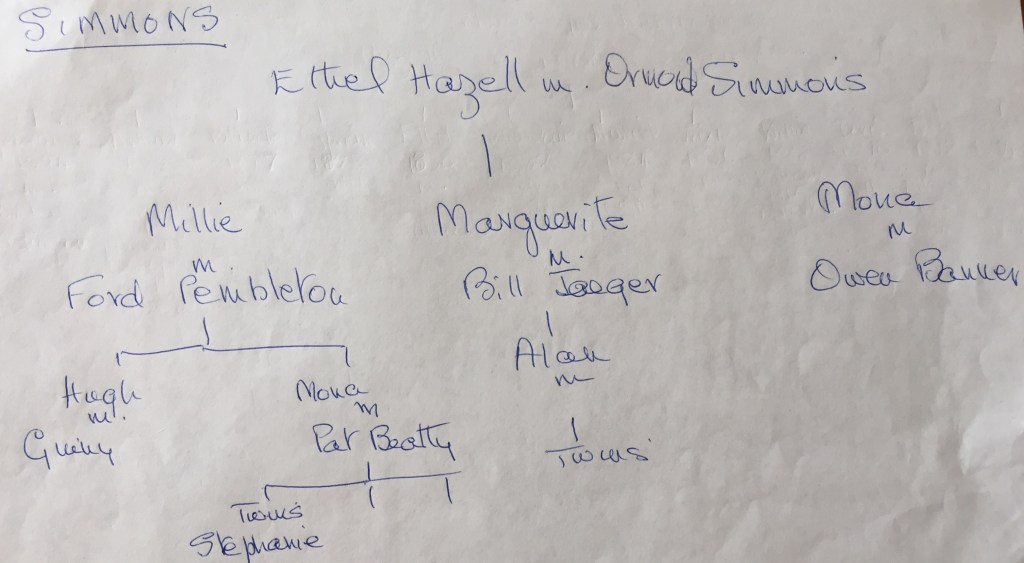
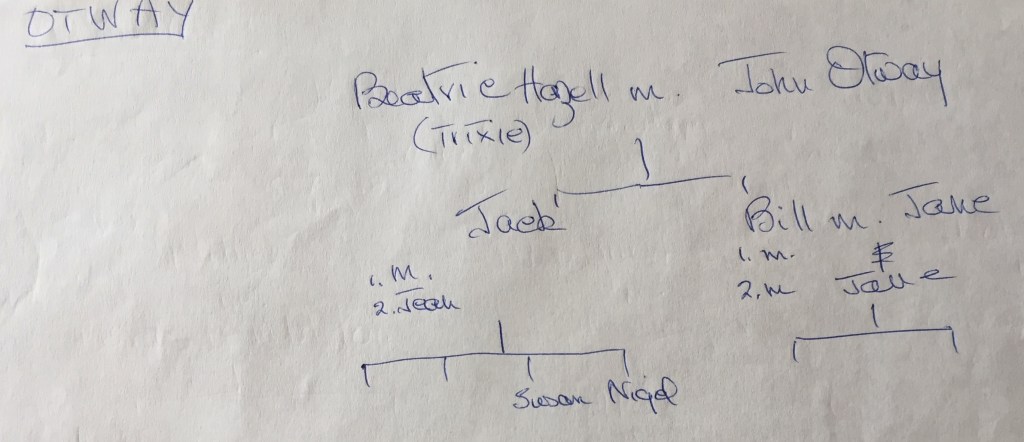
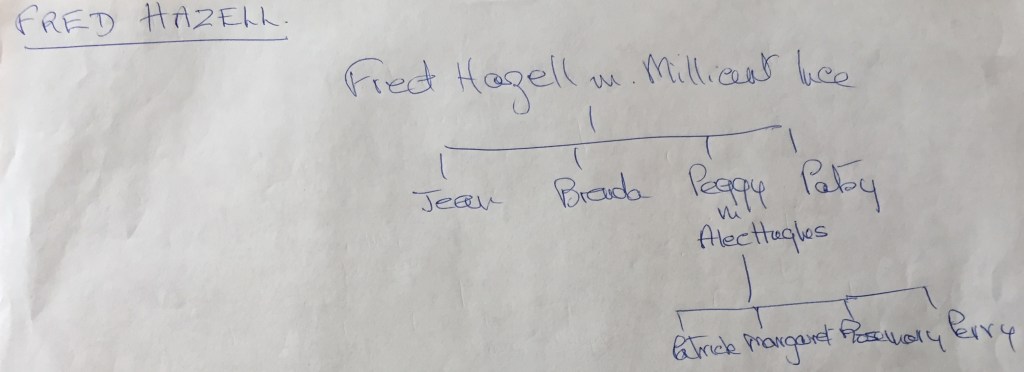
Now, here are the family tree diagrams Cynthia and her Hutchinson cousins Basil and Ina, maybe Monica too, put together in Ottawa toward the end of the century. Cyn was clear about her own generation, but the third generation is scrappy, and their children mostly missing. As we get into the 1950s, maybe the letters will help fill in the blanks.

Hutchinson Family Tree 1
Hutchinson Family Tree 2
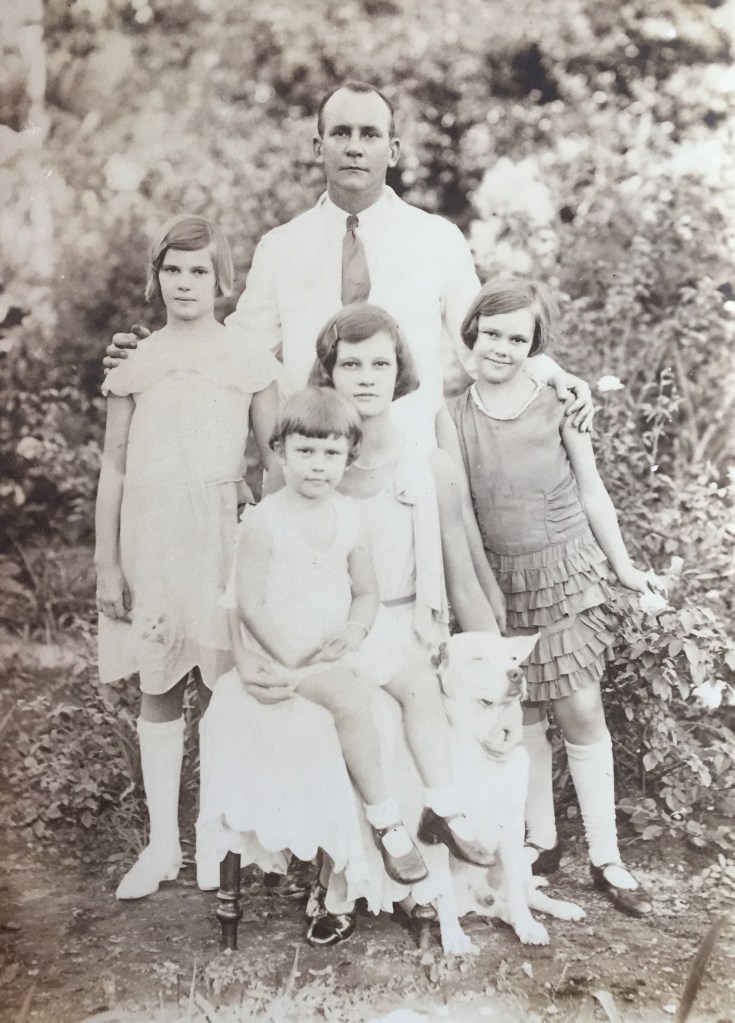
Ettie and daughters
Fred and daughters

Family Letters

When I first thought of reading my mother’s old letters to my grandmother, it was because I had been listening to CBC radio talking about the polio scares of the 1950s.  My husband Pat is five years older than I and can remember the public swimming pools in Windsor being closed because of fear of polio.  Had my mother worried about her children being affected, I wondered?  I should read her letters and find out.  But of course, reading one meant reading them all, for who knew where such information might be buried? 

I knew I had letters from my past in boxes somewhere and that some of the boxes from my mother had letters that my grandmother had preserved from their past.  I must have considered these of some value, since I had lugged them through our many moves (an average of every three-and-a-half years all our married life).  We have made our second-last move (back to our house in Haida Gwaii- the last one will be the one forced on us by old age and infirmities); have as much space as we’ll ever have; Pat and I are retired and thus I had lots of time to consider A Project. So I dug out the boxes, sorted the letters and other documents into binders, and then left them alone for ten years.

My Family Letters Project involves 80 years of letters saved by and written by the women in my nuclear family to their mothers. 

The youngest child of twelve, Carol Enid Hazell, was born in St.Vincent, West Indies into the British colonial empire of Queen Victoria.  She went to school in England, returned and married Dr. J.M.G. Ewing (Gordon) in St. Vincent, and after World War 1, went to live in Newcastle-upon-Tyne with her husband and daughter.  It is hard to imagine how many letters they all wrote over the years: she kept in touch with her mother, brothers, and sisters in the West Indies, Britain, Canada, and the USA; but the only letters she saved were those from her daughter, Cynthia Ewing, written to her mother in Newcastle from boarding school in York, then as an adult, from Cambridge, Toledo, Ann Arbor, and Ottawa.  When, in old age, she joined her daughter in Ottawa, she brought those letters with her.  Between us, Cyn and I kept my memorabilia and those letters that friends wrote to me, although the letters I wrote home to Ottawa from England and Nigeria sadly seem to have disappeared.

This chain of personal letters to our mothers, of course, involves all our friends and the extended families, personal comments that I hope those living will excuse me publishing, and a lot of little details of life gone by, such as the information that my mother at boarding school as a teenager would have her hair washed every three weeks.  [Letter dated May 8th, 1929]  To the 21st century reader, this results in several thoughts, including ‘ick’, but also: at 14, someone else washes her hair? also, what did they all look like? and, oh that explains a few puzzling incidents in that Chalet School series (written in the 30s).  

Adding to the vicarious enjoyment of these letters is the fact that nothing very distressing ever happens because no one wants to upset her mother: so agonizing experiences (if any) are kept private and don’t enter into the flow of weekly letters; and major events happen off stage since the family tends to get together in a crisis and so no letters are written, and the accident or crisis is only referred to afterwards. 

As well, it should be admitted, I come from a very fortunate family: on both sides generally, there was health and enough wealth, in spite of the Depression and World War Two, no great tragedies happened, and if all marriages were not successful, most were, families were loving, and children were treasured.  For me, reading these was like enjoying a familiar novel, or maybe a prequel: you know the main characters and the ending, but you are getting all sorts of new and entertaining information.  As the boxes reached my memorabilia, 40 years ago rather than 80, there were notes and cards from my past, and that walk down memory lane was fun too. Those notes and artifacts add variety, since they are from friends to me- the odd letter in the collection from someone else added interest to my mother’s letters, but in 1951 she tells her mother how much she and my father enjoy the letters they get, but also says she is going to burn them since the collection was getting so bulky. How glad I am that my grandmother kept Cyn’s letters, one-sided though the conversation is.  

So I read the letters, put them in chronological order in plastic sleeves and binders, annotated them with stickies when I recognized the names, and supplemented the narrative with the oral stories I’d heard all my life.  My grandmother had a box of loose photos too, so I have slipped them in the sleeve too if relevant.  My mother took a writing class in her 70s, and wrote short stories about her mother’s life: the eruption, the earthquake, fictionalized versions of family sagas. I include similar tales we loved as kids: our mother being naughty with a midnight feast at boarding school. And long term?  As I wrote to my 97-year-old godmother in England, I can’t help thinking there is a thesis in here somewhere.  Now we have the Internet, I think publishing these may be a contribution to the domestic history of the 20th century.  My grandmother kept the letters from her daughter, and enjoyed reading them and putting them in order in her old age, and there are indications that my mother looked them over as well before her sight went.  Now we have the technology I feel they should serve a wider purpose than bringing a smile to my face as I enter old age.  The collection may lack drama for an outside reader, but the small details of life in the last century are strangely compelling. So I am posting these online and sharing the love with the world- because what these years of letters do show is a century of caring and long families and teasing, friends and connections and love.