I’m so impressed with the amazing postal system in England in 1945! Who needed email or delivery companies when such efficient government-run communication existed? Admittedly, the telephone system didn’t work that well- since not everyone has it in their houses it did mean that Cyn had to keep dashing out, whether in Cambridge or in London, to phone boxes, but in dire straits she fell back on a telegram. As the previous letters of this crowded week have shown, on Friday Cynthia discovered she needed an evening dress from her home in Newcastle in the north of England and sent her mother a telegram. On Monday it arrived, in time for the dance Tuesday!
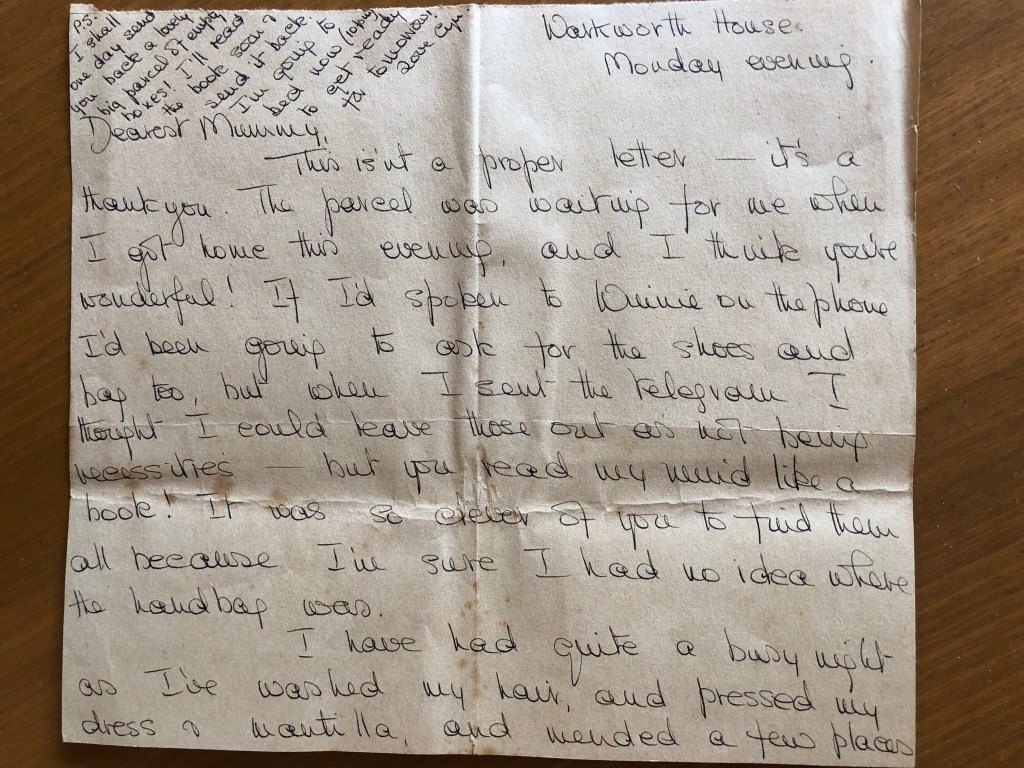
Warkworth House
Monday evening
Dearest Mummy,
This isn’t a proper letter – it’s a thank you. The parcel was waiting for me when I got home this evening, and I think you’re wonderful! If I’d spoken to Winnie on the phone I’d been going to ask for the shoes and bag too, but when I sent a telegram I thought I could leave those out as not being necessities- but you read my mind like a book! It was so clever of you to find them all because I’m sure I had no idea where the handbag was.
I have had quite a busy night as I’ve washed my hair, and pressed my dress & mantilla, and mended a few places in the lace which were giving away, and also tried everything on. Unfortunately I seem to be really getting colossal around my bosom, as this is tight too, but it’s not bad! Jessie was so inspired that she got out & tried on her evening dresses too & we had quite a lot of fun. I have also written to Miss Dickie to thank her for my testimonial & to a woman in Scotland to see if she’ll knit me 3 Shetland vests!
By the way our date did arrive last night- quite pleasant, but nothing thrilling! They took us out & fed us & took us to the Red Lion & gave us a drink. And WHO do you think I saw there? Uncle Joe! He didn’t see me & he’d gone (upstairs to bed I presume!) before I could catch him, so I left a note in the office saying I seen him & hoped he was well etc. But I didn’t put my address on it, because he was so disagreeable last time I saw him!
Thank you again Mummy – it was sweet of you.
Lots of love Cyn.
P.S. I shall one day send you back a lovely big parcel of empty boxes! I’ll read the book soon & send it back. I’m going to bed now (10 pm) to get ready for tomorrow! Love Cyn.
Unfortunately, we never find out how the dance at the Polish Club turned out, because these are the only letters from this school year. (Nor do we know anything about disagreeable Uncle Joe, who I assume is a Ewing, older brother of her father, who was pretty disagreeable himself.) The war is over, the men are going home, and the next letters Cynthia sends are from America, where she’s gone on a year’s teacher exchange. I will finish off the wartime years with photos and commentary, then tackle Cyn’s next adventure!
Sometime towards the end of the war, Cynthia Ewing got a teaching job in Cambridge and moved south. It was a much happier situation for her- she was on her own, living away from home; in a much prettier city, probably less war-torn than Newcastle; nearer to London for holidays and closer to friends. She lived in a house with other women, where they seemed to have their own rooms or suites but shared common areas, and sometimes ate together or went out in the evenings or to visit friends on weekends.
Cynthia’s letters to her mother at this period are undated, probably because the postal service was so good that a letter dated Sunday would arrive the following day in the north, and there would be no doubt in the reader’s mind which Sunday it had been written on! The first letter seems to have been written in April 1945 because there are references to her recent birthday (April 3rd) in letters that her mother has forwarded to her. (Once more, it seems she has started at a new school in the middle of the school year, like her mother before her!) The Easter holidays would have been about a month long, time to move and set up, but the letter to her mother describes the few days with her American friend Hugh on leave in London, and only briefly alludes to work at the very end. Then there is one written on VE Day, when the war was over in Europe. Four letters from the 1945/46 school year follow, starting after a visit from her mother at half term in the autumn, and ending with a hint at Cynthia planning for a more drastic change.
I have included at the end of this wartime section excerpts from a letter my godmother sent me summing up this period, and finished with an article Cynthia wrote years after, ‘Remembering’.
Although this site exists to cover years of letters, I am going to start with stories that fill in the background, by posting documents that were written by my mother, Cynthia, about the early life of her mother, Carol. These were written in her 70s when she took a writing class, and are fictionalized versions of the family stories that she had been told, and that she passed on to us- the fact that my grandmother had survived a hurricane, a volcanic eruption, and an earthquake seemed impossibly exotic to me, a Canadian child. Some of these are finished products, some have marks indicating editing is intended, but they all are typed and, I hope, legible, and I think she’s a good storyteller!
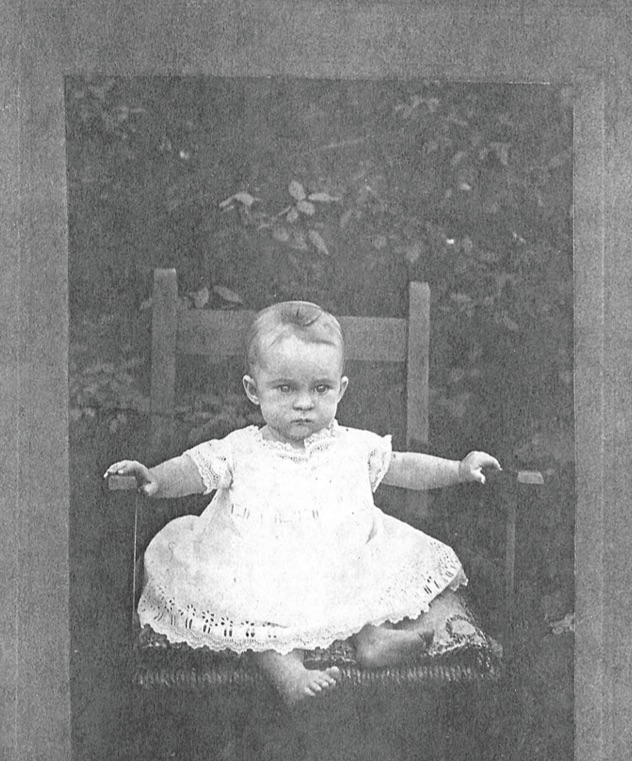
Baby Carol
LONG, LONG AGO
by Cynthia Costain
Over a hundred years ago, at the end of the nineteenth century, a little girl called Carol was born on a small island, St. Vincent, in the West Indies. It was part of the British Empire, proud to be a colony under the rule of Queen Victoria. St. Vincent is one of a chain of beautiful, tropical, volcanic islands arcing through the Caribbean from North to South America. The island had one main town, Kingstown, enclosed in a great harbour. Above the town arose the mountains, dotted here and there with large sprawling houses, the red roofs showing through the palms and flowering trees. One of these houses was called `Windsor’ and was the home of the Hazell family, which had originated with two brothers who left England in 1748. They were ship-builders by trade and, having built their own ship, embarked with their wives, families, and all their goods and sailed west and south to begin a new life.
There is no record of their voyage, though it must have felt perilous to two men whose past experience had probably been confined to coastal waters, but eventually they landed in Saba in the Virgin Islands. This was not the lush tropical land they had hoped for, as it was bare and infertile, with rocky shores and little shelter, but they anchored and there they remained until a baby boy named Hercules was born in 1749. Soon afterwards they sailed south and finally settled in the island of Bequia in the Windward Islands. There they found a friendly climate and friendly people where they made their homes and founded a ship building business.
Eventually Hercules grew up and married, moving with his family after some time to the bigger island of St. Vincent where he began a trading company. Within his lifetime his grandson, John Gregg Windsor Hazell, had become one of the leading businessmen of the island. This grandson John was the father of the tiny baby at the beginning of this story.
There was not much excitement when the twelfth baby, Carol, arrived in the family and the busy but leisured life of most of the members hardly suffered a hiccup. The older daughters helped the nurse look after Mother and their new little sister, took over the housekeeping and saw that things in the house continued smoothly; the older brothers took little interest in babies. The only members of the family who were excited about Carol were `the little ones’. With Mother’s permission the nurses brought them to see the baby the next day and as they stood around the cradle looking down at the baby with the big brown eyes, Doris said, “She’s very small.” “She’s no use to play with,” said two year old Fred, who was disappointed, but Willie, aged six, looked at the baby seriously and announced, “She looks just like a monkey!” and from that time on, Carol was known as `Monks’ in the family.
The young children all had nurses and Carol called her nurse `Dada’. Dada bathed, dressed, and fed the baby; washed and ironed her clothes, and, most important, kept her quiet and amused. At teatime the children were washed and dressed in clean clothes (if company was expected the boys wore sailor suits and the girls white starched dresses) and brought to the verandah to be petted and join in the conversation with Mother, sisters and friends. At the sign of tears, spills, or noise, a nurse would appear and hastily remove the offender.
Carol grew up in a busy household. Mother was the firm disciplinarian, ruling her family and the household, while Father was the good-natured benevolent Papa. With numerous servants, nurses, cooks, grooms, and gardeners working in a slow noisy West Indian way there was plenty for Mother to do: she was a severe woman, feared by some, but there was much love and affection and the family was a closely knit, safe world. Much of the time older members of the family would be at school in Barbados, England, or Canada, or working in the U.S.A. but the young ladies and gentlemen at home all had their ‘work’ each day. The men went to the family business on the harbour with Father, or rode out to one of the estates. If it was time for the sugar crop all the estates would be busy with the cutting of the cane and the sugar mill would work day and night crushing, processing, and finally bagging the sugar to send to England. Later the molasses would go to the rum factory to be distilled into raw alcohol and then aged in barrels before it too was sent overseas.
The young ladies of the family had various jobs: they cut and arranged the flowers, such as hibiscus, lilies, ixora, and bougainvillea; shopped in town for small items not trusted to the maid who went every morning to the market; and sometimes visited the dressmaker. This was very important as the only chance of a `ready-made’ dress was to ask a friend who was visiting some larger place to bring one back for you. The girls also did a little cooking- cakes for tea or a special dessert if guests were expected for dinner. They used the woodstove and oven, but the cook preferred the charcoal `coal pot’ outside.
The whole family were expected back at noon for the main meal of the day. Having risen at six or earlier and begun work while it was still cool, everyone was hungry and sat down to what was considered in Victorian households to be a simple family meal (albeit with a West Indian twist): roast pork with crackling, or a large dish of chicken pilau, or sometimes a whole baked redfish. With this would be served rice, sweet potatoes, fried plantain, tania cakes crisp and brown, or perhaps breadfruit or pigeon peas. Beforehand would be hot pumpkin or callalou soup, and the main course would be followed by a sweet coconut pudding with stewed guavas. Business did not resume much before three o’clock.
Until they became teenagers, the children went to school in the town. The boys’ schools were run by clergy or teachers from England, while the girls attended schools run by maiden ladies in their own homes. The older daughters helped the young children but actually their social lives were fully occupied. Making calls took up many afternoons and the horse and a carriage would take two or three of the ladies to sign the Book at Government House or make other calls. They were all devoted churchwomen and much time was spent at the Cathedral doing the flowers, seeing to the vestments, or attending meetings. In the evening between five and seven when the air became cool and the sun set, friends and relatives would drop in for a cool drink and a chat. Riding parties and picnics were planned, or arrangements made to play tennis or watch a cricket match.
The arrival of one of H. M. Ships of War was a great occasion, and any ship from England or America or even the small vessels from other islands brought visitors or old friends as well as business and everything from buttons to furniture, horses, carriages and machinery. The ship’s officers were always entertained at the big houses as well as visitors, and return invitations, particularly on board ship, were looked forward to eagerly.
Carol’s childhood was a happy one. The white people were the wealthy people on the island and she accepted all the St. Vincentians of every colour and any other heritage as being `natives’. Some she loved like her old nurse Dada, and she realized that any who worked for the family had to be `looked after’ when they were ill or became old, but it was a paternalistic society that she did not question.
When Carol was very young she remembered that one of her older sisters taught her to count on her fingers. She was told, “Look, you have ten fingers and you have ten brothers and sisters.”
This seemed to her to be the most astonishing piece of news she had ever heard! She began counting: “Georgina, Arthur, Blanche, Ethel, John Louis, Muriel, Beatrice, Willie, Doris, Fred makes ten. Oh, and there was baby Cyprian, but he’s dead. And Me.”
 A Family History in Letters