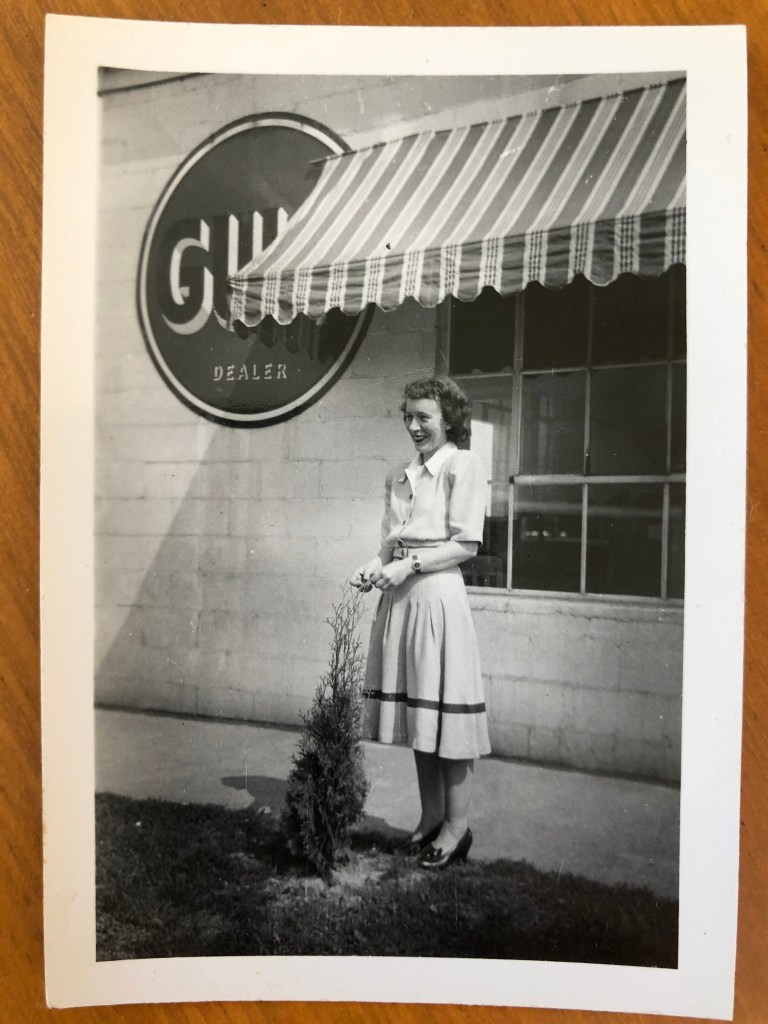
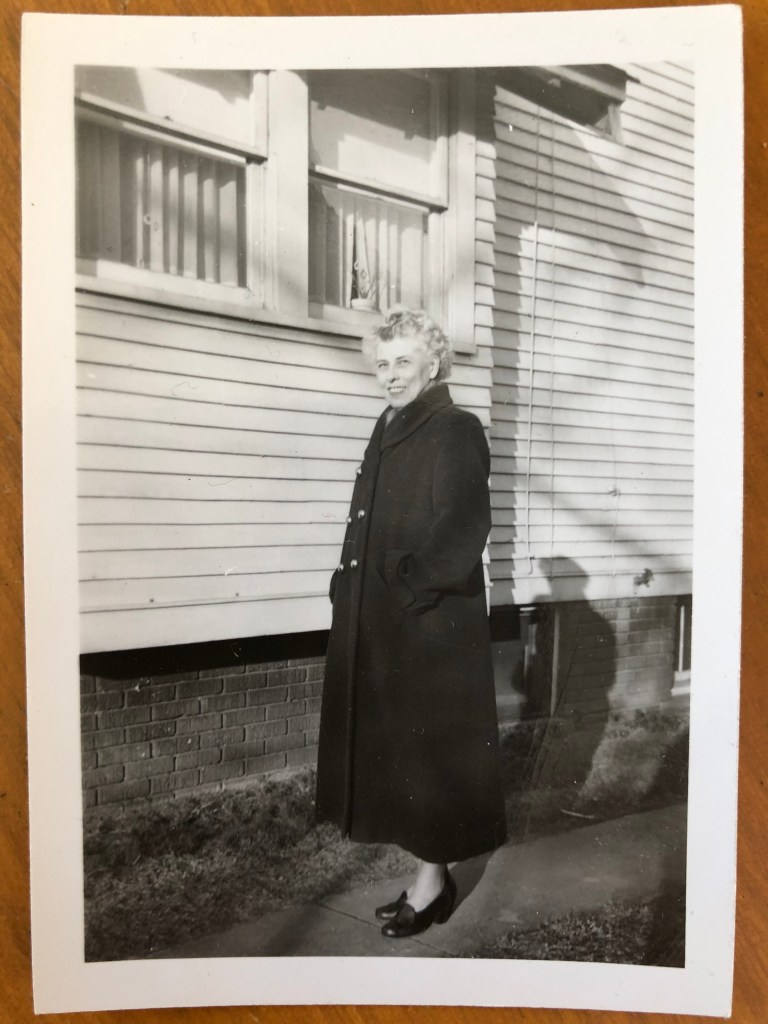
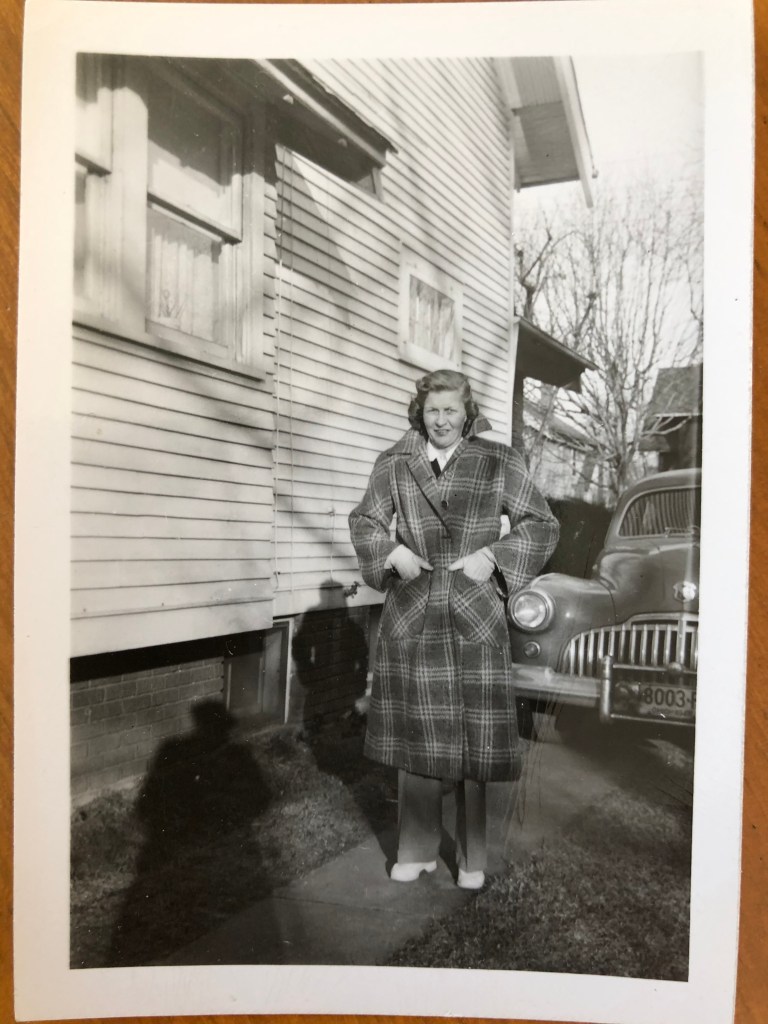
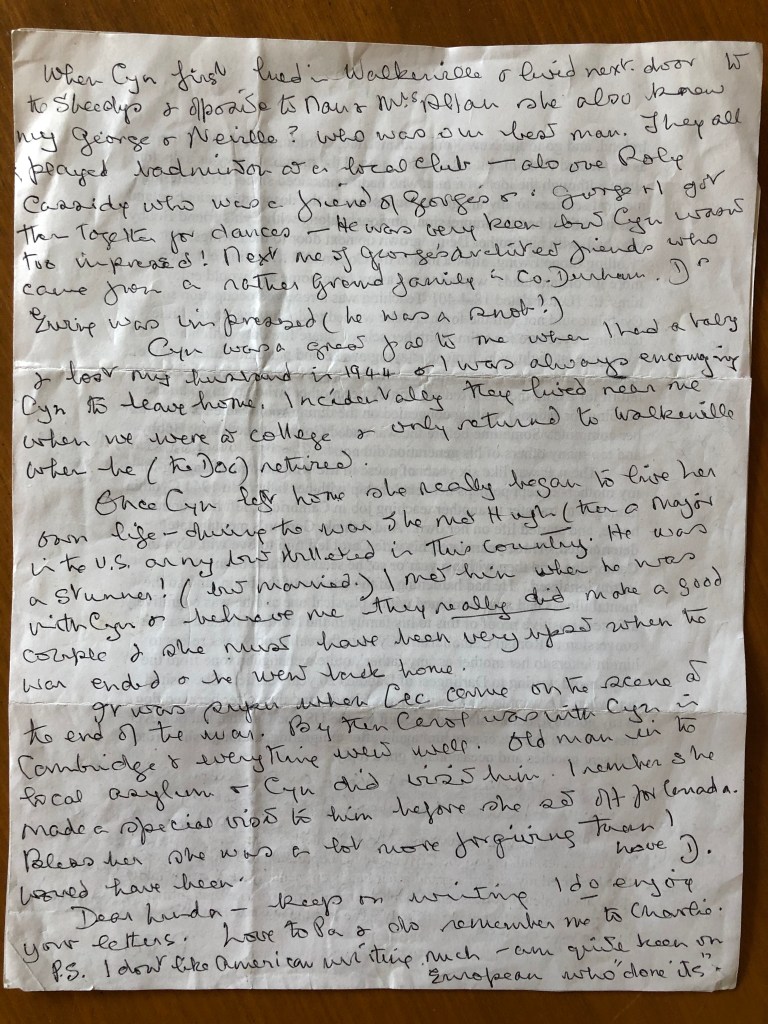
Later, 1948.

This letter contains one of those mysteries where both the sender and recipient know what has happened so there is no need to discuss it, and we can only guess.

37 De Freville Ave.

Cambridge 

Sunday 

Dearest Little Mummy,

Thank you for your telegram & letter. I was so disappointed that you couldn’t come on Friday after all, but I quite understand that of course it was much more sensible to stay up there once you are there, rather than make another journey.

You have been having a horrible and wildly busy time – I am only sorry that I couldn’t be with you to help you, but I knew that all your friends would be sweet & kind, & I hope that Uncle John and Mary were of some help. I suppose they went back on Thursday as planned though, so you will have had all these days to get through without them, but I hope that the worst business was over by then, & that Maud and Chris would help you.

As I will be seeing you so soon, I won’t write anything about all the arrangements and what you have had to do, as we will be able to talk at all over when you get back. But I know you were having a wretched worrying time, dear, and I do hope you will try not to worry too much, because you have done all that could be done, over many years, and I think that it will all turn out for the best eventually.

I had a note from Joe on Friday saying he was coming & he arrived yesterday evening. At the moment he is very busy in the conservatory & has done all sorts of things- mended one broken shelf- lifted some others to make them straight- screwed up a loose bracket & it looks to me now as if he were going to mend the door! However, you better not tell Winnie all this, as apparently you mentioned the fact of his doing odd jobs before, & she must’ve been remarking on it to him! Probably, you better not tell her he’s here at all! By the way, it is Winnie’s birthday on Tuesday & I am sending a card.

Last night Joan had a little party, with two Poles, a fat girl Anne, Pam & George, & Joe & me. We all got quite matey & though Joe didn’t want to go, I think he really enjoyed it once he was there. Anne Chapman came in this morning (brought me 6 eggs & Joe brought 8- come home quick & help eat them!!!!) & Pam invited us all up for coffee at 12.0, so we had another little gathering. After all this we were not a bit hungrey, so we skipped lunch & are having a light tea & dinner this evening! I don’t know how Joe’s digestion will stand it- mine feels most odd!!

I must stop now, honey & catch the post. Take care of yourself now, & come home safe and sound on Wednesday. Pam and Joan & the butcher & the cats all keep asking when you’re coming & you’ll get a very warm welcome from all of them as well as from your loving daughter! We will be able to have a lovely lazy time during the holidays after Friday.

Joe sends his love, & I send lots & lots from me-

      from 

          Cyn P.T.O.

Love to Mrs. Johnny & Bella & Maud & Winnie & all the others.

Clues: It is later in the year of 1948 or even possibly 1949, because Cyn’s address is that of the flat she shared with her mother, so it would be at least spring of 1948, because they are obviously living there together. However, something has happened in Newcastle, because that is where Carol is, dealing with something upsetting. I assume this was the catastrophic medical incident that resulted in the husband she had left, Gordon, being hospitalized- but I don’t know what that was. I think that the ‘Uncle John and Mary’ mentioned were Ewings, probably Gordon’s older brother, and Maud and Winnie were friends of long-standing. The ‘Joe’ visiting Cyn in Cambridge is a Sheedy, also longtime Newcastle neighbours of the Ewings, possibly a younger brother of her childhood friends, and obviously handy to have around the house! From the list of things he’s fixing, it sounds as if they haven’t lived there very long. Maybe when Carol gets back, she and Cyn will be planning a house-warming party…

December 1947

Presents I Brought from America

While Christmas 1947 approaches, I thought we could look at the very organized records Cyn kept of her purchases and gifts, which her letters from America showed were very important to her. I think some of the things listed above that Cyn brought for her friends from the States in August 1947 were scarcities in England such as the stockings, and had been arranged and paid for by the recipients, but she seems to have brought something for everyone mentioned in her letters, so perhaps not.

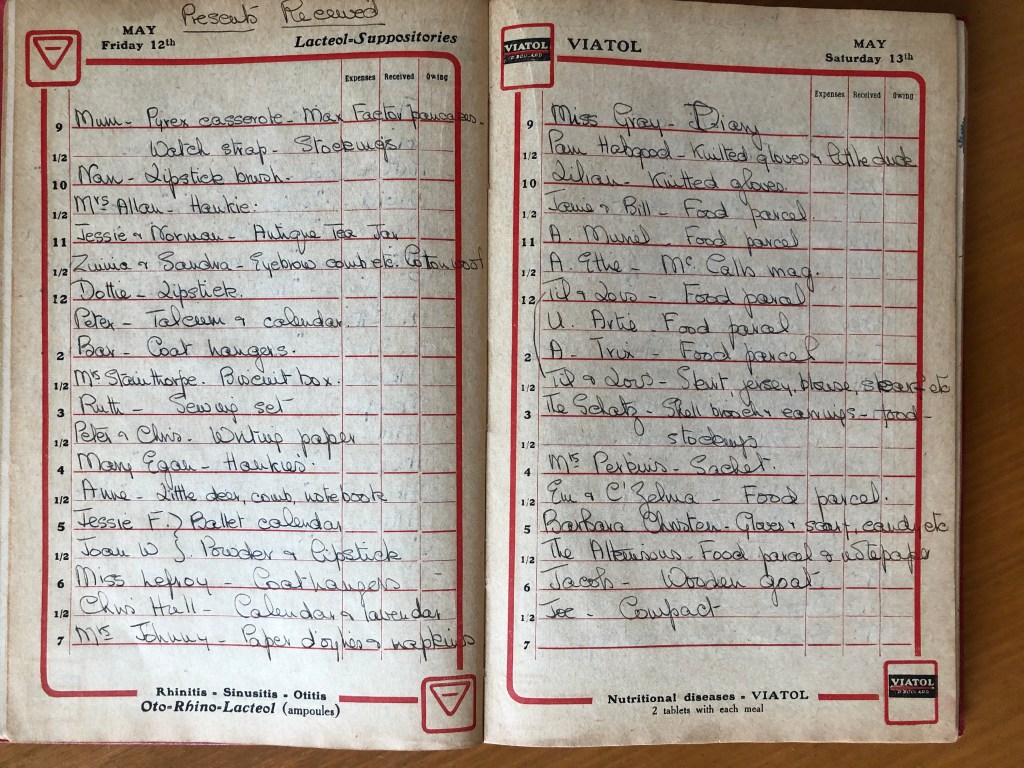
In her previous letter of December 6th, she is already telling her mother about her Christmas shopping. She listed (in an outdated diary from her father’s medical days, judging from the ads for tablets on every page) all Christmas cards sent and received, and all the presents she gave and received, from 1932 until 1965 when the book was full! This December, besides the cards and gifts exchanged with her family and friends in England, she sent cards to all her American friends, and presents to her relatives and closer friends there, mostly calendars for the adults and books for the children- things easy to post. And as my last post showed with the close-up of her Presents Received page, (repeated here, 2nd page) they responded with generosity! But her father does not feature in the lists this year, or any year after.

Presents Received 1947

Marriage Break-up

The week after the Royal Wedding, changes began in the Ewing family, changes that had been years in the making but which moved swiftly in the months that followed. The marriage between Cynthia’s parents, Carol and Gordon Ewing, was not a happy one.  I have said before that I suspect my grandfather Gordon suffered from depression, or bi-polar disorder, and in his sixties things seemed to get worse. His wife was the one who bore the brunt of his behaviour.  At the end of 1947, their troubles came to a head, and Carol decided to leave him, coming to live with Cynthia in Cambridge.

Eventually Gordon was diagnosed with hardening of the arteries of the brain. I don’t know whether he had vascular dementia or had had strokes, but within two years of his wife leaving him he had been institutionalized. 

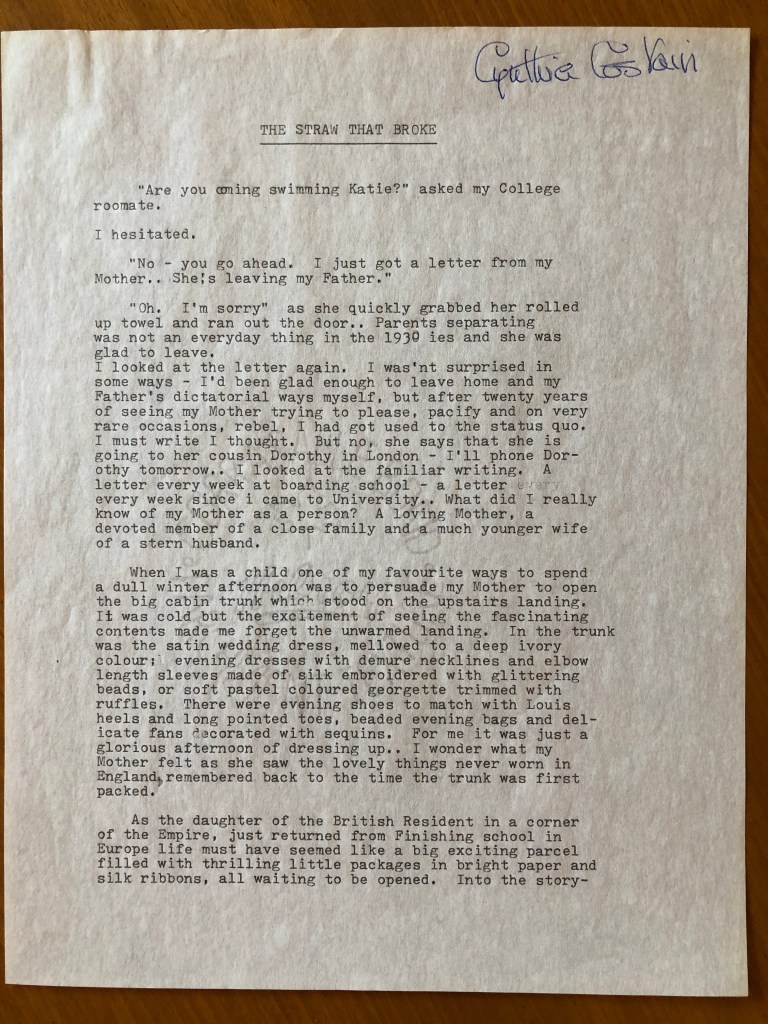
In Cynthia’s late seventies, she wrote a short story “The Straw That Broke” that fictionalized the break-up, giving a good picture of the sort of life Carol and Gordon led and what their daughter thought of it.  Then there is a letter from Carol to Gordon- probably not sent to or read by him- that shows clearly the psychological abuse she endured and the toll it was taking.  Cyn’s letters to her mother that follow are supportive – and worried!- as Carol goes through the process of splitting up the home and moving.  But by April 1948, Cyn and Carol were happily sharing a flat in Cambridge and enjoying it- and there was no need for letters between them!  

Luckily by then Cyn had met Cec Costain, her future husband, so that 1948 is illuminated by a few of his letters to his mother, and holiday postcards to Cyn, as well as photographs from a happy Cambridge courtship.  In the summer of 1949, they began a much happier marriage than Carol and Gordon’s, honeymoon letters were sent to Carol, and then they all left Cambridge, scattered, and- 

          the letters continued.  

A short story by Cynthia Costain.

THE STRAW THAT BROKE

“Are you coming swimming Katie?” asked my College roommate.

I hesitated.

“No- you go ahead. I just got a letter from my Mother. She’s leaving my Father.”

“Oh. I’m sorry,” as she quickly grabbed a rolled up towel and ran out the door. Parents separating was not an everyday thing in the 1930s and she was glad to leave.

I looked at the letter again. I wasn’t surprised in some ways- I’d been glad enough to leave home and my Father’s dictatorial ways myself, but after 20 years of seeing my mother trying to please, pacify and on very rare occasions, rebel, I had got used to the status quo. I must write I thought. But no, she says that she is going to her cousin Dorothy in London – I’ll phone Dorothy tomorrow. I looked at the familiar writing. A letter every week at boarding school – a letter every week since I came to University. What did I really know of my Mother as a person? A loving Mother, a devoted member of a close family and a much younger wife of a stern husband.

When I was a child one of my favourite ways to spend a dull winter afternoon was to persuade my Mother to open the big cabin trunk which stood on the upstairs landing. It was cold but the excitement of seeing the fascinating contents made me forget the unwarmed landing. In the trunk was the satin wedding dress, mellowed to a deep ivory colour; evening dresses with demure necklines and elbow length sleeves made of silk embroidered with glittering beads, or pastel coloured georgette trimmed with ruffles. There were evening shoes to match with Louis heels and long pointed toes, beaded evening bags and delicate fans decorated with sequins. For me it was just a glorious afternoon of dressing up. I wonder what my Mother felt as she saw the lovely things never worn in England, remembered back to the time the trunk was first packed.

As the daughter of the British Resident in a corner of the Empire, just returned from Finishing school in Europe life must have seemed like a big exciting parcel filled with thrilling little packages in bright paper and silk ribbons, all waiting to be opened. Into the storybook setting of tropical sunshine and waving palm trees swept the handsome prince. The newly arrived Cultural Attaché was charming, good looking, travelled and was single!

“What happened next?” I would ask when I was told this story.

“Well” my Mother would say “My Mother thought he was too old for me, and Dad wondered why a young man had been moved so often but I wanted to get married – it was SO romantic.” and she would laugh at her 19-year-old self. “We got engaged and then we got married and not very long afterwards we came to England.”

How could my mother know that the charm could be turned on at will; that the friendliness could change to cold dislike if his opinions were challenged; or that irritability could become rage?

On returning to England my Father left the Foreign Service and joined a business firm. In the provincial city where we lived my parents at first knew no one. My Father’s work bored him and he had no hobbies. How quickly my Mother’s dreams must have dissolved, living in a small house in a suburb of identical houses, with one young untrained maid coming daily to clean. The shopping for someone who had never bought a loaf of bread; the cooking of three meals a day for someone who had only been taught to bake a cake for tea; the whole bewildering process of running a house with a husband and eventually a child. I remember in my teens realizing that no one had ever given my Mother a Cookbook.

“But what did you do Mum?”

“I just tried and tried again- not always very successfully. I had a nice neighbour, Mrs. Halliday- do you remember her? She helped me a lot, but I still made lots of mistakes.”

“I remember one mistake that I liked. The steamed puddings that sank in the middle and that was the part I liked! I was sorry when you learn to make them properly!”

With my Father’s boredom came depression and through my childhood the periods when he sat in his armchair staring at the fire for days on end while my mother tried to get him to eat or persuaded him to look at a paper or go for a walk. I would return from school, creeping into the house praying that he would be “happy” again.

As the years went by I escaped to boarding school and we moved to a new house. In that move the cabin trunk and its contents disappeared. My father was no sentimentalist. I began to want my independence and holiday times at home became more difficult as I rebelled at the strict rules. However, once I was away from home I was free.

Through the years my mother had found a few good women friends, but visits from her family were frowned upon and contact with his family was minimal. I realize that she had developed a “peace at any price” attitude; they went where he wanted for their rare holidays; they entertained as little as possible; outings to theatre and concerts dwindled. I got used to it but did my mother?

When I went to London to see her that weekend she told me that she had decided to go and live with her unmarried sister in Mexico.  It seemed like a very long way away. 

“Mum” I said “What finally made you leave?” 

“He called me a parasite.” she said.

The beginning of the critique from her writing class. Spot on!

Cynthia fictionalized the minutia of dates, jobs, and places in telling the story but the details of the relationship were completely true. I remember Cyn telling me about my grandmother’s ending the marriage.  The final question was the same- “What finally made you leave?” The answer even simpler. 

“He told me I was useless,” she said.  

When Cyn next saw her father, as she was collecting the packed boxes from the house during her holiday, she found him baffled.  After all, he had called her things like that for years…

Coming of Age in the Twentieth Century

My mother introduced me, at the age of fifteen, bored and disgruntled at our rented summer cottage with nothing new to read, to Georgette Heyer, then coming out in paperback.  I fell in love with her books, read my mother’s copies, and joined my friend Janet in collecting all we could.  The fact that Cynthia had had a ball in her honour when she was 21 put her firmly in the Georgette Heyer class in my mind.  One of the exotic stories I remembered from childhood was Cynthia’s coming of age ball.  She had been the focus of family and friends on Her Day – the closest we would ever come was the high school graduation dance in a hotel when we were 18, where we would as always be in competition with the popular and more sophisticated ‘in’ girls.  She may not have had A Season or been Presented as they had in the Regency- I didn’t know or care about 20th century debutantes- but she had gone to dances and had one of her own.  However, Cynthia’s vague allusions to her 21st birthday suggested it had not been a night of complete pleasure.

I remember as an adult asking questions to try to get a handle on the class she lived in- was it common in her circle to have a Coming-of-Age ball?  Did Jessie Muir, a doctor’s daughter as well, but one whose job after completing school was to manage her widowed father’s house, surgery, and phone, have a ball?  Did Dottie, who shared my mother’s domestic science training and also became a teacher, have a ball?  Did boys have an equivalent celebration?  I got no clear answer.  It could be that Gordon wanted to indulge his daughter and she was not appreciative; that her feelings towards him were affected by the difference of opinion over her college training; or that events in the future coloured her opinion of her father as she looked back on what, at the time, she enjoyed.  I have no idea how big this dance was, or whether it was a success.  All I know is that what she remembered were the flaws in the evening, not the enjoyment.
(And, by contrast, what do I remember of my high school graduation dance?  Well, not much.  It was the end of the sixties- hippies and free love were cool, dating/pairing off/marrying was not, really, except that if you weren’t in a relationship, you knew you were tagging behind as always.  But at my life stage and academic level, I was not ready for any of that- along with the rest of my high school class, all 5 of the Grade 13 classes, I was off to university with at least 3 years of that before we would consider settling down.  The idea was to go away to university first year and snag a date for your high school graduation in October.  I had no interest in that so I begged my cousin Bruce to be my escort and he very kindly obliged.  We returned for the graduation weekend- Thanksgiving?- had the usual tedious ceremony in rented gowns, and with close friends, organized ourselves for the evening.  

I remember my dress: floor length, A-line, sleeveless, made of a strange material in a bluey-green aqua pattern with sparkling pale silver threads sort of laminated on a spongey foam backing, made by my mother and never worn again that I remember. (The foam disintegrated in time, leaving a nasty mess among other carefully preserved garments of the era in cotton or silk.)  In fact, I remember very little- we went downtown to a hotel, we were all dressed up, we had familiar or unfamiliar dates, and it was awkward.  I can’t remember that we fundraised the way graduation classes in schools I taught in did, so did we pay for the whole thing ourselves?  If so, it was the done thing to do so, because everyone was there.  There were round tables and food, there was no drink since we were all under age and no surreptitious drinking around me anyway, there was a band, we must have danced and caught up on each other’s lives, but my main feeling was that I had moved on.  I loved my new university life at Trent where I wore blue jeans all the time instead of the incessant pressure of dress-to-look-good of high school, I had new friends who liked me, and I didn’t need my high school acquaintances any more.  Bruce and my friend Janet would always be a part of my life, but that was the last I saw of most of those people, and I have to say I didn’t miss them.  

I felt sorry for those, Janet among them, who had stayed at home in Ottawa and went to Carleton to university- scurrying around those tunnels greeting known faces from high school and only gradually finding better friends in other places.  Living in residence at Trent had acquainted me at once with all the girls on my corridor, and helped me to become good friends with people in my college that I liked.  Classes were small so within weeks, I had acquaintances in all the other colleges and knew my professors well enough to talk to.  My life expanded in every direction- but enough about me. Maybe my poor memory explains Cynthia’s vagueness- she didn’t remember much either.)

I don’t remember her description of her dress, but she did tell us about the cold water thrown on her appearance by her friend as Cyn appeared in all her glory.  Meeting at her house was the party she would go to the dance with- her escort, and her close friend, as well as her parents.  I don’t remember if it was Nancy, Jessie or Dottie, but the girl friend cried out as she twirled in front of them, “Oh Cynnie, you haven’t washed your neck!”  (This entailed a pause in the story while little Canadians were given an explanation of coal fires and soot in 30s England, and an assurance that she had washed in a lavish bath and was totally mortified by this comment.)  Even when it was discovered to be a shadow, not dirt, and the friend had apologized, and they had all moved on for a gay evening, it was the humiliation of the moment that Cyn remembered.

Was this the dance where the skirt of her dress was so tight that when she kicked a little too enthusiastically, she knocked herself right off her feet and landed on the floor?  As her 1939 Travel Diary and her letters show, dancing was one of her favourite things.

I’m not sure if it was this night or a later event, but one of her friends was staying at the Ewings’ and going to a dance with Cyn.  They went, they had fun, I assume they separated after since they had different escorts- and the friend got home before Gordon’s curfew while Cyn did not.  That meant that Cyn was locked out huddling in the cold, the household was in bed, and the friend had to feel her way down in the dark through the unfamiliar house  to let Cyn in.  Another example of Gordon’s peculiar control.

This underlines the difference between the position of women in the 30s and mine.  My mother and I both were privileged.  In my 20s, with teaching credentials and a teaching job, (having been given the gift of my education and the old car by my parents- much nicer than Gordon, I may add), I made enough in the 1970s to rent a one-bedroom apartment; run an old car to get me to my job, and drive away home or to friends in cities three to five hours away on weekends; go to visit my grandmother Carol in St. Vincent in March Break; and generally be independent.  Cynthia, also a teacher, obviously did not.  (I did have trouble finding a job for more than that one year- hence the adventure of CUSO in Nigeria 1978-80.  Furthermore, I missed my university friends, finding myself out of step with the young couples at my school.  But back to my mother.)  Until the end of the war, through 8 years of teaching, she lived at home with her parents.  And at least her father’s diktat had given her training, and her profession opened the way for her post-war exchange.  Her friend Jessie had lived at home and acted as her father’s housekeeper and receptionist after her mother’s death- until he married again and did not need her any more. The solution?  Early marriage.

When she moved to Cambridge, Cynthia seemed to have a room in a house shared with women colleagues from her school, and did not rent a flat in a house until her mother joined her.  Was it the salary or the culture?  Unmarried women in the 1930s may not have needed chaperoning at this stage of the twentieth century, but they did not seem to live alone.  My mother’s letters are full of older pairs of women sharing a life- lesbian couples or hard-up friends?  The Great War had wiped out much of a generation of young men but working women were not paid equally- a thing we’re still coping with one hundred years later.  And women teachers in the 20th century always have been held to a high standard of moral behaviour- along with the lower salaries.  (My Canadian grandmother had more in common with my mother than either of them perhaps realized, coming from different generations in different countries.)  But Cyn’s exchange year in America had given her experience of working in a different culture among people with different ideas- as my years teaching in Nigeria did me- which broadened her world view, as well as boosting her self-confidence. This maturity made her later immigration much easier than the experiences of many of the British war brides trying to cope with life in a strange new country.

Cyn, at different stages of her life in different cities and countries, seems surrounded by friends and acquaintances in her own age group doing the exactly same thing as she- working, dancing and holidaying, then slogging through the war, all the time conscious that other people were suffering more than she, since saying goodbye to friends who did not return was not the same as death or widowhood.  

But her post-war generation faced a different kind of Coming of Age.  The Nuremberg Trials attempted to establish a universal agreement about the responsibilities of states and individuals, and the consequences of abuses.  The world became more conscious of global connections, the UN established the Universal Declaration of Human Rights, and in England, post war elections meant a Labour government moved to a better kind of attitude towards its citizens, instituting safety nets such as the National Health and changes in education and social services.  Canada followed, with the 1949 baby bonus, for example, which was sent out in the mother’s name, and Cynthia would benefit.  Again, she and her generation were all doing the same thing: getting married, getting pregnant, creating the world-wide Baby Boom- my generation- and, after she had emigrated, falling off on the letter-writing as she and her English friends produced offspring and got on with their lives far apart from each other, but still parallel.

It’s a pleasure to follow them into the post war era.
A Wonderful Year

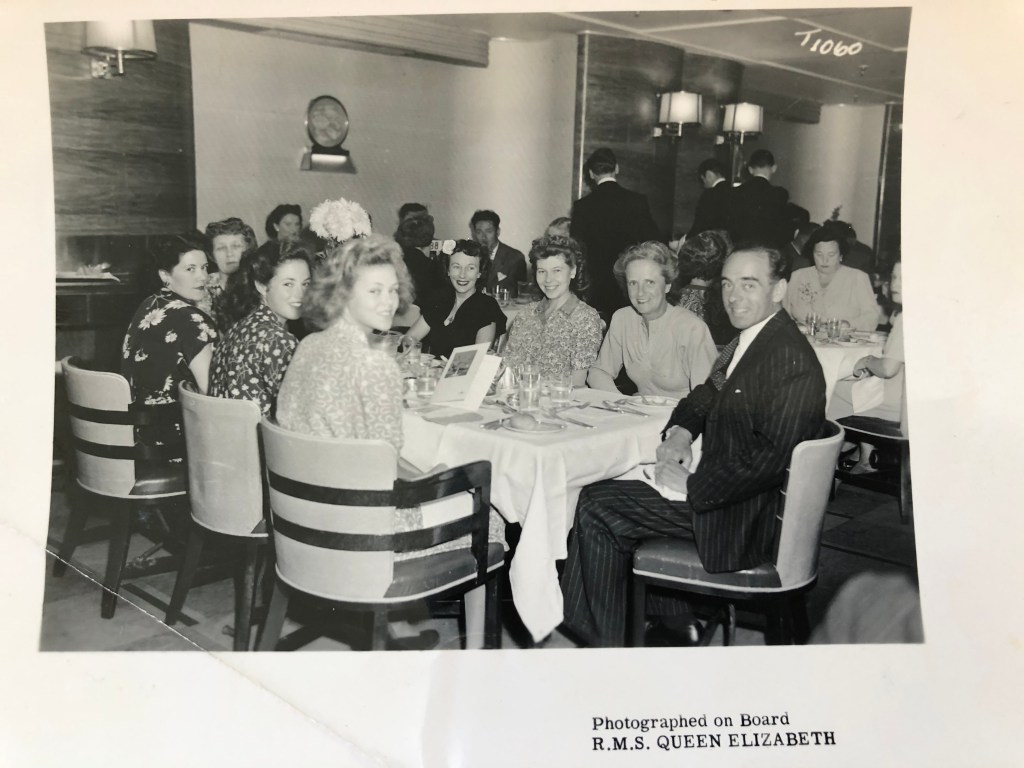
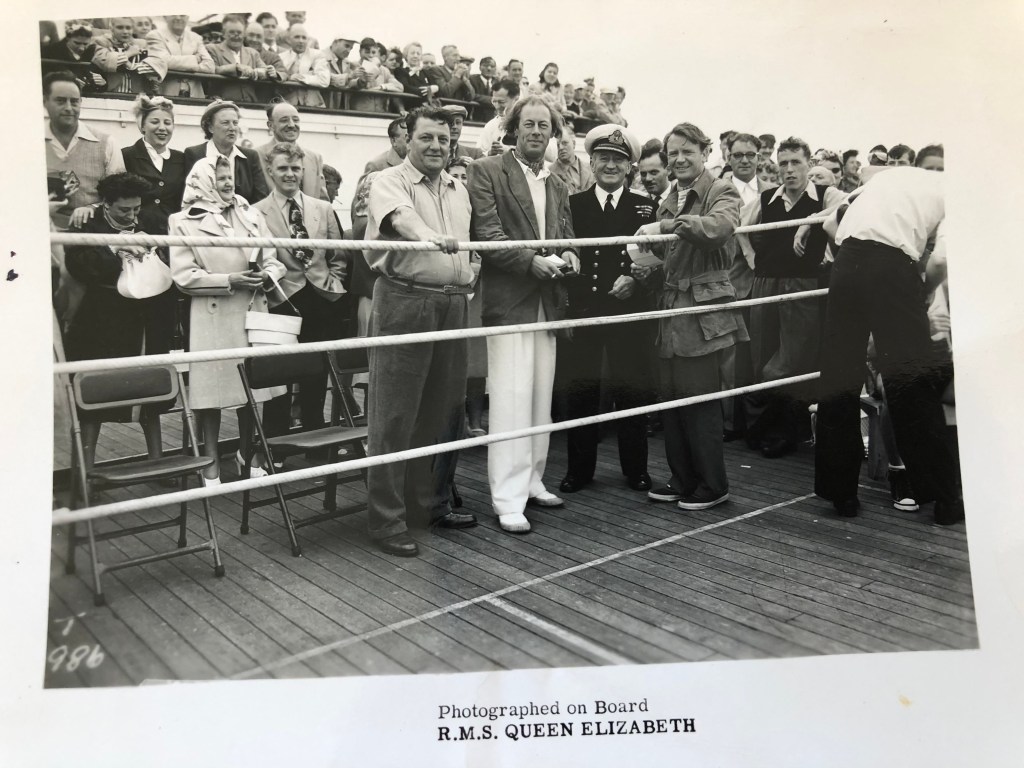
With these photos, we have come to the end of Cyn’s year of adventure as an Exchange Teacher.  She had worked hard in a different country, both at her teaching and her speaking engagements, had made friends and had travelled and seen more of America.  She had made a success of her position as somewhat of a local celebrity, and was returning home with more self-confidence, and a lot of new clothes!  She sailed for England in August 1947 on the Queen Elizabeth, (apparently with Rex Harrison on board?), but no letters exist telling us about her arrival back; her attempts to be 1/2 way honest with the Customs; her speech to the Gosforth audience at home, her father’s opinion of his delayed Christmas present- the magazine subscription to ‘Holiday’; or her managing to find a place to live in Cambridge before the new school year started. 

Having missed two important weddings while in America, those of her friends Irene and Nan, the next letter surviving describes the Royal Wedding of Princess Elizabeth and Prince Phillip, in November 1947, which Cyn had said she was determined not to miss!  This public event was the start of a few years of private change for Cynthia and her mother, with her own wedding in the offing… 

Long Beach July 1947

Margs and Alan
Cyn with a flower in her hair!


Friends and Fun

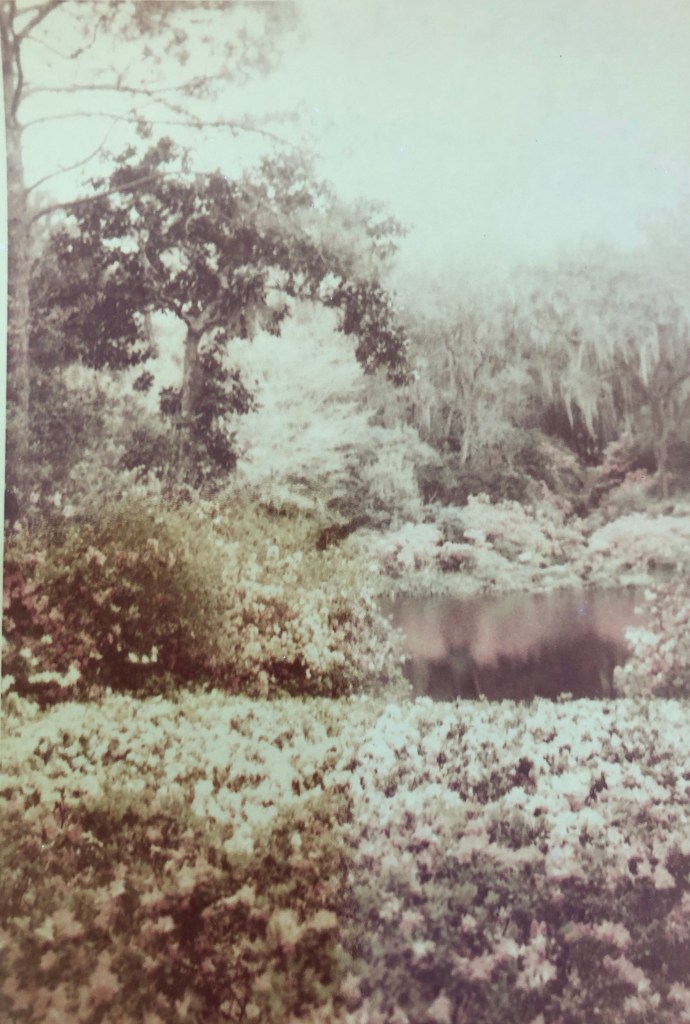
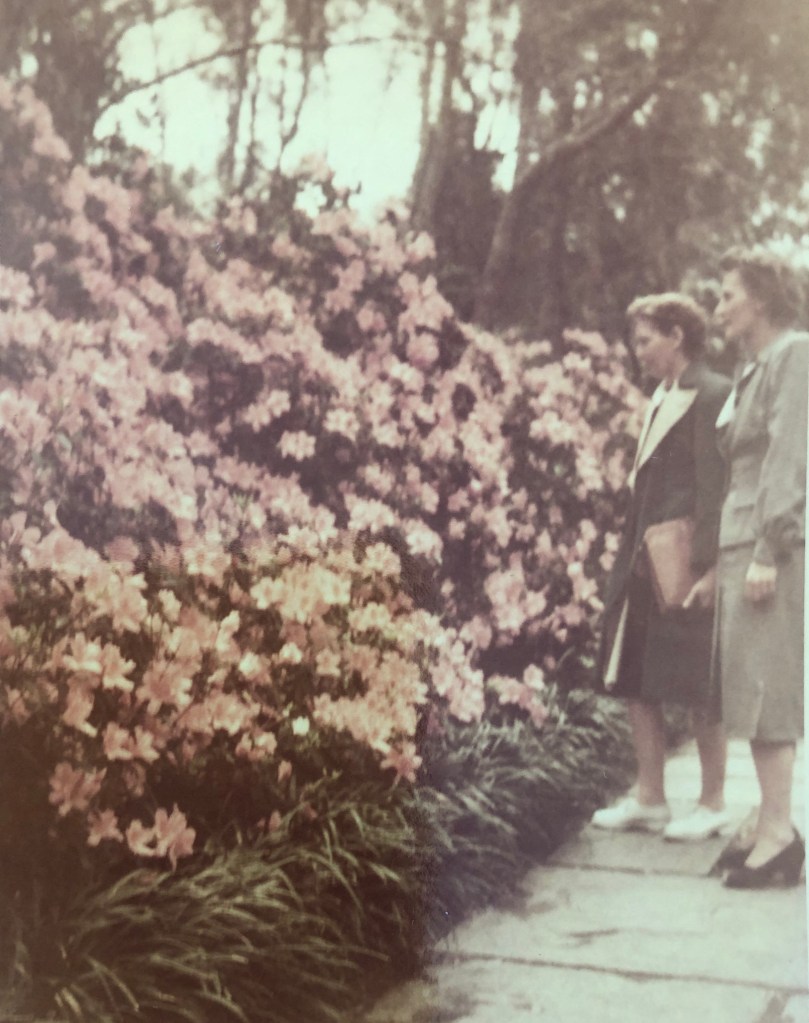
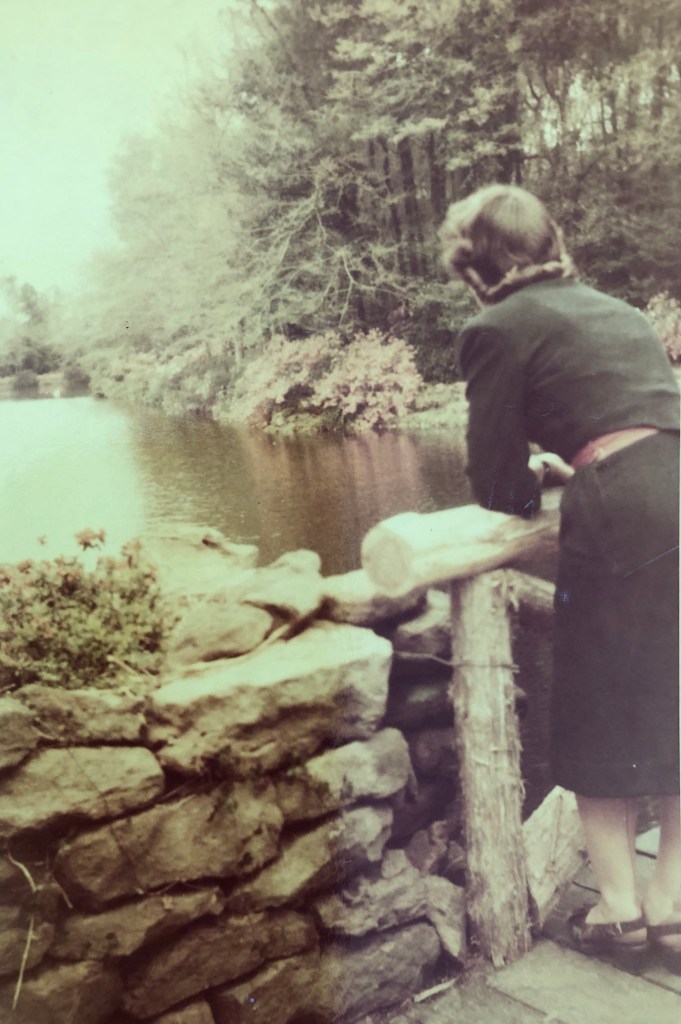
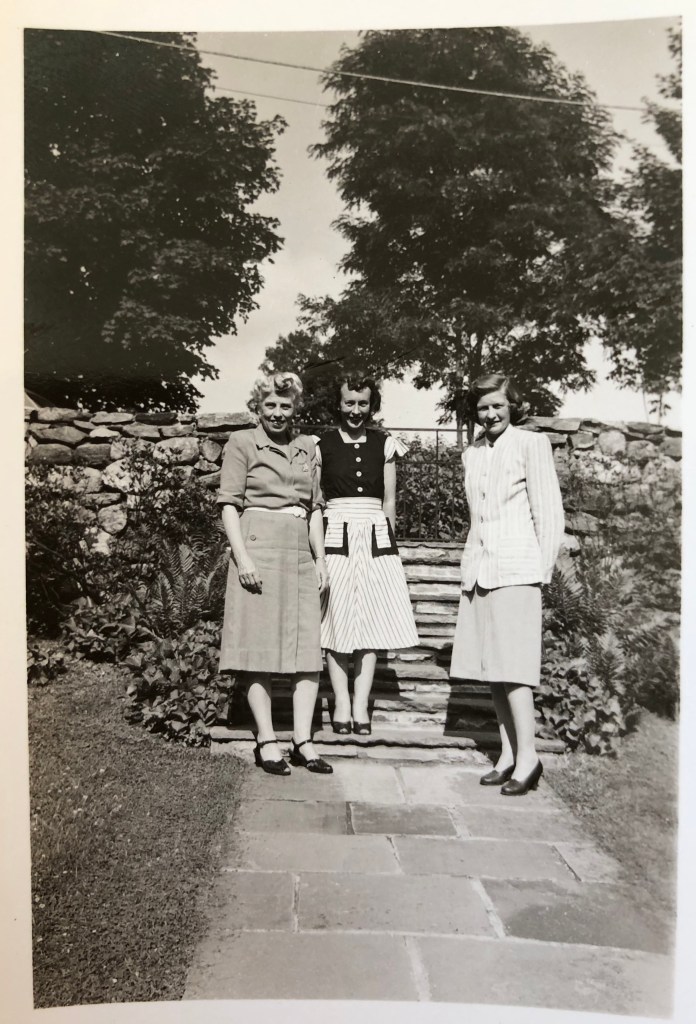
Cyn’s photographs are more successful in black & white than colour- sadly the colour of the marvellous azaleas have faded in yellowed snaps. But the friends she writes of and the gorgeous cars show up quite clearly! Of course in the days of rolls of film, pictures remained in the camera until the roll was finished, so her photos of her trip at Easter were not developed until July 1947, and include some of her visit to her New York relatives then. The black & white snaps start in September 1946 at Lois’ airport, show winter coat weather, and finish with the Easter trip. Also included are Easter Sunday snaps of her New York relatives- I’m assuming it was the same Easter!

Cyn at the airport in September 1946.
Cyn’s first flight!
Til.
Lois.
Til, Bill, dog, and the car!
Bellingrath Gardens, Mobile Alabama, March 1947.
Azaleas!
Bellingrath Gardens.
Til, Cyn, and Lois.
On the road: Cyn pointing, with Til and Mildred.
Mona and Owen visiting Highland Mills at Easter.
Hugh and Little Mona on Easter Sunday.

A Year in the U.S.A.

By Cynthia Costain.

After the end of the Second World War, the aim of every service man and woman was to go back home and start again where they had left off. But in England for many the aim was reversed. After six years locked into essential jobs with food rationing, clothes rationing, air raids, blackouts, no public transport after 10 o’clock at night, fire watching overnight at one’s workplace once a week, life had been something to be endured. Now, the urge was to GO!

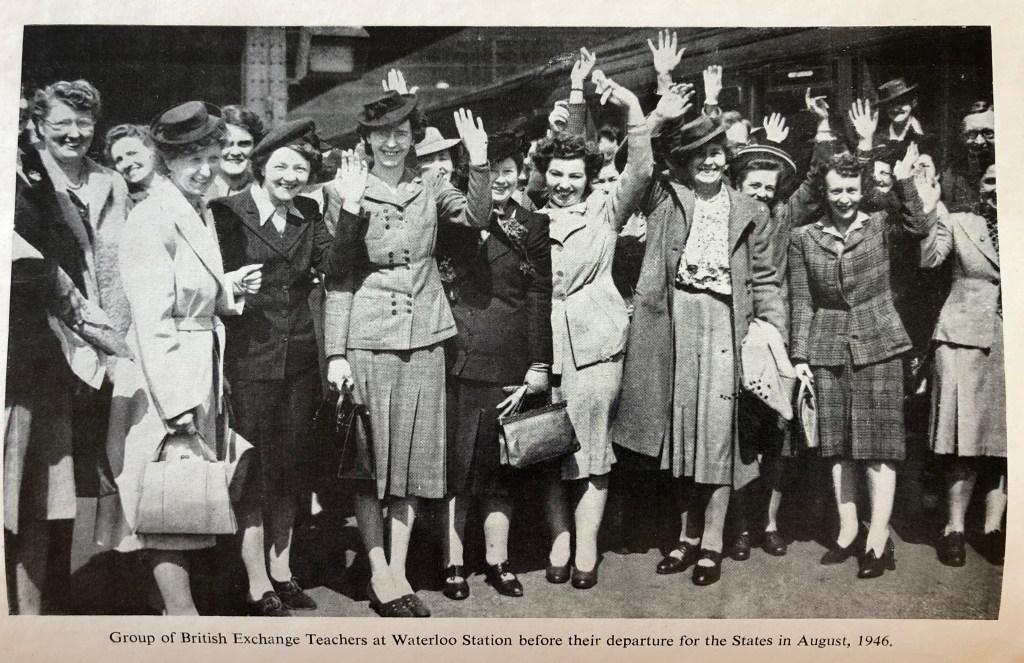
I first heard about Teachers Exchange Programs the winter of 1945, and wrote to the New Zealand and Australian Education offices for information. However after some time they wrote and told me that they would not be able to begin their exchanges until 1947. Then I heard that the English Speaking Union was sponsoring an exchange of teachers with the U.S.A. and after applying and being interviewed in London I was one of the approximately 80 teachers chosen. I was very excited and pleased when I heard that I would be going to Colorado but this did not materialize as the American teacher must have got cold feet. I eventually heard that I would be going to Toledo, Ohio and leaving England towards the end of August 1946. My education authority in Cambridge was agreeable to having an American Home Ec teacher in my place.

The ship sailed from Liverpool and carried a large contingent of returning Canadian troops, British war brides married to Canadians many with children and finally a small group of “ordinary “passengers. We were strictly segregated and it was not until we landed that I met and could talk to some of the married women and children and the troops seem to vanish once they marched on board. Our group of Exchange Teachers made up the majority of “normal” passengers and were a mixed group- mostly women and the ages spread from late 20s to late middle-age. Our accommodation was adequate with double shared cabins and we heard nothing of the difficulties of the mothers with children and the crowds of servicemen and women. Fortunately it was a calm crossing and we had a small deck and sitting/dining room to ourselves so we were able to begin to get to know our colleagues. For many it was their first trip on a big liner, a first break from home and the first taste of some long-forgotten luxuries. WHITE BREAD! For so many years we had been used to the “national” bread – neither wholewheat, brown or white but the uniformly greyish-beige. Quite a few of the letters mailed from the ship before we left had bits of white rolls tucked into the envelopes to remind the friends of this forgotten pleasure.

We tended to gather into age groups and discussed where we were going to be in the U.S. and what we taught. I was a Home Economics teacher known in Britain as Domestic Science and at that time found no one else going to Ohio. The varied meals were a surprise and delight to us after the shortages and monotony of meals during rationing and what with discussing food and the geography of America (of which most of us were very ignorant) the time passed quickly. Previously unknown to us we were landing in Halifax, continuing by train to Montreal, and then changing trains to continue to New York. Those long train journeys must have given us some idea of the immense distances we would cover during our next 12 months, but I remember very little of it except talking to some of the married girls who were heading out to unknown lives on prairie farms and strange towns. I admired their courage and could see that a sturdy Scottish girl from a farming background was determined to succeed whereas I felt desperately sorry for a small dark-haired girl who was obviously already suffering from homesickness…. In Montreal we changed trains and left the British Empire behind us!

Arriving at Grand Central Station we were met by the U.S. Education representative of the Exchange, Dr. Smith, a rather worried-looking gentleman. We were taken to International House on Riverside Dr., Columbia University where we were to stay and have a few days indoctrination before leaving for different parts of the country- 76 teachers in 28 different states. We were split into Primary and Secondary Teacher Groups and attended lectures and discussions interspersed with a little sightseeing – and as much shopping as we could squeeze in! Columbia University Faculty gave us a banquet where we were welcomed by various educational dignitaries. My stay at International House was somewhat complicated by a Persian student also staying there, who, on discovering that we were English, announced that he wanted to marry an English girl just as his brother had done. On looking us over he must’ve decided that I FIT THE BILL and proceeded to corner me and pour out the beauties of his homeland, the romance, the sweet singing of the nightingales etc. if only I would marry him and fly back to that glorious land. My friends were much amused but I spent my remaining time very carefully keeping out of his way!

I am glad to report that our rather worried and harassed Dr. Paul Smith gradually relaxed and enjoyed us all, although he insisted that they were only 75 1/2 of us – I was the 1/2!

I had exchanged letters with Mr. Nauts, the principal of DeVilbiss high school in Toledo and when I was given my travel times and tickets I sent him a telegram. Unfortunately the train was an overnight ride arriving at 7:20 a.m. and no one had told me that there were two railway stations in Toledo- each with an early train from New York. After a rather stressful night I was all prepared to alight when we arrived on time in Toledo. After English stations I was a bit surprised to be decanted among the railway tracks but other people also got out and I stood among my cases and watched all the other passengers being greeted and departing. Finally there was one big man with brown hair and glasses standing alone, so I went up and said “Excuse me, are you Mr. Nauts?” He looked at me in astonishment and said “Miss Ewing?” I understood his surprise when a number of years later I met Miss Marie Stoll, the Home Economics teacher from the High School who had gone to England as my exchange; she was the epitome of the American Club Woman as portrayed in the New Yorker cartoons! At that time the teachers in Toledo High Schools were all older- perhaps they had taught Grade School first and then worked for their degrees in Summer School etc. and Miss Stoll was within 2 years of her retirement, as well as being a very large white-haired overpowering lady! No wonder that I was such a shock to him! He had been about to depart to the other station, poor man.

From the very beginning I was treated with the utmost kindness and hospitality by all the American teachers and in fact by everyone I met. My first morning was spent at the Nauts home where I had breakfast and then I was taken to see the School which looked to me to be the size of Buckingham Palace and nearly as ornate. I had been teaching at a Girls School in Cambridge with a few hundred pupils and maybe two dozen teachers. The school had 2400 students and about 80 teachers or more. When I saw the immense parking lot for the STUDENTS’ CARS I realized I was in a very different world.

A room had been booked for me at the YWCA downtown and I was happy to settle in, unpack a bit, have a bath and a nap, before being taken out to dinner by the Nauts and the Superintendent of Education and his wife. He was a very large heavy man and I got another surprised look- Miss Marie Stoll’s image still haunted me! Not long afterwards I met the Assistant Supervisor who reported the Superintendent’s opinion of me. “There is a girl whose country needn’t be ashamed to send her anywhere.”

This brought home to me what we had been told at our final briefing in London- that besides teaching we were acting as “ambassadors” for Britain and we must be prepared to give talks and interviews, meet people and generally represent Britain to the best of our ability. I did not realize what a complete novelty I would be in a mid-West city. Most of the people I met had never met an English person before and their roots were more German, Polish and Scandinavian than British. This was just one year after the end of the War and although I met a few men who had been in the army in England and a few people who knew of a British war bride, I was usually the first real live specimen. Also the press had painted such graphic pictures of war-torn Britain, and poor people bombed out and homeless that it was very hard for them to realize that although this had happened there were very many people who went on leading very ordinary lives with  mundane jobs who lived through it all despite all the difficulties.

This was how the American people looked at me. How did I find them? I did not realize how drab and colourless my country had become until I was taken to Church one Sunday after I arrived in Toledo! Quoting from a letter which has survived all these years “The Episcopal Church was just like ours in England, the big difference was the congregation! They all look so gay and glamorous, with flower hats and feather hats and plumes and veils and jewels and furs and colours that I was quite astounded after the sober styles and colours I was used to at home.” The colourful clothes people wore were a joy and all the women looked so well-dressed and well groomed that I thought they were all beautiful and glamorous! The faculty at the High School came to work all dressed up and made up with jewellery and in comparison today’s career women look a very dull lot. Some of the women were married but many were single and very well paid. The cars were another thing- big beautiful Buicks and Chryslers, gleaming and gas guzzling while in Britain private cars were practically unknown because one could only get a gas ration if it was a real necessity. Thinking of the movies of the 40s it was really a time of excess- America was celebrating having “won the war” and the more the better. But what fun it was for me! The food was a dream- I learned what “a roast” was and “a tea” and “a chicken dinner with milk gravy on Sunday” and cinnamon toast, and tried many other delicacies. When people learned that I really missed my tea at 4 o’clock I was invited to many teas, so elegantly served with a “pourer”and tiny cut out sandwiches and cookies and mints etc. so unlike the usual homey English tea, but most enjoyable all the same.

Another difference was MONEY. We English teachers were paid by our English salaries, and the American teachers their usual salaries in dollars. This meant that they were wealthy in Britain and we were poor in the U.S. When we had been accepted we were told this and that we would find it very hard to live on what we earned and that we would need some extra back-up money, which I fortunately had. There were restrictions on bringing money out of England but we were able to bring out additional funds if needed. When I began giving talks to Women’s Clubs and various groups I made a little bit extra which was very welcome. I was usually fed, deliciously, given a corsage and handed a small envelope at the end- the country groups were the most generous and the Ladies Teas tended to give me a small gift – a hankie or a small piece of costume jewelry.

This is where Cyn’s essay ends, at the end of a closely typed Page 3.  I can’t help feeling that Page 4 is missing, Cyn was such a good writer, I’m sure she would have some sort of a conclusion- and a few more details about her experiences.  But there are lots of details in her letters to Carol, so I shall start on them in my next post.  Meanwhile, here is what she wrote, published in The English – Speaking Union pamphlet, second teacher exerpt:

SOME EXTRACTS FROM LETTERS OF BRITISH TEACHERS IN AMERICA TO THE CHAIRMAN   

SEPTEMBER 1946

From a teacher of Cambridge, teaching in DeVilbiss High School in Toledo, Ohio: “ I am getting slightly adapted to American High School life now, after a rather foggy period of bewilderment, but everyone is being very kind to me. My greatest astonishment is at the size of everything – the school is enormous – the number of pupils is huge – the classes are big- and my home room group of boys and girls consists of some of the largest specimens of American youth that I have ever seen- I am quite the smallest in the class! But it’s fun!”

And this last is the sentence that turns up often in her letters- But it’s fun!

An Adventure in America

Cynthia was a well- traveled person- she’d been born in the West Indies, had visited her grandparents and cousins in the North of Ireland on holiday in the 20s and 30s, popped over to France one summer with friends, and had gone to New York in July and August of 1939 to see the relatives there.  (See Travel Journal)  Letters and parcels kept family members in touch with each other, West Indian cousins were sent to school in England and visited, and as adults, came back and dropped in on Auntie Carol and Cynthia in Newcastle whenever possible.  But as the war ended, Cynthia organized an adventure of her own: she went on a teacher exchange to America for a year and positively blossomed.

Quite what the American teacher thought of the school system and work load of a Domestic Science teacher in an English girl’s school was never clear although Cyn implied that it would have been a shock to her.  Cynthia found that a Home Economics course was taken a lot less seriously in DeVilbis High School in Toledo, Ohio, and probably gave a few students a nasty shock as she involved them with her methods.  She made lifelong friends of the teachers she lived with- Til (music) and Lois (gym); traveled with them on holidays, met their families and saw something more of the States; and since it was part of her obligation as an exchange teacher, gave very well-received talks on British life and the war, to great acclaim and confidence-inducing return invitations.  She visited her American relatives and friends during vacations. And she bought new clothes- on returning home, she overheard the little charmers she taught speculating on what she actually had been doing to earn those clothes on her year away- which unfortunately were rendered unfashionable when Norman Hartnell lowered the hemline to mid-calf in 1947 (Cyn being so small, the dresses had assuredly been that length when she bought them and had been painstakingly cut off so that she could wear them- no letters remain to mourn this, but it’s a detail I remember hearing.)

This successful year gave Cyn the confidence and the experience to take a different path for her future.  Although successful and happy with her life in Cambridge, especially after Carol arrived, she looked to a bigger world and continued the adventure.  She enjoyed the company of a Canadian man, married him, and emigrated to a new life with a lot more knowledge of the new world and the culture than the war brides who had arrived a few years earlier.  Her American-born Canadian daughter is grateful she had an adventurous spirit.

Remembering

I grew up in Ottawa, Canada’s capital, where, on Remembrance Day, there was a national ceremony at the War Memorial just down from the Parliament Buildings.  As teens we would go downtown and join the crowds for the service, but one time in the 1960s, I remember going into the study where my mother was watching the television broadcast across the nation.  And she was crying.  It was a shock to me, realizing that this ceremony which meant something intellectually to me, had far great emotional meaning to my mother, who had lived through it.  I suppose all children reach an understanding sometime of their parents as separate people, humans in their own right, and this was that moment for me.  In this essay, Cyn looks back and expresses fifty years of ‘Remembering’.

REMEMBERING

It has become so familiar; the War Memorial with the Honour Guard, the crowds of people clustered round, filling the sidewalks and streets. The television camera focuses on faces, veterans wearing medals, school children, young families, men and women standing quietly as the hands of the clock move towards eleven on the eleventh day of November.

What brings them here, year after year? Who do they remember? Is this old man in a wheelchair remembering his comrades? Does this woman think of her young freckled boy who never came back? Do others remember brothers, husbands, fathers or sisters? Perhaps middleaged men remember when Dad was overseas and they became the man of the family. Others might remember the stories their parents told of battles and air raids which happened long ago. Do people in the crowd remember one special person or unforgettable incident which for them was the essence of war?

What do I remember? A city in the north of England-  industry, shipbuilding, coal mining- a prime target for enemy bombs. A group of young people who had grown up together; the young men vanished into the Services, some of the girls also, but most of us at home in ‘essential’ services. Blackouts, nights in air raid shelters, bombs, burning buildings; struggling to get to work each morning through streets littered with bricks and debris, climbing over blocks of cement and firehoses with the stench of burning and the thick smoke filling the air. But all that is not worth remembering-  a desert in one’s life-  it is the people who are important.

Who do I remember? 

Malcolm. He was a pilot in the RAF and was shot down in the Battle of Britain in the spring of 1940. He was married to my friend Barbara-  the first in our group to get married and we had had such fun at her wedding. She had a baby girl two months after Malcolm died.

George. He was a young architect and he and Dorothy had so many plans of the house they would build one day. George went into the Army and he and Dorothy had a quiet wedding when he was on leave. Training in England for the invasion of Europe he was drowned in a sluggish muddy river trying to rescue one of his men who had sunk while carrying full equipment. His little son was less than two years old. 

Bob, Joan’s husband, was killed on DDay leaving her with a baby girl. 

Neville was a pacifist. He volunteered as a radio operator in the Merchant Navy. After three years of Atlantic crossings in all weathers in cramped dark ships, he developed TB and wasted away in a sanatorium on the bleak cold Northumbrian moors.

But most of all I remember Bobby.

We had been neighbours and playmates since we were kindergarten age. He was a goodnatured four year old with red hair and a snub nose. We played with tricycles and scooters, played shops and school. With other children we climbed trees in back gardens and enacted Robin Hood’s daring escapades. Bobby had a real bow for his birthday, so he was Robin, and under the misapprehension that Little John was a small man, that was my role. We went our separate ways to school but I was educated into the rules of football and cricket and finally graduated to tennis and badminton as we grew older, with the same group of friends. Bobby’s parents were a friendly convivial couple active in the social life of the area. As their sons matured they were measured for dinner jackets and included in the party at the frequent dances to which we girls were included as their partners. No going with a boy friend and dancing only with him! Everyone danced with everyone else  young and old – foxtrots, waltzes, reels, Dashing White Sergeant, and I even remember the Lancers. No one was allowed to sit out a dance- and who would want to? I wore holes in all my silver sandals.

There was no thought of romance in our small circle. It was a hard time and all of us lived at home and were attending university or training college and the few who were lucky enough to have jobs were at the very bottom of the ladder. Love and marriage were far ahead and all we wanted was to have fun.

In the spring of 1939 young men of 21 were conscripted. Bobby left home for the Army. When War broke out in September he was sent to France. His father had died some time before and his older brother was at home in a ‘reserved occupation’ as many of us were. Bobby had a leave at Christmas and we all tried to pretend that it was just like old times.

Then came Dunkirk. There was no news for days- weeks- as the little ships ferried across the Channel, lifting the remains of the British Army off the beaches and out of the sea as the aircraft dive bombed and the machine guns fired.

I left the house on a hot summer afternoon to go to tea with one of my mother’s friends. I had on a silly little hat with lace and flowers- do you remember the time when all of us wore hats? and along the road sauntered Bobby- a thin tired fellow in a new battledress. I ran into his arms and we hugged and I wept and it was a truly joyous moment. A leave, then Officer’s Training and he was a 2nd Lieutenant. More leave, then overseas to India.

We wrote letters of course-  everyone wrote letters, they included so many and stretched so far. The letters to Bobby continued and his replies came until the Japanese entered the War in 1942. There were no more letters, no news. It was a long time before we heard that Bobby’s Company had landed in Singapore the day the Japanese took over the city, and they were all taken prisoner. Months passed, years, and his family received two postcards with only his name written on. They were allowed to send a one page letter every eight weeks. His Mother would only write “Love from Mother” so his brother would write a paragraph or two and then bring it to me fill in the rest. I don’t suppose he ever got those letters. In early 1945 we heard that Bobby was dead.

After the War ended, a returned fellow prisoner came to see the family. He had been in hospital with Bobby after they had been working on building the Burma Road. When they became too weak and ill they either died or were sent back to camp if they were lucky. Hospital was a crowded hot tent with mats on the earthen floor, no medication, and very little food. They had no way of shaving or cutting their hair and he described Bobby’s long red hair and beard. Hearing a sound from his friend he turned and took his hand. Bobby died.

Who will remember them when we are gone?

Another Opinion

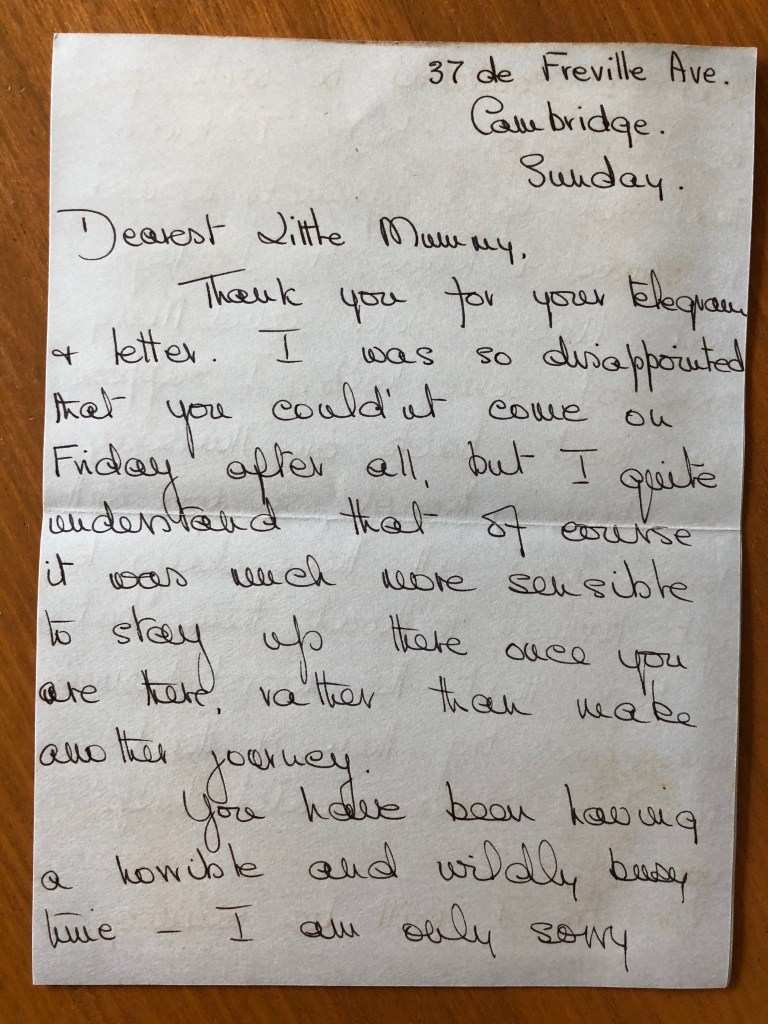
Cyn’s great friend from college, Dottie, may have had the same training in High Class Cookery as she did, but Dottie’s path during the war was very different.  She had married towards the beginning of the war, and her husband George Burton was an officer who died in 1944, leaving Dottie with one son.  Later she married Ken Wilyman and lived a long and happy life in Sutton Coldfield, bringing up 4 boys, and dying in her 100th year.  She was my godmother, and encouraged me in this project.  When I sent her my commentary on my grandfather Gordon Ewing* (whom she loathed, she said), she returned it as a letter that gave her opinion of him and summed up Cyn’s life until she left for Canada.  I include it because it gives a different perspective- not only from a friend, but also from the distance of 50 or 60 years later.

Dear Linda – I hope this passes as a letter.

When Cyn first lived in Walkerville & lived next door to the Sheedys & opposite to Nan & Mrs. Allan she also knew my George & Neville? who was our best man.  (Both George and Neville died in the war.) They all played badminton at a local club – also one Roly Cassidy who was a friend of George’s & George & I got them together for dances- he was very keen but Cyn wasn’t too impressed! Next one of George’s architect friends who came from a rather grand family in Co. Durham. Dr. Ewing was impressed (he was a snob!)

Cyn was a great pal to me when I had a baby & lost my husband in 1944. I was always encouraging Cyn to leave home. Incidentally they lived near me when we were at college & only returned to Walkerville when he (the Doc) retired.

Once Cyn left home she really began to live her own life- during the war she met Hugh (then a major in the U.S. Army but billeted in this country. He was a stunner! (but married.) I met him when he was with Cyn and believe me- they really did make a good couple & she must’ve been very upset when the war ended & he went back home.

It was super when Cec came on the scene at the end of the war. By then Carol was with Cyn in Cambridge & everything went well. Old man in the local asylum & Cyn did visit him. I remember she made a special visit to him before she set off for Canada. Bless her she was a lot more forgiving than I would have been.

Love D.

* see earlier post, ‘Dr. J.M.G. Ewing, my grandfather.’